At Svitla Systems, most of our team consists of seasoned senior-level professionals, but we always have room for those who are just beginning their journey in tech. Sometimes it is a long-planned decision, but often it is a career switch that no one saw coming.
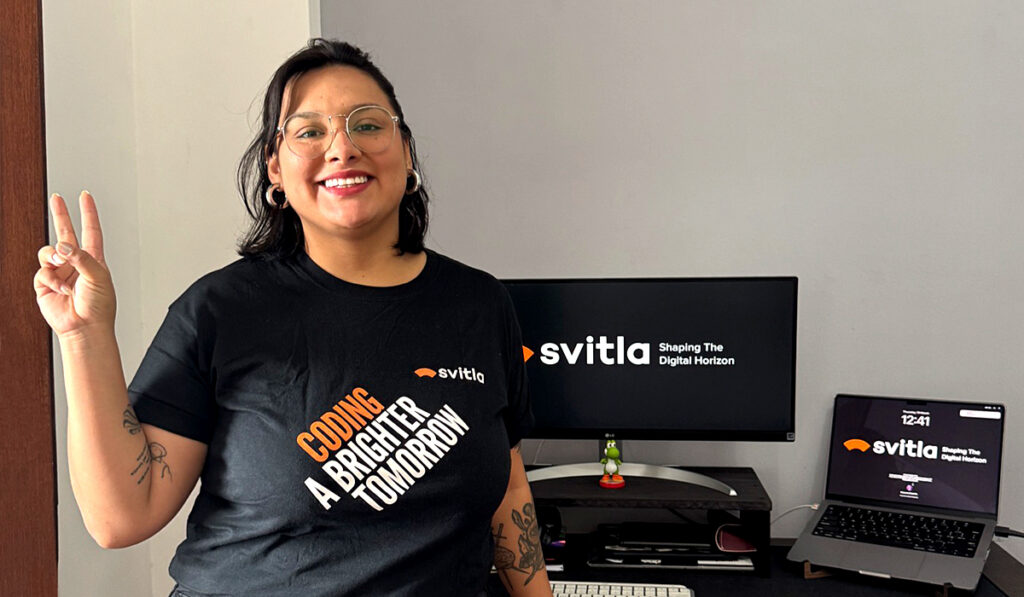
Today, we are happy to share the story of Maria Bazualdo, a Junior Data Analyst at Svitla Systems, who spent years studying dentistry and training in maxillofacial surgery before making the leap into data analytics.
Leaving a profession you have spent years building, starting from scratch, and proving yourself in a completely new field is no small feat. That is exactly why we admire Maria’s courage and decision to take a risk and make it work.
Making a Life-Changing Career Switch Into Tech
As a Junior Data Analyst at Svitla Systems, I aim to share how I switched careers from medicine to tech by finding peace in data analytics.
I wish to encourage anyone who might be on the fence or feel it’s “too late” or “too difficult” to make a switch. Regardless of career or background, everyone should pursue what they truly want. Ultimately, finding joy in your work should always be the goal.
As I share my story, I’ll also detail the skills and knowledge that made the decision a no-brainer and brought genuine fulfillment to my everyday life.
Before data, I lived and breathed medicine.
My parents were doctors, so for us, medicine was part of our identity. Our dinner table conversations centered around patients and treatments, normalizing topics that others might find a bit out of the ordinary.
Studying medicine felt like an unavoidable destination. It was ingrained so deeply in me that I never even entertained the idea of anything else. Simply put: my path was laid out.
I studied dentistry and later trained in maxillofacial surgery. I should have been happy, right? Well, not quite. Everything was great on paper, but the right things never fully clicked for me, leaving me deeply unsatisfied, anxious, and with a strong sense of failure.
As time went on, the pressure only increased. Anxiety became a routine for me. At one point, I even stopped recognizing myself since the stress had affected my health so visibly. In denial, I kept telling myself that things would get better if I pushed harder, studied more, or went further.
Spoiler alert: they didn’t.
When I decided to leave medicine, I didn’t have a plan in place. I needed a job, and fast, since money was tight, and my parents felt alienated by my choice.
Stumbling Into Data Analytics and Self-Education
I didn’t necessarily set out to become a data analyst. In fact, when I first encountered data work, I didn’t even know that what I was doing had a name.
I found a company that needed help migrating files to the cloud and organizing information so business partners could understand their numbers. I jumped at the opportunity since the position wasn’t advertised as a technical role, and I didn’t think of myself as someone “in tech.” After a quick background check, I was offered the role and accepted it because it was practical, not because I was planning a career change.
During onboarding, we were asked about our backgrounds. I tried to be as transparent as possible about my limitations so I wouldn’t set the wrong expectations. The response surprised me: my soon-to-be manager didn’t question my background or my lack of formal training. He simply asked if I wanted to try. That mattered more than he probably realized.
I started helping with simple database structures, organizing information and thinking about how data should be stored, how different pieces relate to each other, and how it could be meaningful to others reading it.
I quickly realized that, at its core, the role was about making sense of information so that others don’t have to struggle through it themselves.
I also realized that this first experience in data analytics didn’t make me confident, but it definitely made me curious.
With the newfound knowledge that I loved working with data, it was inevitable to wonder: what’s next?
After years of becoming an expert in dentistry, jumping into data analytics meant accepting that I was a beginner again. I was afraid, yes, but also excited. I began exploring online courses and certifications, studying in the same way I did in medicine: seriously, consistently, and with focus.
The difference? This time, learning felt like discovery, not pressure.
I quickly learned that Python was a must for data analytics. Intellectually, I understood its power, but emotionally…it felt abstract and overwhelming. Filled with black screens and strings of code, I couldn’t see the results of my work in a way that made sense to me, which made it harder to trust myself. At the time, I even worried that this meant I wasn’t suited for data work after all.
That all changed when I started using Power BI. I felt an immediate switch go off in my brain.
For the first time, I saw data as a visual, living being. Numbers turned into shapes, trends, and patterns…and the logic I was applying was laid bare in front of me.
I stopped feeling lost, and it revealed something important about how my brain works: visual representation helped me better consume the information.
That truth connected deeply with my past. In medicine, I had always gravitated toward the “materials and methods” sections of research papers. I cared more about understanding how conclusions were reached. I wanted to see the structure behind the results. At the time, I thought that was just a personal preference. In data, I turned it into a strength.
Learning the tools wasn’t easy, but it was grounding. Each new skill reinforced the same idea: I was capable of learning beyond the path I had been given; I just needed patience.
What a Data Analyst Actually Does
Now, when I tell people I’m dabbling in data analytics, they often think my days are filled with complex formulas and advanced programming, and that I have years of technical education…all of which are not entirely true.
I started working with a very limited definition of what the role entailed. I knew there were numbers and reports involved, but that was about it.
I soon learned what a data analyst role entails. A data analyst is responsible for transforming raw data into information that people can actually use. The analyst takes large, messy datasets and organizes them in ways that enable teams to answer key questions. As a data analyst, you’re not tasked with making decisions; you’re just providing a clear, reliable foundation on which decisions can be made.
From a technical perspective, the role requires strong skills:
Strong knowledge of SQL is a must. Queries are how we retrieve, combine, and clean data, shaping everything that comes afterward.
Visualization tools present data in clear, accessible ways. You turn numbers into dashboards, charts, and reports that others can quickly understand.
Programming languages are inevitable. Python, for instance, is especially designed for data preparation, automation, and complex analysis.
Of course, tools alone don’t make someone a data analyst. The role also requires key soft skills:
Analytical thinking and discipline: You need to be able to spot inconsistencies, question assumptions, and understand how small changes in logic can affect results.
Eye for detail: Accuracy matters, so it’s critical to always pay attention to how a single filter or calculation error can lead to incorrect conclusions.
Patience: Data takes time, so it’s crucial that you give yourself the grace to learn the ropes and avoid rushing for quick results that could impact the final outcomes.
Communication: You often act as the bridge between technical data and non-technical stakeholders, so you need to be ready to explain what the data shows, what it doesn’t show, and why certain conclusions are reasonable.
Curiosity: The best insights usually come from asking follow-up questions and being genuinely interested in what the data is trying to reveal.
Online courses, certifications, and practical projects go a long way when it comes to building confidence. I recommend starting with courses in data analytics fundamentals, SQL, Python, and data visualization.
Another win is to constantly practice and apply what you’ve learned to real tasks, especially in this field that rewards hands-on experience over theory alone.
Learning in a Real Environment
Working at Svitla Systems is my first serious role in tech. I don't come from a traditional programming background, and I don't have previous analytics roles on my resume. What I do have is curiosity, discipline, and a desire to understand how data supports outcomes.
I’m free to explore, try new things, and ask questions. I’m not expected to know everything from day one, and that rewired my brain chemistry. In fact, in stark contrast, I’m encouraged to understand why things are built the way they are. And if I happen to make mistakes? They’re treated as part of the process, not as proof that I don’t belong.
Svitla has given me the chance to gradually grow into my role rather than expecting perfection from the very beginning. That means a great deal to me and makes me feel empowered.
Today, I focus my data analytics efforts in two main areas: product and insights. Together, I have a clear picture of how data supports internal teams and clients.
On the product side, I work with tables, queries, and filters that allow account managers and other teams to retrieve the information they need efficiently.
On the insights side, I work to improve reports clients use to understand performance, trends, and potential issues. I review queries, refine logic, and carefully consider how information is presented.
For me, what I enjoy most is the thought process behind it all. I find it interesting to look at highly complex datasets and try to explore them so that people consuming the data don’t feel confused.
Another thing I love about the role is the sense of completion it offers. Projects have a start and finish line. Reports are delivered. Questions are answered. That closure brings a kind of satisfaction I hadn’t experienced before, and it allows me to move on to the next task with clarity instead of lingering stress.
If I needed to sum up my work in tech in one word, it would be balance. I’m intellectually challenged without being overwhelmed. I’m growing at a sustainable pace.
My journey in data analytics is far from over, and I feel fortunate to work with experienced analysts who proactively share their knowledge. When I run into a problem, I’m encouraged to think it through, propose an approach, and discuss it openly. Sometimes I’m right. Sometimes I’m not.
Over time, this has changed how I respond to challenges. Instead of feeling immediate anxiety when I don’t know something, I’ve learned to pause and break the problem down. I’ve learned that uncertainty means there’s something new to understand.
I’ve learned to be patient with myself. I’ve learned that progress doesn’t require constant urgency.
I can take the time to think, to ask, and to refine my work.
What This Journey Taught Me (And What I Hope To Leave You With)
For a long time, I believed that success meant endurance. It meant staying on a path because I had already invested so much in it, even when it was affecting my health and happiness. Changing direction felt irresponsible, and if I’m being honest, like I was letting my family down.
Today, success looks different to me. It means working in a role that challenges my thinking without overwhelming me. It means continuing to learn and contributing in thoughtful, reliable ways. It means being able to grow professionally while still taking care of myself.
If you are considering a career change, especially from a field that feels very far from technology, I would tell you the following: You don’t need to have everything figured out. You don’t need to feel confident from the start. What matters is knowing yourself well enough to be honest about what actually works for you.
Starting over doesn’t erase what you’ve done before. In my case, my background in medicine taught me discipline, attention to detail, and respect for complexity. Those skills followed me into data and gave me confidence.
I didn’t leave medicine to escape the hard work. I left to find a new journey that made sense to me.