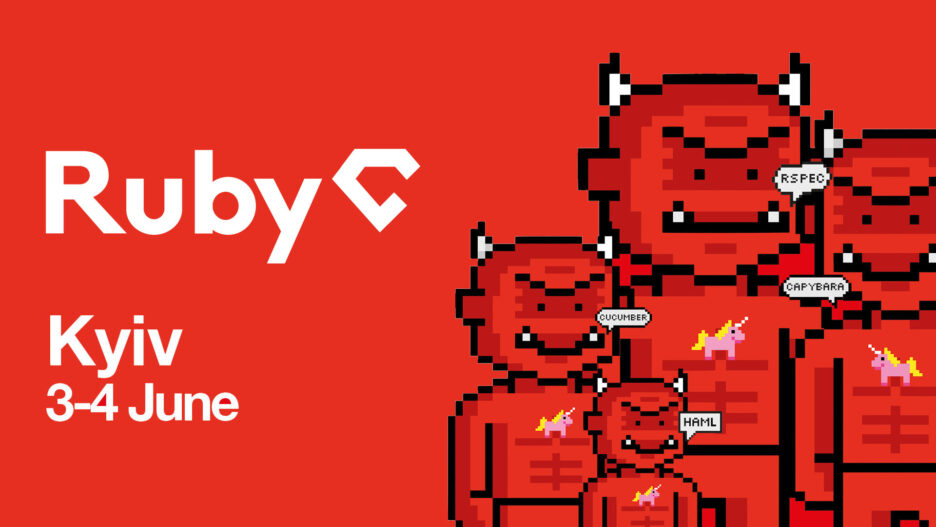
RubyC-2016 Agenda

570-rubyc23.jpg

Svitla Ruby Conference (aka RubyC) — is the biggest Ukrainian conference devoted to Ruby, Ruby on Rails and related technologies. This year organizer Svitla Systems invites Ruby-developers in Kyiv on the first summer weekend, 4-5 June, to spend two wonderful days in a company of the most experienced Ruby-experts!

For more information about RubyC-2016 agenda please visit https://rubyc.eu/

This year RubyC welcomes 13 speakers from Ukraine and abroad, and unlike previous years, all talks will be presented in English. Moreover, in the beginning of the second day, an Open Talk will be held, so that everyone has a chance to ask questions and have a discussion about latest news in Ruby world.

Web Development Services and Solutions Require Trusted Expertise Discover how Svitla Systems empowers your web development initiatives with innovative technologies and proven experience. Learn More

Welcome RubyC-2016 Speakers!

Aaron Cruz (Austria) — “Ruby Alternatives”
Adam Niedzielski (Poland) — “Responsible gem collector”
Bozhidar Batsov (Bolgaria) — “The Master Rubyist”
Yorick Peterse (Netherlands) — “Making GitLab Faster”
Robert Pankowezki (Poland) — “The Saga Pattern”
Andy Pike (Great Britain) — “Building maintainable Rails apps for the long term”
Ben Lovell (Great Britain) — “FOSS like a BOSS!”
Andrey Savchenko (Ukraine) — “KISS me gently”
Michael Serdyuk (Ukraine) — “For whom is the code written or why every programmer has to be a designer”
Elena Morgun (Ukraine) — “Service oriented vs Microservice architecture”
Мichael Bortnik (Ukraine) — “Ruby in unusual environments”
Alex Simonov (Ukraine) — “Technology mess”
Dmitriy Zimin (Ukraine) — “How I build stand-alone Cucumber Rocket for testing none Rails application”

Traditionally all participants will be served with tasty coffee-breaks from “Rus” Hotel, receive presents from RubyC sponsors DataArt, Global Logic and N-iX, and drink lots of tasty beer on a Party in the end of the first day!

Organizers kindly remind that tickets can be bought only from official website, and their number is limited.

Follow the news on Twitter or Facebook.

Join RubyC-2016!

 

FAQ

Is Ruby like C#?

Ruby and C# are quite different: Ruby is a dynamic, interpreted scripting language known for concise syntax and rapid development (especially with Ruby on Rails), while C# is a statically typed, compiled language designed for the .NET ecosystem with strong tooling and performance. Ruby emphasizes developer happiness and flexibility (metaprogramming, duck typing), whereas C# emphasizes type safety, IDE-driven workflows, and enterprise features. Both are fully capable for web apps and services, but they differ in runtime (Ruby MRI/Truffle vs. .NET CLR), typical frameworks (Rails vs. ASP.NET), and performance/typing trade-offs. Choose Ruby for fast iteration and expressive code; choose C# for static typing, performance, and deep .NET integration.

Is Ruby backend or frontend?

Ruby does the backend. It is known for building server-side apps and APIs with Rails, of course. Business logic, database stuff, background jobs, and web services all run on Ruby code. The pretty part at the front is made with HTML/CSS/JavaScript frameworks. Sure, technically speaking, Ruby can spit out some view via templates, but honestly, its heart and community put their love into backend work.

Is Ruby better than Python?

Neither is “better” than the other in all cases – it’s all relative to what you’re aiming for. Ruby is great as far as fast web development and convention over configuration is concerned, and Rails embodies a very productive, opinionated stack to build startups and APIs quickly. Generally, this covers data science, machine learning, general scripting, and backend frameworks (mostly Django/FastAPI) and comes with a huge scientific computing ecosystem. If you prefer fast iteration and pretty cohesive web tooling, go with Ruby; if you like more flexibility in the web/data/automation space, go with Python.

What is the best RPA tool?

Robotic Process Automation (RPA) tools vary widely based on the business requirement, size, and technical environment. UiPath, Automation Anywhere, and Blue Prism form part of other popular choices among large enterprises because they offer good support for process orchestration with AI integration as well as scalability. Small teams or developers may prefer TagUI or Robocorp since these open-source tools have much fewer restrictions and are more cost-effective. The best tool is the one that is easiest to use yet reliable and integrates with your workflow.

Is RPA the same as AI?

No, RPA (Robotic Process Automation) and AI (Artificial Intelligence) are not the same, though they are often complementary. RPA focuses on automating repetitive, rule-based tasks by mimicking human interactions with digital systems, essentially automating “what to do.” AI, on the other hand, involves systems that can learn, reason, and make decisions, addressing “how to do it” for more complex, cognitive tasks. While RPA automates existing processes, AI can enhance RPA by enabling bots to handle unstructured data, make predictions, and adapt to new situations, moving beyond simple automation to intelligent automation.