Article summary: Agentic AI is growing fast, but most organizations are still struggling to deploy it in production. This article breaks down five trends shaping adoption in 2026, backed by research and case studies. It also highlights the gap between experimentation and production, and what separates successful deployments from failed ones.
Agentic AI is scaling faster than most enterprise technologies in recent years. The market expanded from $7.6 billion in 2025 to a projected $10.8 billion in 2026, outpacing early cloud adoption. At the same time, Gartner predicts that 40% of enterprise applications will include task-specific AI agents by the end of 2026, up from less than 5% a year earlier. Still, growth doesn’t mean deployment is easy.
79% of enterprises say they’ve adopted AI agents, but only 11% run them in production. That gap reflects how difficult it is to integrate agents into real workflows, data systems, and accountability structures.
In parallel, risk is increasing. Gartner estimates that more than 40% of agentic AI projects could be canceled by 2027 due to unclear value, rising costs, and weak governance. This creates a split in the market. Some organizations are turning agentic AI into measurable results, while others are funding experiments that never scale.
In this article, you’ll explore five trends where agentic AI is delivering real impact, and what it takes to move from experimentation to production.
Where does agentic AI stand in 2026?
The headlines around rapid adoption of agentic AI are hard to miss:
- 79% of enterprises say they’ve adopted AI agents
- 93% of IT leaders plan to introduce autonomous agents within two years, according to a MuleSoft and Deloitte Digital survey.
But the adoption numbers need context, because most of what's being adopted isn't what most people mean when they say, "agentic AI."
Gartner drew a clear distinction in mid-2025. An AI assistant responds to prompts and depends on human direction at every step. An AI agent can plan, use tools, reason outcomes, and act toward a goal with minimal oversight. Most of what enterprises currently refer to as "agents" are actually assistants, a pattern that Gartner has labeled "agentwashing."
This distinction explains why adoption numbers look high, but production numbers stay low. Saying you've adopted AI agents can mean anything from embedding a chatbot on a support page to deploying an autonomous system that resolves customer issues end-to-end.
The 79% adoption vs 11% production gap is the clearest indicator of where things actually stand. The gap exists because moving from a proof of concept to a production deployment involves problems that don't show up in demos: data access, security boundaries, error handling, compliance review, and integration with existing systems that weren't designed with autonomous agents in mind.
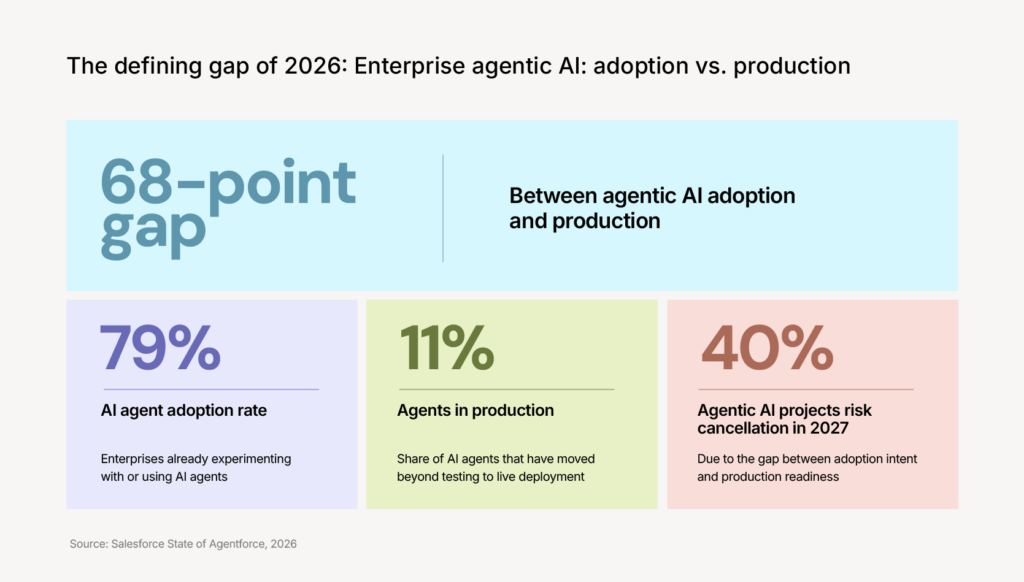
The organizations that have crossed the 68-point gap offer the most instructive data. For example.
Customer operations
- The IRS used Agentforce to cut tax court case openings from 10 days to 30 minutes, saving one division approximately 50,000 minutes per year.
- Salesforce's Agentforce platform reached over 18,000 customers across 121 countries and reported 330% year-over-year ARR (Annual Recurring Revenue) growth by Q3 FY2026.
- Salesforce's Agentforce handled over 380,000 customer support interactions and resolved 84% of cases autonomously, requiring human escalation for only 2%.
Operations and supply chain
- A large North American retailer reduced quarterly inventory losses from $5.4 million to $1.6 million after deploying agents to detect demand patterns and manage stock transfers.
Healthcare
- AtlantiCare deployed an agentic AI clinical assistant that achieved an 80% adoption rate among its 50 test providers and cut documentation time by 42%, freeing roughly 66 minutes per clinician per day.
Financial services
- A Fortune 500 enterprise used Agentforce to reduce reporting time from 15 days to 35 minutes while dropping the cost per report from $2,200 to $9.
These deployments share a clear pattern: they are task-specific, targeting high-volume, well-defined workflows like customer service resolution, document processing, inventory redistribution, and clinical documentation.
What are the five trends shaping agentic AI in 2026?
For 2026, the AI agentic applications market trends cluster around five key shifts. Some of these are already well underway, while others are just starting to take shape:
1. From single agents to multi-agent orchestration
The first wave of enterprise AI agents focused on one thing at a time: a customer service agent resolved tickets, an inventory agent monitored stock levels, and a documentation agent generated reports. Each worked in isolation, connected to its own data sources and operating within a single workflow. The 2026 shift is toward multi-agent systems where specialized agents coordinate with each other. For example:
An inventory agent detects a low-stock pattern → notifies a procurement agent → contacts supplier agents and places orders → triggers a logistics agent to schedule delivery
No single agent handles the full process. They collaborate, each contributing its specialization to a shared outcome. Two protocols are making this possible.
- Anthropic's Model Context Protocol (MCP) standardizes how agents connect to tools, APIs, and data sources. MCP handles the vertical layer (agent to system).
- Google's Agent-to-Agent (A2A) protocol defines how agents communicate and delegate tasks to each other. A2A handles the horizontal layer (agent to agent).
Over 50 technology partners, including Atlassian, Salesforce, SAP, and PayPal, support A2A, and most enterprise architectures being designed now plan to use both protocols together.
2. Agentic coding goes mainstream
Today, engineering proactively uses GitHub Copilot to generate 41% of code worldwide, as per recent research. The next step is agents that plan, execute, test, and iterate on tasks with minimal human guidance.
Gartner predicts that by 2028, 75% of software developers will use AI coding agents, up from less than 10% in 2023. This shift is visible in the tools: GitHub, Cursor, Devin, and Amazon Q Developer are all moving toward full task execution.
The quality concerns of AI-generated code (1.7x issue rate, 45% security flaw rate, and avoidance of refactoring) are greater when agents can commit or deploy code without review.
3. Guardian agents emerge as a governance layer
As AI agents gain more autonomy, the need for agents that monitor other agents has emerged as a category in its own right. Gartner projects that guardian agents will capture 10 to 15% of the agentic AI market by 2030, making governance one of the fastest-growing segments in space.
Guardian agents monitor other agents for compliance violations, safety failures, hallucinations, and scope drift. They operate in real time, checking whether an agent's actions stay within approved boundaries before those actions reach customers or production systems.
For example, Salesforce built a trust layer that handles data privacy, mitigates bias, and prevents hallucinations, with automated escalation to human agents when confidence drops below a set threshold.
The growing interest in guardian agents is reinforced by Gartner’s forecast: more than 2,000 "death by AI" claims by the end of 2026, tied to safety failures involving autonomous systems.
4. Agentic commerce changes how transactions happen
AI agents are starting to make purchasing decisions on behalf of consumers and businesses. Gartner predicts that by 2028, AI-powered agents will handle 20% of interactions at digital storefronts designed for humans. 70% of consumers already use AI agents for travel bookings and 59% for electronics shopping, primarily for price comparison and personalization.
This shift changes who the "customer" is. AI agents now evaluate options, compare prices, and complete purchases, which is why the storefront job shifts from persuading a human buyer to satisfying an agent's criteria. Product descriptions, pricing transparency, and API accessibility start mattering more than visual design and emotional marketing. The shift is still in its early stages, but the implications for e-commerce architecture, SEO, and customer experience design are already becoming clear.
5. Low-code platforms democratize who builds agents
Low-code and no-code platforms now allow teams to deploy agents in 15 to 60 minutes using visual builders, templates, and pre-configured components. 80% of IT teams already use low-code tools. Increasingly, business users, not just engineers, are building agents for their own workflows.
This creates a governance challenge. When anyone in the organization can build an agent that connects to production data and takes automated actions, the surface area for errors, security vulnerabilities, and compliance violations grows with every new deployment. Organizations should look for ways to establish governance standards from a central governance team, security policies, and approved integration patterns, and then build within those guardrails.
What's driving agentic AI adoption and what's holding it back?
The trends covered in this article point to two things happening at once: investment and enthusiasm are accelerating, while governance, infrastructure, and readiness are lagging behind.
The investment/enthusiasm side
Investment in agentic AI is accelerating:
- IDC projects AI spending will reach $1.3 trillion by 2029, growing at 31.9% year over year, driven largely by agentic AI applications.
- The agentic AI market alone is projected to grow from $7.6 billion in 2025 to roughly $10.8 billion in 2026 and reach somewhere between $139 billion and $196 billion by 2034, depending on the source and the scenario.
- Salesforce's Agentforce, combined with Data Cloud 360, reached $1.4 billion in ARR with Data 360 and surpassed 9,500 paid deals.
- Microsoft, IBM, NVIDIA, and Anthropic are all positioned as key players, each building agentic capabilities into their core platforms.
- The startup ecosystem is equally active, with over 400 AI agent startups mapped by CB Insights across 16 categories.
Over 80% of organizations believe that AI agents are the new enterprise apps, triggering a reconsideration of packaged software.
The friction side
Gartner warns that over 40% of agentic AI projects risk cancellation by 2027 due to three recurring problems: escalating costs, unclear business value, and inadequate governance.
- Cost escalation. Agentic AI projects tend to look affordable in the proof-of-concept stage and get expensive fast once they hit production. The computational costs of running agents that reason, plan, and iterate are higher than simple inference. Integration with existing systems (CRM, ERP, HR platforms, proprietary databases) requires engineering work that's hard to estimate in advance. And the ongoing cost of monitoring, maintaining, and updating agents in production often surprises organizations that budgeted only for the build phase.
Johann Beukes, Chief AI Officer at Svitla Systems, described this disconnect in a recent interview with Digital Journal: "The assumption is that once it works in a demo, it's ready. In reality, that's when the work begins."
- Unclear ROI measurements. Many organizations struggle to connect agent deployments to business outcomes in terms that finance teams and boards can evaluate. Harvard Business Review noted in early 2025 that traditional financial metrics may understate AI productivity gains because benefits like improved decision quality and faster market response don't immediately appear. That's true, but it also means organizations can't always prove the investment is working, which makes continued funding harder to justify. The successful deployments share a common trait: they picked use cases where ROI was measurable from day one (tickets resolved, time saved, errors avoided) rather than starting with ambitious, hard-to-quantify initiatives.
- Governance gaps. AI agents that access customer data, execute transactions, and make decisions on behalf of the organization need governance structures that most enterprises haven't built yet. Who is accountable when an agent makes a wrong decision? How should organizations audit what an agent did and why? What happens when an agent accesses data it shouldn't? Regulatory frameworks are evolving (the EU AI Act, emerging US state-level legislation), but most organizations are building faster than the regulatory environment can keep up with.
Another friction point worth bringing up is talent scarcity. Building and maintaining agentic AI systems requires skills that sit at the intersection of ML engineering, systems architecture, and domain expertise. That combination is rare, especially with 63% of businesses reporting shortages in AI and ML talent. The gap between demand and supply is widening as more organizations launch agentic AI initiatives simultaneously.
Some are addressing this gap through partnerships with external engineering firms, which provide specialized expertise without the overhead of permanent hiring in a talent market that's highly competitive.
What comes after the current wave of agentic AI?
The future trends in agentic AI applications point toward a gradual increase in autonomy, not a sudden leap. The agents in production today are task-specific, doing one thing well within tightly defined boundaries. The next question is how far that autonomy can extend, and how quickly.
The autonomy ladder
A useful framework comes from the parallel to autonomous vehicles, which progressed through defined levels from cruise control to fully self-driving. Agentic AI is following a similar pattern.
- Level 1 (Chain): Rule-based automation with fixed sequences. A task always follows the same steps in the same order. This is where most "agents" actually sit today.
- Level 2 (Workflow): Predefined actions where the sequence gets determined by logic or a language model. The steps are known, but the order adapts based on context.
- Level 3 (Partially autonomous): Agents that can plan, execute, and adjust with minimal oversight. They handle exceptions and make decisions within guardrails.
- Level 4 (Fully autonomous): Systems that set goals, learn from outcomes, and operate with little human input over extended periods.
Most production deployments in 2026 sit at Level 1 or Level 2. Marketing often implies Level 3 or 4, and that’s where organizations find the disconnect. Gartner projects that by 2028, at least 15% of day-to-day work decisions will be made autonomously, up from essentially zero in 2024.
Multi-agent ecosystems replace single-vendor platforms
By 2028, Gartner expects agent ecosystems to enable collaboration across multiple applications and functions, with a third of user experiences shifting from native applications to agentic front ends. What does this mean in practical terms? Instead of buying a CRM with a built-in agent, organizations will assemble ecosystems where agents from different vendors coordinate through shared protocols like MCP and A2A.
This resembles the shift from monolithic enterprise software to microservices, where the value moved from any single application to the orchestration layer that connected them. Microservices adoption taught the industry that distributed systems bring distributed problems: harder debugging, more failure points, and coordination overhead that can eat the efficiency gains. Multi-agent ecosystems will face the same pattern, especially for those organizations that moved faster on deployment than on infrastructure.
Agents start acting on behalf of other agents
Today, AI agents mostly act on behalf of humans: an agent books a flight, resolves a support ticket, or fills out a form. The next step is agents that interact with other agents without a human in the loop at any point in the chain.
What it will look like: A procurement agent identifies a supply need, contacts a supplier's sales agent, negotiates terms within pre-approved parameters, and places an order. A compliance agent reviews the transaction, flags anything outside policy, and either approves or escalates. No human touches the workflow unless something falls outside the guardrails.
This is still in very early stages. Most agent-to-agent interactions in 2026 are still experimental or confined to controlled environments. But the infrastructure is being built. A2A was designed precisely for this kind of peer-to-peer coordination, and the 50+ technology partners supporting it include companies on both sides of typical enterprise transactions: buyers and suppliers, platforms and service providers, employers and benefits administrators.
Governance is king
Every agentic AI trend out there and described in this article increases the governance stakes. Gartner identifies agentic AI as one of the top 10 strategic technology trends for 2025, and emphasizes that governance will determine which organizations succeed. We encourage you to treat governance as a design constraint from day one, building accountability structures, audit trails, and escalation paths into your agent’s architecture.
Johann Beukes, Svitla's Chief AI Officer, framed this shift in practical terms: "AI should strengthen the core business. Not compete with it."
Conclusion
The five trends we hand-picked for agentic AI in 2026 all show a clear shift toward more autonomy and higher governance demands.
If your organization is moving from agentic AI pilots to production, Svitla's AI and machine learning engineering team provides the infrastructure, governance frameworks, and integration architecture to ensure the transition works and the results are measurable.
FAQ
What are the top trends in agentic AI?
The five most consequential agentic AI trends for 2026 are multi-agent orchestration, agentic coding, guardian agents, agentic commerce, and the democratization of agent building through low-code platforms.
What comes after agentic AI in development trends?
Industry is still figuring out what “after” looks like, because most organizations haven’t fully adopted what’s available now. 79% adoption versus 11% production gap suggests the future is more about closing the deployment backlog with the technology that exists. We can expect more autonomy for agents that set goals, learn from outcomes, and operate over longer time horizons. Also, agent-to-agent ecosystems following standardized protocols that allow cross-vendor interoperability. On top of that, AI-native software- applications operated by agents rather than humans, changing how software interfaces and workflows are structured.