Article summary: AI-powered software development has accelerated coding, with studies showing 55% speed gains and 41% of code now being AI-generated. But the quality tradeoff shows up in 1.7x more defects, 45% more security flaws in tests, and no architectural judgment. This article compares AI vs traditional software development across project types, team sizes, and risk profiles. It also covers where AI helps, where traditional software development discipline still matters, and how engineering teams can adapt their practices to get the speed without the debt.
AI-powered software development has established one clear truth: code gets written faster now.
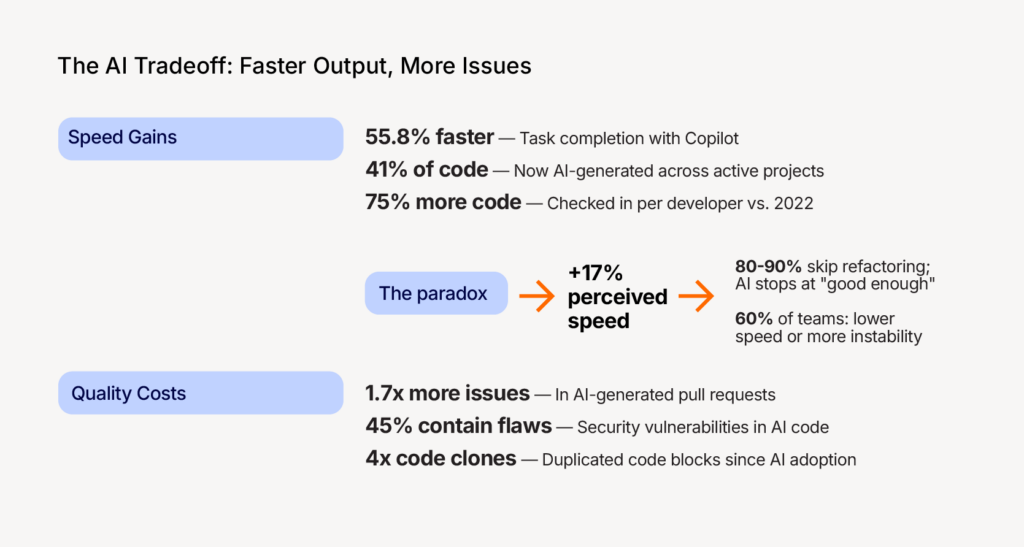
- GitHub Copilot users complete tasks 55.8% faster in controlled studies
- 41% of all code produced in 2025 was AI-generated
- The average developer checked in 75% more code than they did three years ago
By any measure of velocity, AI coding tools are delivering, yet velocity and quality are not the same thing. A 2025 analysis of 470 GitHub pull requests found the following:
- AI-generated requests contain 1.7x more issues than human-written ones
- Logic and correctness errors were up 75%
- Security vulnerabilities rose 1.5 to 2x
Research also shows that in testing across more than 100 large language models, 45% of AI-generated code samples contain security vulnerabilities. Google's DORA research team reported that while developers using AI estimated a 17% improvement in individual effectiveness, software delivery instability climbed roughly 10%. Teams are shipping more code, and they’re also shipping more problems.
After analyzing 300+ repositories, an enterprise security firm found the following: AI-generated code is "highly functional but systematically lacking in architectural judgment." The firm called it an "army of juniors." The code works, but it skips refactoring, over-specifies solutions, duplicates logic, and introduces flaws that create technical debt over time.
This article examines where AI-powered development helps, where it introduces new risks, and how traditional software development must adapt. The goal isn't to argue for or against AI in software engineering. It's to look honestly at what the data shows, because the organizations making the best decisions about AI tooling right now are the ones paying attention to both sides of the ledger.
What is Traditional Software Development Today
With the rise of AI-assisted software development, traditional software development may seem slow, but there are pros and cons for every method. The traditional process exists for a reason: it prevents the same risks that keep showing up in AI-assisted projects.
The traditional software development life cycle follows a sequence that most engineers are familiar with: requirements gathering, system design, implementation, testing, deployment, and maintenance. This structure doesn’t change with AI-assisted development, but how each stage is executed does. Whether the methodology is waterfall, agile, or something in between, the underlying principles remain the same:
- Understand what you're building before you start
- Design the architecture before writing the code
- Test thoroughly before shipping
- Review each other's work
- Document what you've done so the next person can maintain it
These steps exist because decades of failed projects proved what happens without them: projects fail because of unclear requirements, poor design decisions, and insufficient testing. Not because developers typed too slowly. The traditional methods in software development evolved to make teams extra careful because the cost of finding a bug in production is higher than catching it during design or code review.
In a traditional workflow, every piece of code gets reviewed by at least one other developer before it gets merged. Beyond checking for bugs, this review also focuses on architectural consistency by identifying whether the code follows the agreed-upon patterns, handles edge cases, introduces dependencies, and more. All of these are judgment calls that require an understanding of the codebase’s full context, the team’s conventions, and the product requirements. Those are the kind of decisions that AI-generated code consistently gets wrong.
Where AI-Powered Software Development Helps
AI criticism is warranted. But so is acknowledging the genuine productivity shift AI tools provide, meaning we must understand where they add value versus where they create risk.
Boilerplate and repetitive code. AI coding assistants are most effective for writing boilerplate and repetitive code, such as setting up servers or writing CRUD endpoints, because errors in these areas are easy to catch and have minimal consequences for minor errors. This is why productivity gains are highest for standard, repetitive implementations, while AI struggles with complex code that demands original thought.
Prototyping and exploration. AI tools dramatically speed up prototyping and exploration, reducing the timeline for testing the feasibility of an idea from days to hours. Because this code is disposable, speed matters more than polish. The key risk, however, is that this AI-generated prototype code is often promoted to production without a necessary rewrite, driving technical debt accumulation.
Navigating unfamiliar codebases. AI coding assistants help developers orient themselves in code they didn’t write. AI tools can summarize functions, explain patterns, and suggest where to look for specific logic to cut the ramp-up time for these tasks.
Test generation. AI tools are useful for generating test scaffolding and suggesting edge cases. While this saves time, the resulting tests must be reviewed by a human because AI often generates tests that perform without errors but don’t validate meaningful behavior.
Documentation and code explanation. AI produces reasonable first-draft documentation. The output usually needs editing for accuracy and tone, but starting from a draft is faster than starting from a blank page. GitHub Copilot reports that developers save up to 60% of their time on documentation tasks specifically.
The Code Quality Tradeoff in AI-Powered Development
AI coding tools deliver speed gains that are easy to measure, but the quality costs are harder to see. These quality tradeoffs surface when the code is in production, and the original context has faded.
Understanding where AI-generated code fails consistently helps you know what to watch for so that speed gains don’t get eaten by rework, security incidents, and technical debt. For example, AI-generated code was 1.91x more likely to create insecure object references, 1.88x more likely to mishandle passwords, and 1.82x more likely to implement insecure deserialization.
A recent security report identified ten recurring anti-patterns in AI-generated code. Three of them are particularly damaging at scale.
The first is avoidance of refactoring. The report found this pattern in 80 to 90% of AI-assisted repositories. Unlike experienced developers who restructure and improve code as they work, AI stops at "good enough." It solves the immediate problem but doesn't consider whether the solution fits cleanly into the existing architecture. Over time, this creates codebases where similar problems are solved in different ways, fragmenting the architecture and compounding maintenance costs.
The second is over-specification. AI tools tend to create narrow solutions that can't be reused. Instead of writing a flexible utility that handles multiple cases, AI generates a specific function for each variation. The result is fragmented code where small changes require touching many files.
The third is "by-the-book" fixation. AI follows conventions without questioning them. It produces predictable code that mirrors the most common patterns in its training data. That's fine when convention is the right answer. It breaks down when the situation calls for a deliberate deviation, something experienced developers do routinely.
These patterns help explain a paradox that Google's DORA team documented: developers using AI estimated a 17% improvement in their individual effectiveness, yet software delivery instability climbed by roughly 10%.
GitClear's research tracked this at the codebase level, and found that code clones (duplicated or nearly identical blocks of code) grew 4x since widespread AI adoption began. Their framing captures the tension well: developers consistently rank productivity as the top benefit they want from AI. Ask a senior engineer what would actually improve long-term velocity, and the answer is almost always the same: a clean, modular, well-tested codebase that's easy to change.
AI vs Traditional Software Development: Choosing the Right Approach for Your Projects
The framing tends to be binary: adopt AI tools or fall behind. The reality is more situational than that. Different project types, team compositions, and risk profiles favor different approaches, which is why organizations should map the method to their context.
Greenfield prototypes and MVPs. When a team needs to validate a concept quickly, the speed of AI-generated code outweighs the quality concerns. It’s rare to see a request for a perfectly architected codebase for a prototype. Instead, the goal is to learn fast, gather feedback, and decide whether to invest further. AI tools compress that cycle, but this can go wrong fast if the prototype gets promoted to production without a rewrite.
Production systems with long expected lifespans. A system that will be maintained for five or ten years needs clean architecture, thorough test coverage, clear documentation, and consistent patterns. AI-generated code avoids refactoring 80 to 90% of the time and produces 4x more code clones than pre-AI codebases.
Regulated industries and security-critical software. Finance, healthcare, defense, and infrastructure software operate under compliance requirements that can’t afford to deal with the flaws AI commonly introduces. AI-generated code can introduce security vulnerabilities at significantly higher rates, up to 2.74x more, making it a higher-risk approach in regulated environments. Traditional methods in software development emphasize code review, security scanning, and formal testing. AI can assist with non-critical-path work, but the core product code needs human oversight at every stage.
Cloud development vs traditional software development. Cloud-native systems, like microservices, serverless functions, and containers, require a lot of configuration and infrastructure code. Much of this follows predictable patterns, which AI can generate and update quickly. But cloud systems are also distributed, bringing challenges like network delays, service failures, and data consistency. For example, AI can create a Lambda function in seconds, but it can’t always predict how that function behaves when a dependent service fails.
Small teams and startups. Small teams that use AI coding tools save time on boilerplate code or test scaffolding, freeing up time for production decisions. Once a codebase has 20 or 30 contributors and no single person can understand all of it, the structural weaknesses in AI-generated code start causing real coordination problems.
Large engineering organizations. Large organizations have more code, more contributors, more interdependencies, and more surface area for quality problems to propagate. AI tools can speed up individual developers within this structure, but the structure itself becomes more important, not less, as AI adoption grows.
AI tools are most valuable when the blast radius of a mistake is small and the cost of iteration is low. Traditional discipline is most valuable when the system is long-lived, the consequences of defects are high, and multiple teams need to work in the same codebase.
How to Make AI-Powered Software Development Work Without Lowering the Bar
When deciding between AI vs. traditional software development, you must evaluate how your engineering practices must be redesigned so that AI’s speed advantages don’t undermine quality safeguards. In practice, that means:
Treat AI-generated code as untrusted by default. Organizations should treat AI-generated code with the same scrutiny as contributions from external sources. They should run mandatory review processes and security scanning before anything reaches production.
Tighten code review, don't loosen it. AI adoption tends to increase code volume, which pressures teams to speed up review cycles. Quality drops when review standards bend to match the output pace. Review time should focus on the areas where AI is weakest: architectural fit, business logic correctness, security patterns, and edge case handling. Review time should focus less time on syntax and formatting and more on whether the code belongs in the codebase at all.
Automate security scanning for every pull request. Static application security testing (SAST) tools, dependency vulnerability scanners, and secret detection should run automatically on every pull request. The Georgetown CSET research on AI code security recommended embedding security checks directly into development workflows rather than relying on periodic audits.
Set architectural guardrails before developers start generating code. Most of the structural problems in AI-generated code come from the same root cause: the AI doesn't know your team's architectural decisions. It doesn't know that your team uses a logging library, or that database access should always go through a repository layer, or that new API endpoints need rate limiting by default. We recommend that you embed security instruction sets into AI prompts and enforce architectural constraints in the development environment.
Measure what matters, not what's easy to count. Lines of code, PR velocity, and suggestion acceptance rates are the metrics that AI tool vendors typically highlight. Better metrics include defect escape rate (how many bugs reach production), mean time to recovery (how quickly the team can fix what breaks), and code churn rate (how much written code gets rewritten). Another telling indicator is the ratio of new code to deleted code, since healthy codebases have meaningful deletion alongside addition.
Budget for the ramp-up period. It takes 11 weeks for developers to realize full productivity gains from AI tools, and most give up before then. Initial productivity can dip during the learning phase as developers figure out how to write effective prompts, when to accept suggestions, and when to reject them.
Keep seniors in the critical path. AI tools flatten the output gap between junior and senior developers for well-defined tasks. That's valuable, but it creates a risk. If senior engineers get pulled off code review and architectural oversight, the organization loses the judgment layer that catches the problems AI introduces.
Conclusion
AI-powered software development delivers speed gains that are real, well-documented, and too valuable to ignore. Developers are producing more code, completing routine tasks faster, and spending less time on the mechanical parts of software engineering.
But producing more code and producing better software are not the same thing. AI-generated code contains more defects, introduces security vulnerabilities in 45% of tests, and avoids the refactoring and architectural judgment that keep codebases maintainable over time.
The path forward should be a deliberate integration of AI and traditional development:
- Use AI for the tasks it handles well: boilerplate, scaffolding, test drafts, documentation, and routine refactoring
- Apply traditional discipline where it matters most: architecture, code review, security, and testing
- Keep experienced engineers in the review loop
- Measure code health, not just code volume
- Treat AI-generated output the way you'd treat code from any other contributor who's fast but occasionally wrong
If you're building software products and need engineering teams that pair AI speed with the code quality, security, and review practices production systems require, Svitla’s engineering team delivers production-ready results.
FAQ
What is traditional software development?
Traditional software development refers to the structured, process-driven approach to building software that follows a defined lifecycle (requirements, design, implementation, testing, deployment, maintenance) and emphasizes human judgment at every stage.
What is AI-powered development?
AI-powered development uses machine learning models, primarily large language models, to assist developers in writing code. Tools suggest code completions, generate entire functions from natural language prompts, draft tests, and produce documentation.
Scale your AI-powered development with Svitla Systems.
What is an example of traditional software development?
A banking application is a typical example.
- The project begins with detailed requirements: regulatory compliance needs, transaction processing rules, security standards, and integration specifications for existing systems.
- Architects design the database schema, API structure, and service boundaries before anyone writes a line of code.
- Developers implement features following established coding standards and submit their work for peer review.
- QA engineers run automated and manual tests against the requirements.
- Security teams conduct penetration testing and compliance audits.
- The application goes through staging environments before production release.
- After launch, dedicated teams handle bug fixes, performance monitoring, and feature updates through the same structured process.
Each stage involves human review and approval, which adds time but reduces the risk of defects reaching customers.
What is the traditional software development process?
The traditional software development process follows a lifecycle with six core phases.
- Requirements gathering defines what the software needs to do, who will use it, and what constraints apply.
- System design translates those requirements into an architecture: data models, service structure, API contracts, and technology choices.
- Implementation is the actual coding, typically following team coding standards and architectural patterns agreed on during design.
- Testing verifies that the code works as specified, covering unit tests, integration tests, and end-to-end validation.
- Deployment moves the tested code into production through a controlled release process.
- Maintenance covers ongoing bug fixes, performance improvements, security patches, and feature additions after the initial release.
Agile teams iterate through these phases in shorter cycles (sprints), while waterfall teams move through them sequentially. Both approaches follow the same logic: the process exists to reduce risk at every stage, catching problems when they’re cheap to fix rather than after they’ve reached users.
Is AI the end of traditional software development?
No. The data suggests the opposite: AI adoption is making traditional practices more important, not less. Google’s DORA research found that software delivery instability rose roughly 10% alongside AI adoption, even as individual developers reported feeling more productive. AI is changing what developers spend their time on, but it hasn’t replaced the need for judgment, design thinking, and quality practices that traditional development provides.
What is the difference between low code and traditional software development?
- Low-code platforms let users build applications through visual interfaces, drag-and-drop components, and pre-built templates. Low-code platforms are faster for standard business applications but hit a limit when an application needs custom integrations, unusual business logic, or performance characteristics that the platform’s abstractions don’t support.
- Traditional software development involves writing and maintaining source code directly. It offers full control over architecture, performance, and customization.
AI-powered development sits between the two: developers still write or review code, but AI handles much of the routine generation.