Article summary: Multi-agent systems, where specialized AI agents work together on tasks a single agent can’t handle on its own, are becoming core enterprise infrastructure. This article covers multi-agent systems architecture, how they differ from single agents, which orchestration platforms lead the market in 2026, and the limitations that separate successful deployments from experiments.
Multi-agent systems went from a niche research topic to the fastest-growing architecture pattern in enterprise AI in less than eighteen months:
- Gartner documented a 1,445% growth in enterprise inquiries about multi-agent systems between Q1 2024 and Q2 2025.
- Databricks' 2026 State of AI Agents report projects a 327% growth rate in under four months.
- A Google Cloud survey of 3,466 senior enterprise leaders across 24 countries found that 52% of executives already have active agent deployments, with multi-agent coordination emerging as the key strategy for scaling beyond what a single agent can handle.
If software history offers one parallel to multi-agent systems, it’s microservices. In the early 2010s, organizations moved away from monolithic applications toward smaller, specialized services that could be built, deployed, and scaled independently.
Multi-agent AI follows the same logic: instead of one large language model handling everything, focused agents own a specific task, coordinated by an orchestration layer that manages how they work together.
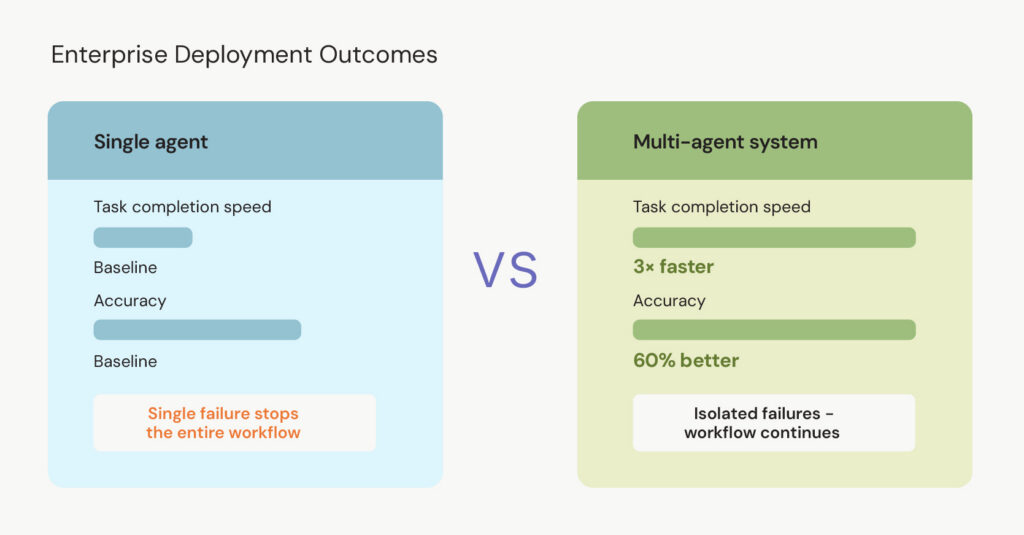
A single agent trying to handle everything at once hits context window limits and makes more mistakes because the task exceeds what the model can manage. And when it fails, the entire workflow fails with it. In contrast, a multi-agent AI system breaks workloads into pieces. Each agent is smaller, more focused, and easier to test than one monolithic system, trying to do it all.
The parallel to microservices carries a warning, too. Microservices solved the monolith problem, yes, but they also created distributed system problems: harder debugging, more failure points, and coordination overhead. Multi-agent systems in AI today face very similar tradeoffs.
Gartner predicts that by 2027, over 40% of agentic AI projects will be cancelled, making early readiness evaluations across infrastructure, governance, and implementation aspects all the more important.
In this article, we explore what multi-agent systems are, how the architecture works, where they outperform single agents, and how leading orchestration platforms differ in 2026.
What are multi-agent systems?
Multi-agent systems consist of AI agents, each with a specific role and set of capabilities, that would be difficult or even impossible for a single agent to handle. Each agent perceives its environment, makes decisions within its scope, and coordinates with other agents through defined communication channels.
Until 2024, most AI agents were wrappers around a single language model with some tools attached. The model handled everything, covering understanding the request, reasoning about how to proceed, calling external APIs, generating a response, and evaluating its output. This worked for bounded tasks like summarizing a document, but it failed with anything requiring sustained multi-step reasoning, parallel tool access, or decisions that spanned multiple domains.
Single agents often get overwhelmed by long tasks, as the workload pushes them against context window limits. This leads to mistakes or forgotten steps as the work grows more complex. Multi-agent AI systems solve these problems through decomposition, where specialized agents handle the tasks, they're best suited for, rather than having a single agent manage the entire workflow.
Enterprises deploying multi-agent architectures report 3x faster task completion and 60% better accuracy compared to single-agent approaches.
From automation to multi-agent systems
For most of the past decade, enterprise AI automation relied on rules-based workflows (if this condition, then that action). Robotic process automation (RPA) handled repetitive, structured tasks well, including data entry, invoice processing, and report generation.
At the same time, language models with tool access can handle complex requests, summarize unstructured data, and make judgment calls that rule-based systems can’t. Still, single agents have a scope problem: the more complex the task, the more the model is asked to hold in context simultaneously, and the more its accuracy suffers.
Multi-agent systems are the response to that problem. Today, the goal is to extend into territory that RPA or single agents couldn't successfully reach. With plenty of agentic AI trends making headlines, three developments in the past eighteen months changed what’s possible with multi-agent systems:
- The models evolved. Gemini 3 Pro broke the 1500 LMArena Elo barrier with a million-token context. Claude can maintain focus on complex tasks for over 30 hours at 77.2% accuracy. GPT-5 explains its reasoning step-by-step.
- The protocol arrived. Anthropic's Model Context Protocol (MCP) standardizes how agents connect to tools, databases, and APIs, turning custom integration work into something closer to plug-and-play. Google's Agent-to-Agent (A2A) protocol, now under the Linux Foundation with 50+ technology partners, defines how agents from different vendors and frameworks communicate with each other.
- The orchestration frameworks matured. LangGraph, CrewAI, AutoGen, Google ADK, and the OpenAI Agents SDK all reached production maturity in 2025 and early 2026, each with different strengths. These production-grade frameworks can now handle state management, error recovery, checkpointing, and human-in-the-loop workflows out of the box.
Gartner predicts that by 2027, 70% of multi-agent systems will use narrowly specialized agents, improving accuracy while increasing coordination complexity.
How does a multi-agent system's architecture work?
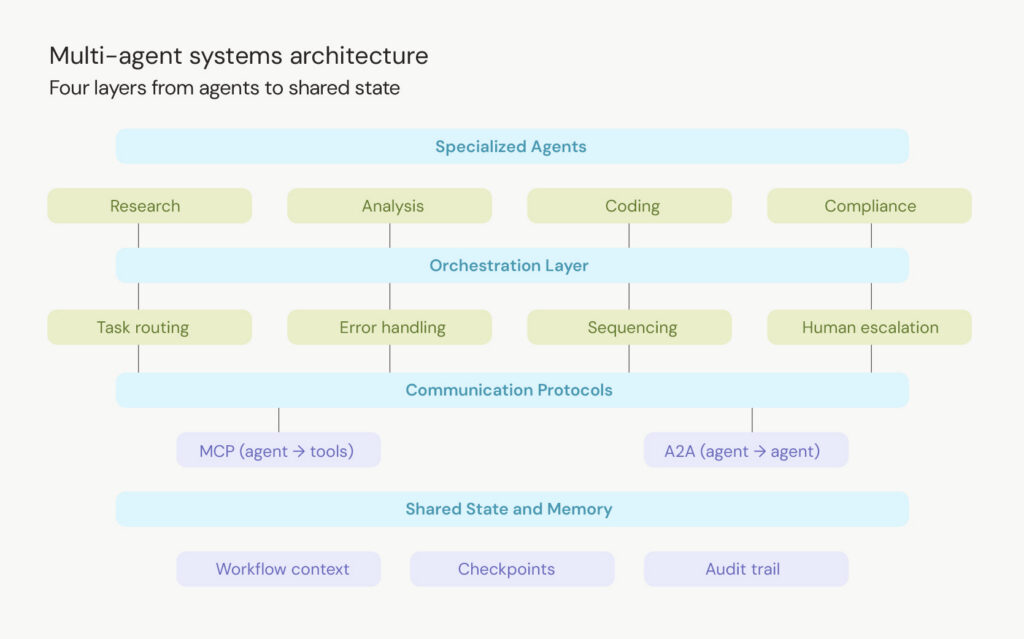
A multi-agent system has four components working together (the diagram above shows how these interact):
- Specialized agents handling specific tasks
- An orchestration that coordinates task sequencing and handles failures
- Communication protocols that standardize how agents connect to tools and to each other
- A shared memory layer that maintains context across the workflow
Each agent operates within a scope it can manage. The orchestration layer absorbs failures without taking everything down. The shared memory layer helps agents build on each other's work rather than starting from scratch at every handoff.
Going from automation to AI
An agent that can't access clean and relevant data makes confident decisions on stale inputs. In a multi-agent workflow, the error spreads to every downstream agent before anyone catches it. There are three things to have in place to ensure multi-agent AI is successful:
- Unified data access: Agents need to query databases, APIs, documents, and real-time feeds through standardized interfaces rather than custom integrations for every source. MCP handles much of this at the protocol level, but data still needs to be accessible and structured consistently.
- Shared state management: Agents need to read from and write to a shared context store without creating conflicts or losing information between handoffs.
- Observability: Every agent action needs to be logged at the handoff level so that when something goes wrong (and it will), the failure can be traced to a specific agent and step rather than disappearing into the workflow.
Benefits of multi-agent systems
Customer-facing workflows benefit from parallel processing. A customer service agent that previously waited for a CRM lookup, then a knowledge base search, then a policy check, now runs all three simultaneously. Response times drop and resolution rates improve.
Back-office workflows benefit from specialization. A financial reconciliation process that requires a human to move between systems (pulling data from one, checking against another, flagging discrepancies in a third) can be decomposed into agents each responsible for one system. Accuracy improves because each agent operates within a narrow scope. Auditability improves because every action is logged at the agent level.
Complex, multi-domain workflows benefit from both parallel processing and specialization. A regulatory compliance review that spans legal analysis, data classification, risk scoring, and report generation is too broad for one agent and too interconnected for separate tools. Multi-agent systems handle the coordination that would otherwise require a human as the integration layer.
Security in multi-agent systems
Single-agent AI introduces one risk surface: the model's output. Multi-agent systems introduce several. Each agent can call APIs, write to databases, send communications, and trigger downstream actions. In a poorly governed system, a compromised or malfunctioning agent can initiate a chain of real-world actions before any human notices. These are the most important security controls in production:
- Scope boundaries define exactly what each agent is allowed to do. An agent that reads transaction logs should have no write access to payment systems, and that blocker should be enforced at the infrastructure level, not just in the system prompt.
- Confidence thresholds determine when an agent acts independently and when it escalates to a human. High-stakes actions should require human confirmation regardless of how confident the model is.
- Audit logging records every decision and action at the agent level, so that any failure or unauthorized behavior can be traced, investigated, and prevented from recurring.
Why are multi-agent systems replacing single agents?
The choice between multi-agent systems and single agents comes down to specific engineering tradeoffs. A single agent works well when the task fits inside one context window, requires one or two tool calls, and has a clear success criterion. The cracks appear when the task complexity increases across any of these five dimensions:
Complexity. Workflows requiring multiple skill sets, like CRM data retrieval, inventory checks, and compliance reviews, often overwhelm a single agent. Multi-agent systems address this by assigning specialized agents to each step, improving accuracy by roughly 60% as each agent operates within a narrower, better-defined scope.
Parallelism. Single agents work sequentially, completing one step before starting the next. Multi-agent systems run tasks simultaneously, like research and data analysis happening at once. This parallelism is the main driver behind the 3x speed boost reported by enterprises.
Reliability. Single-agent failures stop the entire workflow, requiring a full restart. Multi-agent systems offer failure isolation: if one agent fails, its work is isolated, and the orchestrator can retry the specific step or escalate the issue without losing the progress made by other agents.
Specialization. Multi-agent architectures improve performance through model tiering, assigning specialized models and prompts to different tasks. By using fast, cheap models for triage and highly capable models for complex reasoning, systems optimize accuracy while directing costs toward the highest-value steps.
Maintainability. Multi-agent systems isolate concerns, making them easier to debug and update. Unlike a single sprawling prompt, where one change can break multiple functions.
Before committing to this architecture, organizations should evaluate readiness and how multi-agent architectures fit their AI and data infrastructure. The goal should be to connect architecture, state management, and orchestration with multi-agent systems across all dimensions.
Which orchestration platforms lead the market?
Five orchestration platforms have emerged as the production leaders:
LangGraph (LangChain ecosystem)
LangGraph gives engineering teams explicit control over how agents execute, which agent runs when, what triggers a branch, and what happens when something fails. Rather than letting the orchestrator improvise, LangGraph requires teams to define every path through the workflow upfront. That's more work to build, but it means every execution is predictable, auditable, and reproducible.
The feature that sets LangGraph apart in production is its checkpointing system. The workflow snapshots its state at every step, so if something goes wrong at step seven of a twelve-step process, the team can roll back to step six, inspect exactly what each agent was working with, fix the problem, and replay from there.
Capital One, one of the largest banks in the United States, uses LangGraph for governance-critical workflows that require complete traceability across every agent decision. LinkedIn uses it for content moderation pipelines where predictable, inspectable behavior is a compliance requirement. The pattern is consistent: organizations that can't afford unpredictable agent behavior choose LangGraph because it's the only major framework where the execution path is fully under the team's control.
The tradeoff is setup time. LangGraph has the steepest learning curve of the five major frameworks. Teams new to graph-based workflow design typically need two to four weeks to get comfortable with the model before they're productive.
Best for: Financial services, healthcare, legal, and any regulated industry where compliance, auditability, and deterministic behavior are non-negotiable.
CrewAI
CrewAI is built for speed. Where LangGraph asks teams to define every execution path upfront, CrewAI lets you describe what each agent does, and the framework handles the coordination.
It works especially well for workflows that map naturally to how human teams operate: content production pipelines, customer research, lead qualification, and internal reporting.
CrewAI has also added A2A protocol support, so its agents can coordinate with agents from other frameworks. And it supports both code-based and no-code development, which means non-engineering teams can build and run workflows without depending on a developer for every change.
The honest tradeoff is that CrewAI swaps control for convenience. There's no conditional branching, no complex loop logic, and no built-in recovery if a step breaks mid-workflow. State management is basic, where task outputs pass from one agent to the next rather than persisting in a shared store. That works fine for straightforward workflows, but it hits a ceiling fast when the logic gets complex. Most teams that start with CrewAI for prototyping end up migrating to LangGraph once they need production-grade state management.
Best for: Startups, rapid prototyping, business process automation that maps to team roles, and organizations that need something working fast and can accept the eventual rewrite.
AutoGen/AG2 (Microsoft)
The framework, rebranded as AG2 in its v0.4 release, uses a GroupChat pattern: multiple agents in a shared conversation, with a selector determining who speaks next. Microsoft Research uses it for scientific literature reviews where a research agent, a critic agent, and a synthesis agent iterate before producing a final output. The iterative process catches gaps that a single-pass pipeline would miss, which is what you want when the cost of a wrong answer is higher than a few extra LLM calls.
The code generation use case is where AutoGen has the clearest commercial traction. It ships with built-in sandboxed environments where agents can write, test, and debug code without leaving the workflow.
The cost model is the honest limitation. Every agent turn carries the full accumulated conversation history, which means a four-agent debate with five rounds generates twenty LLM calls, each one larger than the last as the conversation grows. For research workflows and code generation where quality matters more than speed, that's an acceptable trade. For high-volume, real-time use cases like customer support, it gets expensive fast.
Best for: Research automation, code generation, quality-sensitive workflows where thoroughness matters more than speed, and teams in the Microsoft ecosystem who need agents to challenge and refine each other's outputs rather than just pass tasks down a chain.
Google Agent Development Kit (ADK)
ADK is Google's answer to a problem that most multi-agent frameworks quietly sidestep: what happens when your agents need to work with agents from a different vendor or framework? Most platforms assume you're building everything inside their ecosystem, while ADK assumes you're not.
The framework organizes agents in a hierarchy and integrates natively with Vertex AI, Gemini models, and Google Cloud services. But the feature that sets it apart is native A2A protocol support. A2A defines how agents from different vendors communicate with each other, and ADK is currently the only major framework where that works out of the box rather than requiring custom integration work for every cross-system connection.
ADK is highly favored in organizations running large, heterogeneous agent ecosystems where different teams or vendors own different parts of the workflow, and everything needs to coordinate without a custom integration for every handoff. Google itself uses ADK to coordinate agents across Search, Workspace, and Cloud services, which indicates the scale it was designed for.
The tradeoff is straightforward: ADK is built for Google's ecosystem and works best inside it. It supports other models, but the further you move from Gemini and Google Cloud infrastructure, the more integration work you're taking on yourself.
Best for: Google Cloud-native organizations, multi-vendor agent ecosystems, and teams where cross-framework interoperability through A2A is a hard requirement.
OpenAI Agents SDK
If LangGraph is the framework for teams who need control, and CrewAI is the framework for teams who need speed, the OpenAI SDK is the framework for teams who need clarity. The coordination logic is explicit and close to the surface: agents hand off to each other through defined handoff points, and every transition is transparent.
That simplicity is useful for teams building their first multi-agent system and for workflows that don't need the complexity of the other frameworks. Dropbox uses it for document processing pipelines where agents hand off between extraction, classification, and routing in a clean, predictable sequence. For workflows like that (linear, well-defined, not requiring cross-vendor model tiering) the SDK gets teams to a working system faster than any of the alternatives.
The constraint is that the SDK works only with OpenAI models. Teams that want to assign Claude for long-form writing, Gemini for multimodal reasoning, and GPT for conversation can't do that here. For organizations already committed to OpenAI's ecosystem, that's a feature. For everyone else, it's a reason to look at one of the other frameworks first.
Best for: OpenAI-committed teams, straightforward multi-agent workflows without complex orchestration requirements, and projects where simplicity and speed to deployment matter more than framework flexibility.
Which orchestration framework fits your use case?
| LangGraph | CrewAI | AutoGen / AG2 | Google ADK | OpenAI SDK | |
| Best for | Regulated industries, compliance-critical workflows | Rapid prototyping, business process automation | Research, code generation, iterative refinement | Multi-vendor agent ecosystems, Google Cloud-native | OpenAI-committed teams, straightforward workflows |
| Orchestration style | Graph-based, explicit paths | Role-based team ("crew") | Conversational group chat | Hierarchical agent tree | Explicit handoffs between agents |
| State management | Built-in checkpointing + time travel | Sequential task passing | Conversation history | Vertex AI-native | Minimal, close to the model |
| Cross-framework (A2A) | ❌ | ✔️ (added) | ❌ | ✔️(native) | ❌ |
| Model flexibility | Any model | Any model | Any model | Optimized for Gemini | OpenAI only |
| Start here if... | You can't afford unpredictable behavior | You need something working this week | Agents need to debate and refine output | You're building across vendors or frameworks | You're all-in on OpenAI and want simplicity |
Multi-agent systems work with the right foundation
Multi-agent systems are a core enterprise architecture pattern that is most valuable where one agent can’t handle the full workflow. While breaking work into smaller parts improves focus and reliability, it also creates new challenges related to state management, observability, governance, and cost controls. The microservices generation learned this the hard way. Multi-agent systems are running into the same issues, just a lot faster and with higher token costs.
If you're past the demo and need engineers who've solved these problems before, Svitla's AI and machine learning engineering team knows exactly where the gap is.
FAQ
What are multi-agent systems?
Multi-agent systems are architectures where multiple AI agents, each with a defined role, a set of tools, and a scope boundary, coordinate to complete tasks that a single agent can’t handle reliably on its own.
Learn how Svitla AI helps you develop multi-agent systems that align your strategy and roadmap with execution.
What are multi-agent systems in agentic AI?
In the context of agentic AI, multi-agent systems represent the shift from autonomous individual agents to coordinated teams of agents. An agentic AI system can plan, reason, use tools, and take action toward a goal with minimal human oversight. A multi-agent agentic system distributes that autonomy across multiple specialized agents that collaborate through defined protocols. In practice, multi-agent agentic systems use orchestration patterns (hierarchical, pipeline, conversational) to coordinate agents that can independently perceive their environment, make decisions, and act, but do so within a framework that aligns their individual actions toward a shared objective.
How do multi-agent systems improve productivity?
The productivity improvements come from three mechanisms.
First, parallelism: multi-agent systems run independent steps simultaneously rather than sequentially.
Second, specialization: each agent is optimized for its specific task with tailored prompts, models, and tools, producing better results than a generalist agent stretching across everything.
Third, failure isolation: when one agent fails, the others’ work is preserved. The orchestrator retries or reroutes the failed step without restarting the entire workflow.
How to scale multi-agent systems?
Scaling multi-agent systems requires:
State management: as workflows grow more complex and agent counts increase, maintaining coherent shared state becomes the primary engineering challenge.
Cost governance: every agent turn is an LLM call, and costs grow with agent count, conversation length, and model capability. Model tiering and per-workflow budget ceilings keep costs predictable as volume scales.
Observability: debugging a failing workflow across dozens of agents requires structured logging at every handoff, distributed tracing, and anomaly detection that flags deviations.
Protocol standardization: scaling across teams, vendors, and organizational boundaries requires MCP for agent-to-tool connections and A2A for agent-to-agent communication, so that new agents can join the system without custom integration work for every connection.