
Article summary: A cybersecurity risk assessment is the way organizations find out what they are exposed to before an attacker does. In this piece, we explore the anatomy of a cybersecurity risk assessment, the four main frameworks that structure it, its step-by-step process, and how AI is changing the speed, automation, and analysis behind risk assessments.
Every organization has risks it knows about, risks it suspects, and risks it has no idea exist. A cybersecurity risk assessment is how you determine which category your exposures fall into, before an attacker does.
Running an assessment tells you what an attacker would find if they got in today, and how much that would cost you. Without that picture, security spending gets allocated by intuition, compliance deadlines, or whatever the last incident revealed.
And the financial stakes are hard to ignore. The global average cost of a data breach reached $4.44 million in 2025. For U.S. organizations, that figure hit a record $10.22 million per incident. Those are the numbers that follow a breach. A cybersecurity risk assessment is the work that happens before one.
Let's look at what a cybersecurity risk assessment involves. The frameworks that structure it, how to run the process, which tools support it, and how AI is beginning to automate and strengthen assessment steps.
What is a cybersecurity risk assessment?
A cybersecurity risk assessment identifies an organization’s critical assets, the threats they face, and the damage an attack would cause. The output provides a prioritized risk profile, guiding security investment, and revealing where controls need improvement.
The definition may sound clear, but two terms blur it in practice, because they often get used interchangeably with it:
- A vulnerability scan runs automated checks for known weaknesses in systems and software, producing a list of findings.
- A penetration test probes the environment to simulate what an attacker would do with the vulnerabilities it uncovers.
Both the vulnerability scan and the penetration test are valuable. But they answer different questions at different points in a security program, and neither one substitutes for the other.
The scan finds security holes, while the penetration test probes which ones an attacker could exploit. The risk assessment translates those findings into business terms:
- which assets are at risk
- how likely each weakness is to be exploited
- what a breach would cost
A cybersecurity risk assessment is most useful when it’s a defined cycle rather than a one-off exercise. Threats change, infrastructure evolves, and last year’s risk picture may not reflect this year’s environment.
The scope of an assessment varies by organization and its regulatory environment. Some cover the entire technology estate, while others focus on specific systems, third-party integrations, planned cloud migrations, or new products before launch. What stays consistent is the underlying logic: identify assets, detect threats, evaluate likelihood and impact, and prioritize the response.
Why does a cybersecurity risk assessment matter for enterprise teams?
The business case for a cybersecurity risk assessment is about making better decisions with limited security resources. Every enterprise has more potential vulnerabilities than it can fix at once. The assessment guides risk decisions: which issues to remediate first, which to mitigate, and which are acceptable given the cost of fixing them.
Detection speed is where the financial case comes into focus. According to IBM’s 2025 Cost of Data Breach report, breaches caught within 200 days cost an average of $3.87 million to resolve. Breaches that ran past that threshold cost $5.01 million. That's $1.14 million more for every breach that took longer to catch.
Speed isn’t the only factor as frequency matters too. The IBM data makes the case indirectly. Breaches caught faster cost less. A higher assessment cadence shortens the window in which undetected exposure accumulates, and that is where costs build. Annual assessments leave eleven months of infrastructure change, new vendor relationships, and evolving threat patterns unexamined.
Vendor risk is the other pressure point that makes discipline harder to skip. According to Verizon’s Data Breach Investigations Report, third-party involvement in breaches doubled from 15% to 30% in a single year. That’s nearly one in three breaches now involving a supplier or partner, rather than a direct attack.
That said, an assessment that finds very little is worth questioning before it gets filed. A narrow scope, shallow methodology, or incomplete visibility into the environment can give a clean report that doesn’t reflect the real picture. If the asset inventory is incomplete or the threat modeling is generic, the output will be too. A report and a secure environment are different things. Confusing the two is one of the more common ways security programs develop blind spots.
What frameworks structure a cybersecurity risk assessment?
Choosing the wrong framework doesn't invalidate the risk assessment, but it can create friction with regulators, auditors, or the internal stakeholders who need to act on the results. The four most widely used frameworks in enterprise settings take different approaches to the same problem: measuring risk in a way that’s consistent and defensible.
NIST Cybersecurity Framework 2.0
The NIST CSF is the most referenced framework in U.S. enterprise environments. It organizes security activity across six functions: Govern, Identify, Protect, Detect, Respond, and Recover. NIST gives organizations a structured vocabulary for describing their current security posture and a way to define where they want to be.
For teams reporting security risk to leadership or aligning with federal requirements, NIST is the natural starting point.
ISO 27001
ISO 27001 is the international standard for information security management systems (ISMS). The standard specifies what an organization must document, implement, and continuously improve to earn certification.
It carries more weight during procurement and vendor reviews than an internal NIST-based assessment. The cost and time of investment for certification is considerable and maintaining it requires annual surveillance audits.
FAIR (Factor Analysis of Information Risk)
FAIR is a quantitative model for measuring the cost of risk. It translates threat scenarios into financial terms: probable frequency of loss events, probable magnitude of loss, and the range of outcomes in between.
For security leaders who need to present risk to a CFO or board, FAIR depicts threats in dollar terms. That framing tends to resonate better with non-technical decision-makers than heat maps and likelihood scores do. FAIR doesn’t produce a certification, but it answers the question governance frameworks typically leave open: what does this risk cost the business?
OCTAVE (Operationally Critical Threat, Asset, and Vulnerability Evaluation)
OCTAVE focuses on organizational risk rather than a technical risk. It brings business unit leaders into the assessment process alongside security teams, ensuring that the threats that matter to operations get assessed.
OCTAVE suits environments where risk decisions need input from multiple departments, and where the security team alone doesn't have full visibility into what the business considers critical. The catch is that it’s resource-intensive, which makes it harder to run quickly or frequently.
Cybersecurity risk assessment frameworks
| NIST CSF 2.0 | ISO 27001 | FAIR | OCTAVE | |
| Certifiable | No | Yes, third-party audit required | No | No |
| Quantifies risk in dollar terms | No, uses tiers and profiles | No, uses control-based assessment | Yes, the core purpose of the model | Partially, qualitative scoring |
| U.S. regulatory alignment | Strong, federal baseline | Moderate, internationally focused | Moderate, complements other frameworks | Moderate, not regulation-specific |
| Best suited for | U.S. enterprises aligning with federal standards or reporting risk to leadership | Organizations seeking international certification or operating across multiple jurisdictions | Security leaders presenting risk in financial terms to the CFO or the board | Organizations where business units, not just security teams, need to drive the assessment |
| Works alongside other frameworks | Yes, often used with ISO 27001 | Yes, substantially overlaps with 83% of NIST requirements | Yes, designed to complement NIST and ISO | Yes, often layered onto NIST |
| Implementation complexity | Low to medium: flexible and voluntary | High: documentation, audit, and certification are required | Medium to high: requires financial modeling capability | High: demands cross-departmental participation |
What are the steps to performing a cybersecurity risk assessment?
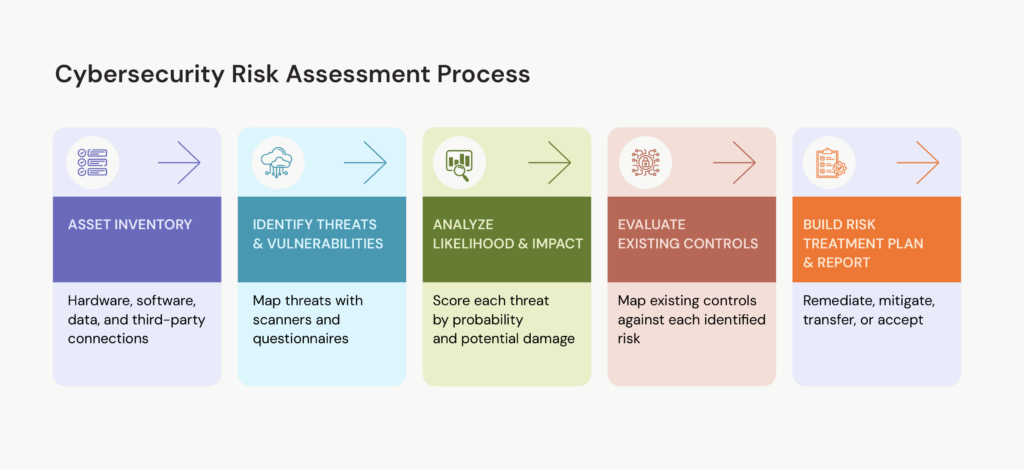
Step 1: Build your asset inventory
Before evaluating any threat, the team needs a clear picture of the environment. That means documenting hardware, software, data stores, third-party connections, cloud services, and user access points. Two things tend to work against the team here:
- asset inventories in large enterprises are rarely complete or up to date
- systems are added, decommissioned, or migrated without the security team's knowledge
Last quarter’s inventory rarely matches this quarter’s environment.
Step 2: Identify threats and vulnerabilities
The next step is to map the threats each asset faces. Structured questions prompt teams to consider threat categories they might otherwise miss:
- insider threats
- supply chain dependencies
- physical access risks
- emerging attack methods
- network and application threats
Teams can map findings to a recognized model like MITRE ATT&CK or STRIDE. MITRE ATT&CK describes threats using real-world adversary tactics and techniques. STRIDE is useful for application, API, cloud, and product-level assessments because it prompts teams to evaluate spoofing, tampering, and more.
These models help teams interpret scanner findings through a threat lens, so the assessment reflects what is vulnerable and how that weakness could be used against the organization. Automated scanner output means little without context. For example, a critical vulnerability in an online, public-facing payment system is a different risk than the same vulnerability in an isolated internal tool used by three people.
Step 3: Analyze likelihood and impact
Every identified threat is then evaluated on two dimensions: how likely it is to be exploited and how much damage exploitation would cause. Likelihood comes from threat intelligence, historical incident data, and the organization's exposure profile.
Impact includes financial losses, business interruptions, regulatory penalties, and reputational damage. The combination of the two produces a risk score for each item, enabling prioritization. Without this step, every finding looks equally urgent, and nothing gets fixed because everything is a priority.
Teams use a qualitative scale of one to five for each dimension and multiply the two scores to produce a composite rating. Teams that need to present risk in financial terms can use a quantitative model like FAIR.
Step 4: Evaluate existing controls
Before deciding what needs to change, the team needs to map which controls are already in place. Existing controls, whether technical, procedural, or contractual, reduce the likelihood and the impact of specific risks. For example, a firewall reduces the likelihood of network-based attacks, while an incident response plan shortens the time it takes to contain a threat.
Mapping controls against risk findings from step 3 shows which risks are managed, which controls aren't working as intended, and which risks have no protection at all.
Step 5: Build the risk treatment plan and report
The output of a cybersecurity risk assessment is a prioritized treatment plan, with each finding assigned a response, an owner, and a timeline. For each risk that exceeds the organization's accepted threshold, the plan should specify one of four responses:
- remediate, meaning fix the underlying vulnerability
- mitigate, meaning reduce the likelihood or impact through additional controls
- transfer, meaning shift some of the financial exposure through insurance or contract terms
- accept, meaning formally sign off the risk and take ownership of it
A well-structured risk assessment report makes every decision traceable, so leadership and auditors can see which risks were identified, how each was handled, and why.
Cybersecurity risk assessment tools
Tools support the team running a cybersecurity risk assessment by surfacing data faster, covering more ground, and reducing the manual effort required to track findings across a large environment.
Organizations sometimes treat tool output as the assessment itself, and end up with a technically detailed report that carries little risk context.
Vulnerability scanners
Vulnerability scanners automate the process of checking systems against databases of known weaknesses. Nessus, produced by Tenable, covers network devices, operating systems, cloud infrastructure, and applications. Qualys offers similar functionality through a cloud-based model, making it easier to deploy across distributed environments without managing on-premises scanning infrastructure. OpenVAS is the open-source alternative for organizations that need scanning capability without the licensing cost.
All three identify what is present and known. None of them tells you how much a given vulnerability matters to the business, which is the judgment the assessment team brings.
GRC platforms
Governance, risk, and compliance (GRC) platforms sit above the scanner layer, helping teams manage the full assessment workflow: tracking assets, recording risk scores, mapping controls, assigning remediation owners, and maintaining the audit trail.
ServiceNow GRC and Archer are among the most commonly deployed platforms at enterprise scale. OneTrust has grown into this space from a privacy compliance background and now covers broader risk management.
AI-powered and continuous monitoring tools
The newer category of cybersecurity risk assessment tools moves away from point-in-time scanning toward continuous monitoring. AI-powered tools ingest signals from across the environment: network traffic, endpoint behavior, identity activity, and cloud configuration changes.
Microsoft Defender, CrowdStrike Falcon, and Darktrace all operate at enterprise scale. The main benefit these tools offer is speed. A configuration change that would have sat undetected until the next scheduled assessment gets flagged when it happens.
How is AI changing the cybersecurity risk assessment process?
The traditional cybersecurity risk assessment runs on a schedule: a team scopes the environment, collects data, scores risks, produces a report, and repeats the cycle every six or twelve months. That model made sense when the tools couldn't do much between assessment cycles. In environments where infrastructure changes daily and new vulnerabilities surface continuously, waiting months for the next window leaves too much unexamined.
AI is shifting the model from scheduled to continuous. Instead of a snapshot taken at a point in time, AI tools continuously monitor the environment, flagging new exposures as they emerge.
AI is also changing risk scoring. Traditional vulnerability scanners assign severity ratings using CVSS (Common Vulnerability Scoring System), a standard that scores vulnerabilities in isolation. AI-driven tools cross-reference vulnerability data against threat intelligence feeds, asset classification, and network layout. The result is a signal that security teams can act on with greater confidence. Organizations using AI and automation in security operations saved an average of $1.9 million per breach and resolved incidents 80 days faster than those without.
That said, more detection means more to triage. AI finds more security threats, which means more signals to investigate and more work for the team to get through. Teams that deploy AI-powered monitoring without processes to act on what it finds tend to end up with more alerts rather than better security.
Turn your risk assessment findings into action
A risk assessment’s output should drive action: a budget conversation, a remediation roadmap, a board presentation, or a vendor contract clause.
The assessment becomes even more actionable when it’s specific. A prioritized list of risks, tied to assets, threat scenarios, and realistic cost estimates, gives decision-makers something concrete they can act on. A general observation that the organization faces phishing risk, ransomware exposure, and third-party vulnerabilities gives them nothing they didn't already know.
Beyond that, the cycle matters as much as the methodology. A thorough assessment run once and then shelved, while the environment evolves around it, loses its value within months. A durable security program runs assessments on a consistent cadence, so the risk picture always reflects the environments teams are working in.
Svitla's cybersecurity services cover the full assessment cycle, from the initial scoping conversation through to the remediation roadmap and the next review.
FAQ
What is a cybersecurity risk assessment?
A cybersecurity risk assessment is a structured process for identifying what an organization has worth protecting, the threats those assets face, and the damage a successful attack would cause. A risk assessment takes vulnerability and threat data and translates it into a prioritized picture of business risk, showing which exposures matter most given the organization’s specific environment, operations, and risk tolerance. The output is a risk treatment plan that tells decision-makers what to remediate, mitigate, transfer, and accept.
Why is cybersecurity risk assessment important?
It’s how an organization moves from reacting to breaches to anticipating them. Without a structured assessment, security spending tends to follow the most recent incident or the loudest compliance requirement rather than the distribution of risk across the environment. The assessment provides the evidence base for making those resource decisions in a way that can be documented, justified to leadership, and revisited as the environment changes.
How often should you run a cybersecurity risk assessment?
There is no universal cadence, but most enterprise teams run a full assessment annually and supplement it with targeted quarterly reviews of the highest-risk areas. The right frequency depends on how fast your environment changes. A higher assessment cadence shortens the window in which undetected exposure can accumulate. For organizations in regulated industries, the cadence may also be set externally.
How do you conduct a cybersecurity risk assessment?
Conducting a cybersecurity risk assessment depends on the quality of the inputs to the process. The practical requirements are a defined scope before the assessment starts, participation from business unit owners alongside the security team, and a reporting format that connects findings to business impact rather than technical severity. Svitla’s cybersecurity team supports enterprise assessments from initial scoping through to the completed report and remediation roadmap.