
Article summary: Explore the ten questions that separate a credible partner from one that delivers convincing demos and weak production. Review the build vs. buy vs. partner framework along with indicators for teams capable of handling AI, data, cloud, and integrations.
More than 80% of enterprise AI projects fail to reach production or deliver value, according to research by the RAND Corporation based on interviews with experienced data scientists and engineers. The research also found that this failure rate is roughly twice that of traditional IT projects. Many of those failures trace back to a single decision: who you trusted with the build.
Any competent team can build a convincing prototype in weeks when the data is clean and the environment is controlled. The question is whether the partner has taken a system like yours all the way to production, kept it running under real conditions, and left your team able to maintain it afterward. Most have not done all three.
MIT's Project NANDA, covering more than 300 AI initiatives, found that external partnerships succeed about twice as often as internal projects: 67% versus 33%. The partner route is a stronger starting position. Choosing the wrong one erases that advantage before the project starts.
The ten questions below are where that evaluation starts.
Why choosing an AI development partner matters more than the technology
S&P Global Market Intelligence found that 42% of companies abandoned most of their AI initiatives in 2025. Organizations are not getting better at AI, but they are getting faster at recognizing that something went wrong. And what tends to go wrong first is partner selection: companies choose on the wrong criteria.
Beyond that, buyers consistently underestimate how much of an AI implementation depends on data engineering, cloud infrastructure, and software integration. They all have to work before the AI layer can do anything useful. A partner who is weak in those disciplines will hit a wall the moment the project moves into production.
That said, the external partner route comes with its own risks. The wrong partner bills hours instead of delivering outcomes. They build technically sound solutions to the wrong problems. And they hand over a system that the client cannot maintain without them. The ten questions below catch all of that before the contract is signed.
Ten questions to ask an AI development partner
1. Can you show us AI work you've taken to production?
Vendor portfolios all look the same: a handful of case studies, a methodology slide, and a wall of recognizable client logos. None of that tells you whether the team has shipped anything that runs in production.
Ask for:
- a specific system, not a category of work
- what the system does today, who uses it, how it is monitored, and what has changed between the prototype and the live version
- what went wrong between pilot and production, and how the team handled it
Every partner who has shipped to production has a story from that phase. If they don't have one, their experience likely ends at the demo.
2. How do you define success before the project starts?
A credible partner will push back if success is defined as "deploying an AI system." They will ask what the system needs to change, in measurable terms, for the engagement to be considered successful.
Ask for:
- the metric the system is expected to move
- the baseline today and the target after deployment
- who owns measurement, and how often results are reviewed
- when the engagement counts as complete, not just delivered
A partner who accepts a vague brief will deliver a vague outcome.
3. What does your data readiness process look like?
Gartner research forecasts that 60% of AI projects that lack AI-ready data will be abandoned through 2026. Data readiness is a common blocker in AI engagements. One that usually surfaces after the model architecture is decided, and the first sprint is underway. A strong partner addresses data readiness before the build starts.
Ask for:
- what their data assessment process looks like in the first weeks of an engagement
- how they handle data that is incomplete, inconsistently labeled, or siloed across systems
- what they do when the data available turns out not to support the use case that was scoped
A partner who treats data readiness as the client's problem creates a project bottleneck that is hard to recover from
4. How do you handle integration with our legacy infrastructure?
AI rarely runs in a clean environment. It gets deployed into organizations with legacy ERPs, proprietary databases, years of accumulated technical debt, and integrations that weren't part of the original scoping conversation. A partner who cannot integrate a model into your systems will deliver something that sits outside the thing it was supposed to improve.
Ask for:
- how the partner approaches legacy integration specifically, not just "we handle integrations" as a general claim
- an example of an integration they've built with a system similar to yours, what the constraints were, and how they navigated them
A conversation about AI implementation should cover how to scope the connectors an AI system is allowed to call and how to build the observability layer that makes those traceable.
5. Who owns the data, the model, and the code, and what are you tied to?
You’ll find the answers to these questions buried in the terms of service. By the time your legal team flags them, the architecture is already built around a specific provider, and your data has been processed under terms nobody fully reviewed.
Focus on the data first. Ask for:
- where client data goes at every stage of the pipeline, and which third-party providers touch it
- whether the data is used to train or improve any model beyond the client's own deployment, and under what contractual terms
- what happens to the data if the engagement ends, and how is it returned, deleted, or retained
Next, address the IP. A partner who builds a custom model on your proprietary data using your compute should leave you with ownership of the results. Many contracts do not default to that. Get it specified before the engagement starts, not in a post-mortem when the relationship has already ended.
Ask for:
- who owns the model weights, the fine-tuning data, the prompts, and the code once the engagement ends
- what is the handoff process like once the system is live
- how is ownership guaranteed
Next, discuss lock-in. A partner who can swap underlying providers without rebuilding the application layer gives you meaningful long-term flexibility. A partner whose retrieval architecture, prompt engineering, and evaluation framework are calibrated to one provider's API makes switching expensive, regardless of what the contract says.
Ask for:
- whether the architecture is tied to one LLM provider or one cloud platform
- what happens when a better or cheaper model becomes available mid-engagement
A partner worth working with will have a defined process around ownership, not a vague "it depends on the client."
6. How do you approach AI governance, explainability, compliance, and data security?
An AI system that produces outputs nobody can explain, audit, or defend when a regulator asks is a liability, regardless of how accurate it is in testing.
Ask for:
- how they approach model explainability, and whether the system can show why it produced a specific output in terms that a non-technical stakeholder can understand
- how their governance framework monitors model behavior in production, flags drift, and escalates decisions outside expected bounds
- how they have handled compliance requirements in environments similar to yours, and name a specific control
- SOC 2 Type II certification status, data residency policies, and contractual commitments on how client data is used beyond the platform
- whether employees' behavioral data or proprietary content used in fine-tuning is subject to any vendor data rights
A partner who leads with "we are compliant with all major frameworks" without naming the specific controls they implemented for a client in your industry has a barely-there answer to a deep question. In regulated environments, document how the audit trail is maintained and who can access it, as it’s equally important as the outputs themselves.
7. How do you handle AI hallucinations in high-stakes environments?
Hallucinations are confidently wrong outputs. They are a property of large language models that require architectural design decisions. Better prompting alone does not fix them. In fintech or healthcare, a single fabricated output can mean a compliance breach, not a bug ticket.
Ask for:
- where they place human checkpoints in an automated workflow
- what guardrails they built at the architecture level
- how outputs are validated before they reach the end user
A credible partner will acknowledge that accuracy in testing and reliability in production are two different things. A partner who confuses the two will build systems that fail in practice.
8. What disciplines does your team cover beyond AI?
This question tends to catch more partners off guard than any other on this list. AI systems need clean, governed, real-time data before they can do anything useful. The infrastructure behind it must handle training, inference, and monitoring at a production scale. And the outputs need to connect to the systems your teams actually use.
Ask for the following:
- what the partner's capability looks like, specifically in data engineering, cloud infrastructure, and software integration
- how those disciplines are staffed on a typical engagement
- whether those disciplines sit inside the partner's team or are subcontracted
- what is an example where a data or integration challenge changed the architecture of an AI system they were building, and how they handled it
A partner with specific answers has built AI systems in the real world, where the model is rarely the hardest part.
9. Who is on the team you’re giving us, and who owns the project?
Vendor presentations are typically delivered by senior people who will not be working on the engagement. The team that shows up after the contract is signed is often a different group entirely.
Ask for the following:
- what are the names and backgrounds of the people who will be assigned to the project
- who the single accountable owner of the project is on the partner's side
- what happens to ownership if the project owner leaves the engagement
- what is the team composition across disciplines
An engagement staffed with ML engineers has no answer for data architecture, cloud, or integration. Those skills get sourced externally when problems surface, at your expense and on your timeline.
10. What does knowledge transfer look like at the end of the engagement?
The most common source of long-term dissatisfaction in AI partnerships is a system that the client cannot maintain, extend, or explain after the partner leaves.
Ask for:
- how does the partner transfer knowledge to the client's internal team throughout the engagement
- what documentation do they produce
- what training do they provide
- what is the client team expected to own once the engagement concludes
- what happens when the client wants to change something six months after go-live
- whether re-engagement is built into the contract or billed separately
A partner who plans for your independence from the start will have clear answers. Real knowledge transfer means your team owns more of the system with every sprint, not a folder of documentation on the last day of the project.
Strong vs. red flag answers
| Question | Strong answer | Red flag answer |
| Can you show AI work taken to production? | Names a specific system, describes what changed between demo and live, and volunteers what went wrong in that transition. | Redirects a case study deck without being able to describe a live production system or a real transition challenge. |
| How do you define success before starting? | Pushes back on vague briefs and asks what specific metric needs to change for the engagement to be considered complete. | Accepts any brief and moves straight to scoping without establishing measurable outcomes first. |
| What does your data readiness process look like? | Has a structured data assessment in week one, with a defined process for what happens when data does not support the scoped use case. | Treats data readiness as the client’s responsibility and frames it as something the client must solve before work begins. |
| How do you handle hallucinations in high-stakes environments? | Names specific techniques: retrieval-augmented generation, confidence scoring, output validation layers, and human-in-the-loop workflows for high-risk decisions. | Says the model is accurate, or that it depends on the use case, without describing any architectural migration. |
| What does knowledge transfer look like? | Describes gradual ownership transfer throughout the engagement with documentation, training, and internal milestones built into the project plan from day one. | Hands over documentation at the end of the project and treats re-engagement for future changes as a natural ongoing arrangement. |
How to decide: build in-house, buy off-the-shelf, or work with a partner
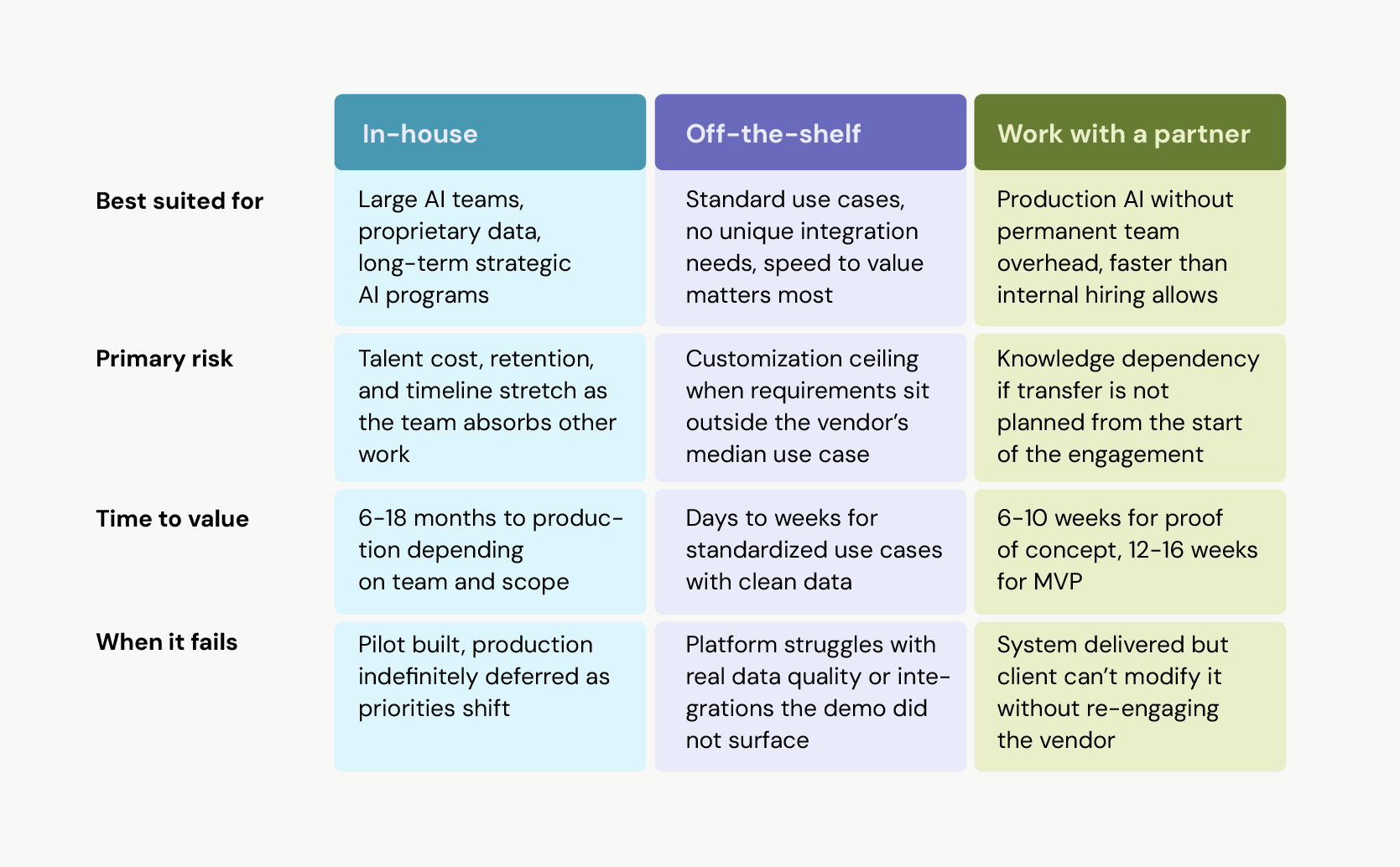
Enterprise AI decisions tend to go wrong when the choice is made on vendor pressure or instinct rather than a clear read of what the organization needs.
In-house
Building in-house makes sense for organizations with a large AI team, proprietary data that cannot leave internal systems, and a long-term AI program that warrants the overhead. The risk is talent. AI engineering roles are expensive, competitive, and hard to retain. The most common failure pattern is a promising pilot that spends two years trying to reach production, only to be reprioritized onto other work.
Off-the-shelf
Buying an off-the-shelf platform works for standardized use cases with no unusual data or integration requirements. The risk is the customization ceiling. Off-the-shelf AI products are built for the median use case across a broad customer base. In enterprise environments, requirements almost always sit at the edges, and that is where the platform starts showing its limits.
Work with a partner
Working with a development partner sits between those two options. You get production-grade AI capability without the overhead of a permanent team, and the project moves faster than internal hiring allows. The failure pattern is an engagement that ends, and a client who discovers that any change requires re-engaging the original vendor.
The decision between the three comes down to these questions:
- how much AI capability does the organization need to own permanently versus access
- how far outside the standard use case do the requirements sit
- how fast does the organization need to be in production
Choose the partner, not the pitch
The ten questions above are your starting point. But, evaluate beyond the pitch: watch how the partner reacts when you probe, and what their instincts are when a question has no rehearsed answer. That is often the difference between a project that ships and one that joins the abandonment statistics at the top of this article. The best approach to selecting an AI development partner is collaboration: one that grows over time instead of stopping at handoff.
Svitla's AI practice is built to close the distance between a working proof of concept and a system that runs reliably in production. The team of AI specialists runs proof-of-concept engagements in weeks, designed to validate feasibility and data readiness before any build investment. MVP delivery follows, moving from prototype to production with the integration and observability layer already in place. After launch, the team keeps tuning the system as it encounters the full range of real-world inputs it never saw in testing.
The core of the team is AI and machine learning engineering, and the work extends into data engineering, cloud architecture, and software integration. Having those skills inside the same engagement keeps the project on track.
As Mykola Klymenko, CTO and co-founder of one client organization, describes: “From the very beginning, Svitla consistently sourced the right people, asked the right questions, and showed a clear understanding of our business and technical needs. Having the right long-term partner gave us the confidence to scale without losing momentum.”
That is what the right partner selection decision produces.
FAQ
How do you choose an AI development company for a startup?
The evaluation criteria for a startup differ from those of an enterprise assessment. The budget is tighter, the timelines are compressed, and the team needs to move fast without creating dependencies that become expensive to unwind later. One of the most important questions is whether the AI development company has worked with organizations at your stage before. Beyond that, the knowledge transfer question is more urgent for startups. Look for an AI implementation partner willing to work embedded with the founding team rather than delivering a system over the wall. Ask what the engagement looks like in month six when the initial build is done, and the startup wants to add a new use case without re-engaging at full project rates.
What is an AI implementation partner?
An AI implementation partner is an external team that takes an AI project from the strategy or proof-of-concept stage through to a working system in production. At its narrowest, an AI implementation partner covers model development and training. At its broadest, it covers the full stack: data engineering, cloud architecture, software integration, and post-launch monitoring.
Who are the top AI development companies?
The right AI development partner depends on the organization, the use case, and the scale of ambition. For large enterprises with global requirements, major consulting firms and hyperscaler professional services teams offer broad coverage but at price points and timelines that do not suit every situation. For organizations that need strong engineering execution, specialist AI development companies typically offer faster time-to-production, more direct access to senior engineers, and greater flexibility in how the engagement is structured.
How can we prevent AI costs from spiraling out of control as we scale?
Cost escalation in AI projects almost always traces back to two things: scope that was not defined precisely enough before the build started, and infrastructure choices made for a pilot that were never designed to support production scale. The scope issue can be fixed by defining what the system needs to do in production before any build begins. The infrastructure issue can be addressed by asking your AI development partner to specify the production infrastructure requirements alongside the pilot architecture.
Can autonomous AI agents really work with our older legacy systems?
Yes, but the integration layer is where most of that work happens. In legacy integration, the agent rarely refuses to work. What fails more often is the access model: agents given overly broad permissions to compensate for an absent integration architecture will eventually do something unexpected. Svitla’s agentic AI implementation work covers this integration layer in detail, including how to scope the connectors, build the observability layer, and govern what the agent is permitted to do inside a legacy environment.
Should we build AI in-house or work with an AI development partner?
The right answer depends on what the organization needs to own permanently. Building in-house creates an internal capability that compounds over time: each project makes the team better, and the institutional knowledge stays inside the organization. Working with an AI development partner makes more sense when the organization needs to move faster than internal hiring allows. The same applies when the use case sits outside the current team’s capabilities, or when AI is important to the business but not its core function. The partner evaluation should also address knowledge transfer from the first scoping call.
How do you evaluate an AI development partner's technical credentials without a technical team on your side?
Start with outcomes rather than credentials. See if the partner can explain what they built, why they made the decisions they made, and what happened when something did not go as planned, in plain language that a business stakeholder can follow. Beyond that, ask for references from clients in similar roles to yours. The proposal itself is also a signal. A proposal that names your integration constraints, flags your data readiness risks, and defines what success looks like in measurable terms was written for you.