
Article summary: In this article, we cover how AI is changing what the best LMS for corporate training can do, what features matter for enterprise teams, when a custom development makes more sense than an off-the-shelf platform, and what to look for before signing a contract.
Companies buying corporate learning management system (LMS) software often solve the wrong problem. They shop for content volume, user limits, and price per seat, when what matters is whether the platform can show them if training is working.
The two rarely point to the same platform, and that's where most enterprise LMS investments go sideways.
The corporate LMS market is expected to reach $17.47 billion by the end of 2026 and grow to $72.30 billion by 2034. What's more interesting is that 42% of companies are proactively looking to upgrade or replace their current LMS, because the one they bought isn't delivering what they expected.
Two things are happening at once: growth and dissatisfaction. This tells you something about the decisions made at the buying stage.
AI is repricing the market. The best LMS today delivers content, yes, but it also reads behavior, adjusts pathways, flags when employees are falling behind, and connects training signals to business metrics.
So, let’s explore what AI changes about corporate LMS performance, which features matter most for enterprise teams, when a custom build makes more sense than an off-the-shelf platform, and what to ask before committing to any system.
What is an AI-powered learning management software?
A learning management system is the platform a company uses to build, deliver, and track employee training.
At its most basic, it's where courses live, where employees go to complete them, and where administrators go to confirm the outcomes. That description still fits most of the platforms on the market today.
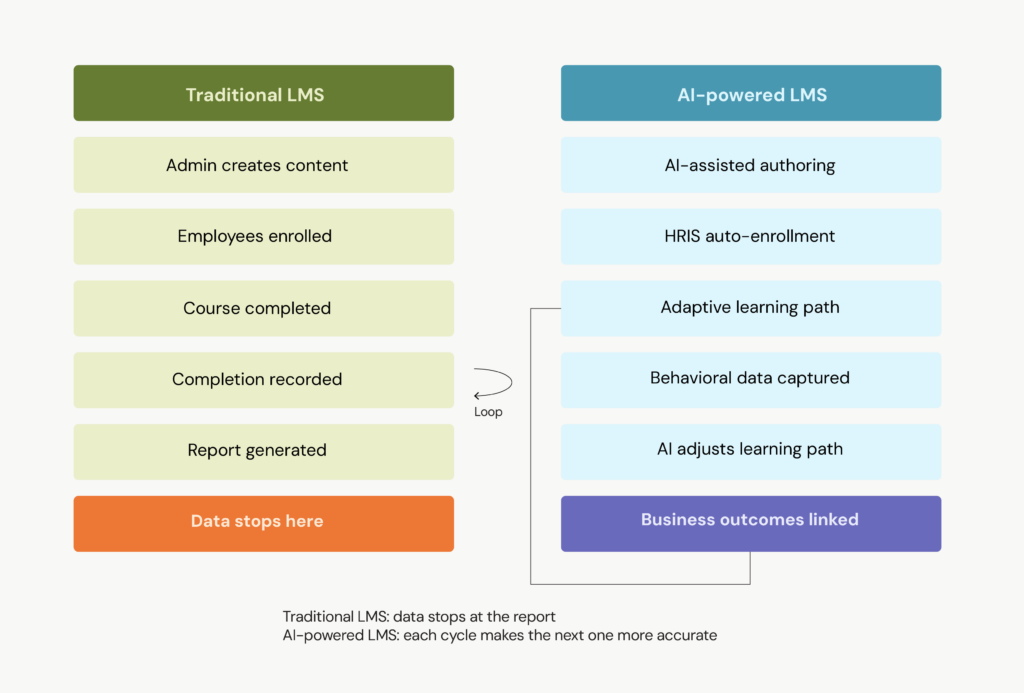
An AI-powered LMS does all of that, but adds an intelligence layer that changes what happens with the data. Rather than logging that an employee completed a course, it tracks how they moved through it.
Where they slowed down, what they skipped, how they scored on specific question types, and how that compares to peers. Over time, that behavioral data builds a picture of what each employee knows versus what they've simply been exposed to. Those are different things, and most traditional platforms can't tell them apart.
From there, the AI layer acts on what it learns. It adjusts the content an employee sees next based on where they're showing gaps. It identifies employees at risk of falling behind before a manager notices. It also takes over the administrative tasks that require manual tracking: sending certification renewal nudges, enrolling new hires based on their role, and surfacing content when performance data flags a skill gap.
What's more important, the content creation side has changed. Older platforms required L&D teams to build courses from scratch or purchase content libraries. AI-powered authoring tools generate course outlines in minutes, draft assessments, and adapt existing materials for different roles or skill levels. For enterprise teams managing training across large, distributed workforces, speed matters.
However, not every platform calling itself AI-powered has earned the label.
Some have added a recommendation engine and a chatbot and stopped there. The platforms worth evaluating have AI embedded in the core product loop: collecting behavioral data, adjusting learning paths, measuring training outcomes, and feeding that information into the next training cycle.
How AI is transforming corporate training outcomes through intelligence and automation
For most of their history, corporate LMS did three things: store content, assign it to employees, and record who completed the course. That was enough when the goal was documentation. It stopped being enough when companies started asking whether any of the training was improving performance.
AI shifts the platform from a record-keeper to something closer to a coach. When a team's compliance scores start slipping, an AI-powered LMS catches that pattern before a manager does. It surfaces relevant content, adjusts the learning path, and flags the issue before it becomes a performance problem.
On top of that, the administrative side of running a training program gets lighter. A 2024 Gartner study found that companies using AI-powered LMS platforms cut training administration time by 30%. That's time L&D teams can spend on the harder questions: whether training is landing, and what needs to change if it isn't.
Beyond that, the analytics layer has improved. Traditional LMS reporting told you what happened: who enrolled, who completed, who scored what. AI-powered reporting tells you what's likely to happen next.
Recent research found that 68% of organizations using real-time analytics improved their training ROI within the first year. That's because they finally had a clear line of sight between what employees were doing on the platform and how that translated into their work.
That said, the gap between what AI-powered LMS platforms promise and what they deliver deserves more clarity. Platforms fail because the behavioral data feeding the personalization engine was never properly collected in the first place.
A lot of platforms that promise AI personalization are simply running smarter recommendations. What you get is a slightly better version of "people in your role usually watch this next." Real personalization, the kind that adjusts based on what a specific employee is struggling with, requires behavioral data that most organizations haven't built the infrastructure to collect.
What features should top LMS systems have?
The feature lists on most corporate LMS software vendor pages are long by design. More checkboxes create the appearance of more value. In practice, enterprise teams use a fraction of what they pay for, and the features that matter most are rarely the ones that lead the demo.
Here's what matters when you're evaluating platforms for enterprise use.
Adaptive learning and personalized pathways
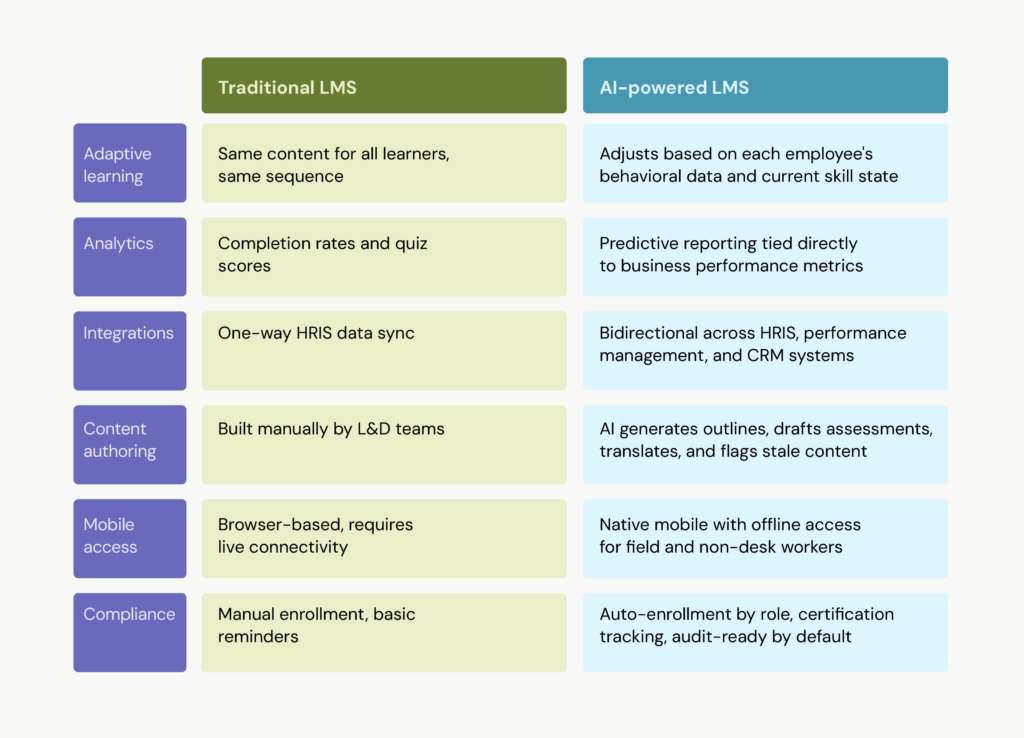
This is the feature that separates AI-powered platforms from traditional ones in practice. A platform with genuine adaptive learning adjusts what an employee sees next based on how they're performing, instead of job titles on their HR profile. Two people with the same role title can have very different skill states, and a curriculum that treats them identically is going to miss one of them.
Look for platforms that can demonstrate how their adaptive logic works, what data it runs on, and how quickly it responds to new behavioral signals.
Analytics that connect to business outcomes
Completion dashboards are table stakes. What enterprise L&D teams need is reporting that connects training activity to the business metrics that executives track: sales performance, error rates, compliance incidents, and customer satisfaction scores.
The corporate training and development segment of the LMS market is growing at 17.9% CAGR, faster than any other LMS application area. A part of what's driving that growth is buyer demand for analytics that justify the training spend at the board level, not just the L&D function level.
If a vendor can't show you how their reporting connects learning data to operational performance, that's a meaningful gap.
HRIS and enterprise system integration
An LMS that doesn't talk to the rest of the enterprise tech stack is an island. Training data needs to flow into the HRIS, so managers can see skill development alongside performance reviews. It needs to connect to the performance management system so that gaps identified in reviews can trigger learning interventions automatically.
For organizations in regulated industries, integration with compliance-tracking systems is what turns the LMS from a training tool into an audit-ready risk-management asset.
AI-assisted content authoring
Enterprise L&D teams spend an outsized share of their time creating and updating content. AI authoring tools can draft course structures, generate assessments, translate materials into multiple languages, and flag content that’s gone stale as role requirements change.
The real value is consistency: when AI handles the content structure, the quality of training materials stops depending on who built them.
Mobile access and offline learning
Distributed workforces don't learn at desks. Field teams, manufacturing employees, retail staff, and remote workers all need to access training on devices, in environments where connectivity isn't guaranteed. A platform that works well in a browser but poorly on mobile, or that requires a live connection to function, is going to have adoption problems the moment it leaves the office.
Mobile-first design and offline capability are now prerequisites for enterprise deployments.
Automated compliance tracking and certification workflows
For most enterprise buyers, compliance training is the non-negotiable core of the LMS investment. The platform needs to:
- Auto-enroll employees in mandatory training based on role, location, and regulatory requirements
- Track certification expiry dates and send renewal reminders before deadlines, not after
- Generate audit-ready reports on demand
- Do all the above without manual intervention from the L&D team, because at enterprise scale, manual compliance tracking is where things fall through the cracks.
AI LMS vs off-the-shelf platforms
Buying a platform feels like the lower-risk move. There's a vendor behind it, a support team, a roadmap, and a contract someone else's legal team has reviewed. That logic holds for many organizations.
But there's a category of enterprise training problem that off-the-shelf platforms consistently fail to solve, and recognizing it early saves a significant amount of budget.
Integration complexity
Standard LMS platforms are built to connect with common HRIS systems through APIs. When a tech stack is non-standard or relies on proprietary systems without clean API access, fitting a packaged platform into it often costs more than building something designed for it.
Regulatory complexity
A healthcare organization training staff on changing protocols needs an LMS that can update content, collect audit-ready compliance evidence, and restrict data access to comply with regulatory standards. A platform that works well for a tech company's onboarding program is often a poor fit where the regulatory stakes are high, and the data governance requirements are specific.
Personalization complexity
Off-the-shelf AI personalization is built around the most common use cases across a vendor's entire customer base. For organizations with highly specific role structures, unusual competency models, or training outcomes that tie to proprietary business metrics, that generalized logic stops working fast. A custom-built AI layer trained on an organization's performance data can deliver personalization that a packaged platform can't match.
That said, custom isn't the right answer for every organization. If your training needs are standard, your tech stack integrates cleanly with major platforms.
Your compliance requirements don't exceed what established vendors already support: an off-the-shelf platform that will serve you well and get you live faster than a custom build. The decision comes down to one question: how far outside standard use cases does your organization sit?
What to look for when choosing a corporate LMS
Choosing the right LMS is less about the longest feature list and more about finding the one that fits your organization’s operating model.
What does the total cost of ownership look like?
The license fee is rarely the biggest number. Implementation, configuration, training, integration work, and ongoing support add up fast, and vendors vary considerably in how transparent they are about those downstream costs upfront.
Before comparing platforms on price per seat, get a realistic picture of what it costs to get the platform live and connected to your existing systems. Then ask what it costs to add users, expand to new regions, or integrate with a system you're planning to adopt in the next 18 months.
How does the vendor define AI?
This question makes vendors uncomfortable, which is exactly why it's worth asking. AI means different things on different platforms. For some, it's a recommendation engine that surfaces content based on completion history. For others, it's a genuine adaptive layer that responds to behavioral signals in real time and adjusts learning paths accordingly.
Ask vendors to show you, in a live environment rather than a slide deck, what the AI does when a specific learner underperforms on a specific task. If they can't show that clearly, the AI capability is probably more marketing than product.
How deep do the integrations go?
Platform vendors will tell you they integrate with your HRIS. The follow-up question is what integration does. Does it push completion data into the HR system, or does it pull performance data out of it to inform learning paths? The first is data export. The second is where the real value of a connected corporate training LMS sits.
The same applies to performance management systems, CRM platforms for sales training, and any operational system that measures job performance. An LMS that connects to your business data bidirectionally is a fundamentally different asset than one that only writes to it.
What does the data governance model look like?
Enterprise buyers are asking this earlier in the procurement process than they used to, and for good reason. An AI-powered LMS collects detailed behavioral data about every employee who uses it. That data needs to live somewhere, be accessible to the right people, be protected from the wrong ones, and comply with the regulatory requirements that apply to your industry and geography.
Ask vendors where learner data is stored, who can access it, how long it's retained, and what happens to it if you end the contract. If those answers require a follow-up call with their legal team, factor that into your confidence in the vendor.
What does implementation and support involve?
A platform that takes 9 months to implement and requires a dedicated vendor consultant to configure every new learning path will create internal dependencies and frustration. Before signing, get specifics on the implementation timeline, what your team is responsible for versus what the vendor handles, and what ongoing support looks like after go-live.
Before signing, run a readiness evaluation. The organizations with the best LMS investments are the ones that understood what implementation required before they committed.
Can the vendor show you outcomes, not just features?
Ask for case studies from organizations in your industry with a similar workforce size and training complexity. Ask what those customers measured before and after deployment, and what changed.
A vendor that can point to specific, measurable improvements in compliance rates, onboarding time, or skill assessment scores in an environment like yours has done so successfully before. One that redirects every outcome question back to platform features probably hasn't.
The LMS decision is a data decision
Enterprise organizations have been buying LMS for decades. The core disappointment has stayed consistent: the platform gets implemented, completion rates go up, and no one can connect any of it to how people perform on the job. What AI does is give organizations the tools to fix it themselves. But only if the data infrastructure, integration depth, and measurement discipline are in place before the platform goes live.
The best LMS for any enterprise is the one that connects training signals to business outcomes in a way that's visible to the people making decisions about the workforce. That might be an off-the-shelf platform with strong integration capabilities. For organizations with complex environments, regulated data requirements, or training outcomes that tie proprietary business metrics, it might mean building something designed specifically for how they operate.
Either way, the platform is only as good as what it's built on. Getting the data architecture, system integrations, and competency framework right before selecting or building a platform is what separates an LMS that delivers measurable value from one that generates a completion report and not much else. Svitla AI works with teams at exactly that stage, helping organizations build the technical foundation that makes AI-powered learning investment pay off rather than stall.
FAQ
What is the ROI of adopting an AI-powered LMS?
ROI from an AI-powered LMS comes from two directions: cost reduction and performance improvement. On the cost side, AI automation reduces the administrative overhead of running a training program at scale, from enrollment management and reminder sending to content updates and compliance tracking. On the performance side, the returns depend on what the organization was measuring before deployment and how the platform’s outputs connect to business outcomes.
What are the best LMS platforms with AI?
Some of the platforms with the strongest AI capabilities for enterprise corporate training in 2026 include Docebo, which offers an AI suite covering content recommendations, skills mapping, and agentic automation for compliance and upskilling workflows. Cornerstone OnDemand combines AI-driven learning pathways with talent mobility and intelligence.
What is the most used LMS?
Canvas holds the largest share of the North American market. In corporate settings, the landscape is more fragmented, with Cornerstone OnDemand, SAP SuccessFactors Learning, and Workday Learning among the most widely deployed at enterprise scale. The most widely deployed platforms are large, established systems built for a broad range of use cases. Organizations with specific integration requirements, regulated data environments, or training outcomes often find that the most used platform isn’t the best LMS software for them.
What is the most affordable LMS?
For enterprise corporate training, “most affordable” depends on what is included in the comparison. Platforms like Moodle offer open-source options with low license costs, but implementation, hosting, customization, and support costs can add up quickly without a vendor managing them. Among commercial platforms, TalentLMS and iSpring Learn offer transparent, competitive pricing for organizations that don’t need deep enterprise integration.
What if my learners are not tech-savvy?
The practical requirements for deploying to a less tech-savvy workforce start with interface simplicity: the learner-facing side of the platform should require no training to navigate. Beyond that, mobile accessibility matters because employees who aren’t comfortable with desktop software are often more comfortable with apps they access the same way they access everything else on their phones. Offline capability matters for workers who aren’t desk-based.
Organizations that phase deployment tend to start with one high-value use case employees can immediately see the benefit of, build internal champions before rolling out broadly, and see better adoption as a result.