
Article summary: This article explores how AI-driven personalization is transforming corporate training, outlines the key drivers behind enterprise AI investments, details the evolution of learning platforms, and shares actionable insights to build a competitive EdTech solution in this growing market.
A training manager may see everything they think they need from the corporate EdTech platform at the end of the quarter: high completion rates, strong quiz averages, and a clean audit trail. However, when the Chief Risk Officer wonders how training impacts compliance, the dashboard only shows completions, a metric that tells you nothing about actual behavior.
Completion-based training assumes everyone who enrolls needs the same content, at the same time, in the same sequence. It doesn't account for what each employee already knows, where performance breaks down, or what kind of reinforcement a specific role requires. Generic training at scale was never designed to change individual behavior. It was built to simply document that training happened.
Learning & Development (L&D) teams are turning to AI to close the personalization divide. The market is focusing on tailored training for each employee’s needs and performance signals rather than following a generic learning path. The AI-powered corporate training market is expected to reach $7.49 billion in 2026, and grow to $18.19 billion by 2031 at a 19.43% CAGR.
In this article, we explore the EdTech corporate learning market, identifying where the growth numbers come from, what's driving AI investment, how platforms are evolving, and what it takes to build for this market in 2026.
Corporate training is a sub-market within the broader EdTech sector, with its own buyer behavior, procurement cycles, and a more direct relationship to ROI.
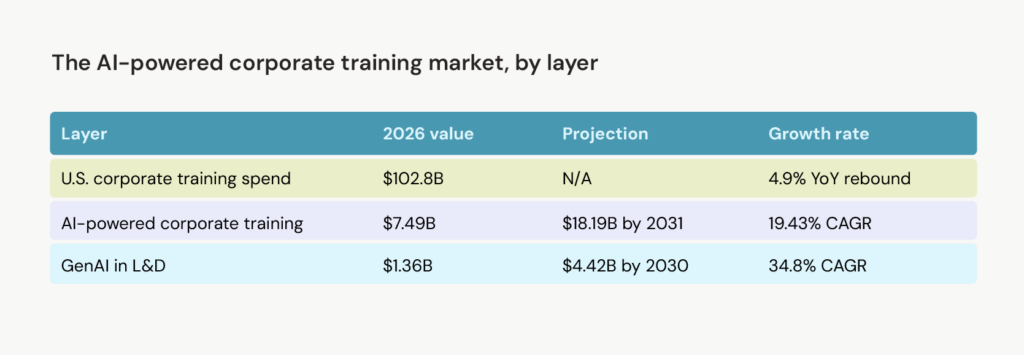
Training spends at large companies fell from $13.3 million to $11.7 million per organization, while per-learner costs reached a five-year high. Enterprises are investing more per person while spending less overall, training fewer people more effectively rather than mass learning.
The same pattern shows up in how the three education technology EdTech market layers grow: each one outpaces the one below it. Institutions are investing in AI to address what traditional training couldn't provide: a way to measure whether learning is working.
What is driving AI investment in corporate training?
Skill gaps are driving AI investment in corporate training. The World Economic Forum's Future of Jobs Report 2025 projects that 39% of workers' current skills will be outdated by 2030. Based on employer projections across industries, 59% of the global workforce will need retraining within that window.
Those figures come from employer surveys about which roles are being replaced, retooled, or created by automation. No two employees need the same thing. That's the case for personalization, not just more training.
Yet the corporate response has been slow. Fewer than 40% of companies have a clear reskilling strategy in place.
That mismatch between the scale of the problem and the organizational capacity to address it is where AI-powered learning platforms are positioning themselves. AI-powered personalization is what makes a reskilling strategy specific enough to work. It can route the right training to the right employee based on their performance data, not just their job title or enrollment date. Without that, a reskilling strategy is just a content calendar with ambitions.
Beyond that, economic pressure on L&D teams to justify budgets has intensified. Enterprise buyers now demand evidence of learning transfer: whether employee practice in training leads to measurable performance improvement. Traditional LMS platforms manage content delivery and track completions but aren't built to personalize. They don't identify each employee's needs or adjust training paths.
The makeup of L&D teams is changing, too. Content creation, which once kept large teams occupied, is now largely AI-generated. That frees people managing training to focus on the harder question: whether any of it is working. That harder question is also a personalization one. L&D teams are being asked whether each person's training worked. That is a different standard, and one that generic content delivery was never built to meet.
How is AI reshaping corporate learning platforms?
Personalization is the defining thread in the evolution of corporate learning platforms and its hardest unsolved problem.
First-generation corporate EdTech was the learning management system (LMS): a content warehouse with a completion tracker. You uploaded a course, enrolled employees, and generated a report showing who finished.
The LMS solved a real problem: organizing and delivering training at scale, but it measured activity rather than outcome. For organizations where the regulatory requirement was completion, that was enough. For companies that needed to change behavior on the job, a completion report didn't tell much.
The learning experience platform (LXP) was the next step. LMS platforms were designed for admin needs, while LXPs were built around learners. This included content aggregation from multiple sources, personalized playlists, social learning features, and skill tagging.
The transformation meant that employees don't learn the way institutional programs assume they would. People learn in fragments, across channels, pulled by job needs rather than pushed by scheduled training. LXPs tried to accommodate that. While many succeeded in making learning more accessible, only a few made it measurably better.
Agentic AI moves from recommendation to action. Unlike LXP personalization, which recommends modules based on completed ones, agentic AI can identify when an employee is underperforming, create an intervention program for optimal learning, and update the system on the employee’s skill status. The platform continuously closes skill gaps without waiting for a manager or the L&D team to intervene.
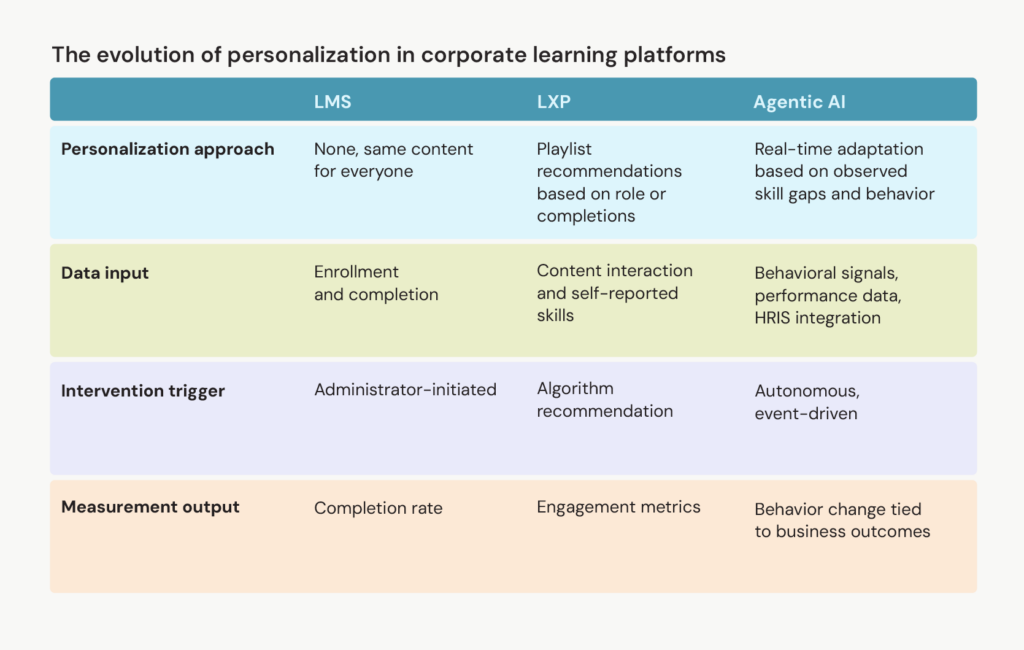
Here's the catch: the agentic category is still in its early stages. Most platforms that are currently marketing agentic capabilities are running more complex recommendation logic than prior generations.
Still, they are not yet operating with the kind of autonomous, multi-step reasoning the label implies. Creating an agentic learning system that can track learners in real-time, respond to their needs instantly, and continually improve itself is harder than building a basic LXP. If you start with the wrong setup, it becomes expensive and difficult to achieve agentic learning.
How does AI-driven personalization transform enterprise learning outcomes?
Personalization in enterprise EdTech can mean simple things, like reordering lessons based on someone’s progress. It can also mean creating new scenarios for each person based on their specific role, manager feedback, and performance data.
Research cited by McKinsey and WhatFix on AI-powered learning points to a 57% increase in efficiency, a 30% gain in engagement, and a 25% improvement in learning outcomes. These averages are based on deployments that varied widely in quality and in the measurement of outcomes.
AI personalization outperforms generic training, but only when the data behind it reflects what people are genuinely doing on the job. Job titles, outdated profiles, and self-reported skills don't cut it. The output is only as good as the input.
The platforms with the strongest personalization results share one thing: they knew exactly what they were trying to change before they built anything. For example, a financial firm that ties AI training in credit risk assessment to portfolio performance gets different results than one that labels adaptive content playlists as personalization.
To compete in the evolving corporate EdTech market, now is the time to evaluate your organization’s approach to personalization. Assess your current learning outcomes and identify where AI-driven strategies can deliver measurable impact. Start rethinking your EdTech solutions for the needs and opportunities of 2026 and beyond.
Also, enterprises need data infrastructure that most L&D teams haven’t built yet. You need response patterns: how long someone took on a task, where they got stuck, and how often they retried. Those are the kinds of behavioral signals that make personalization work. That data must flow into the platform fast enough to shape the next interaction, not just log the last one. It's an engineering challenge more so than a learning one.
What are the barriers to AI adoption in corporate EdTech?
Today, AI platforms can do more than most organizations are equipped to use. Low levels of AI adoption can’t be blamed on technology. The real blockers turn to be organizational:
- How L&D teams measure outcomes
- The data quality those platforms must work with
- The trust managers and compliance teams place in AI-generated assessments
- The data security thresholds vendors are expected to meet.
Get those conditions wrong and the AI layer, however capable, won't deliver.
Lack of internal expertise
Deloitte found that 95% of L&D teams don't link learning programs to business goals, and 69% can't connect learning outcomes to business results. Eventually, most organizations lack both AI readiness and proper measurement discipline. Deploying AI without solid measurement doesn’t fix the problem and can make invalid outputs look valid. The key takeaway is that without solid measurement, AI will not drive the business impact organizations need.
Data infrastructure
AI learning platforms ingest behavioral signals: what content a learner interacted with, where attention dropped, what was skipped, what was retried, and how long specific tasks took. Moving that data cleanly through a corporate LMS, a learner record store, and into a personalization engine requires integrations that most enterprise IT environments were never built to handle.
Change management
L&D teams must understand what AI is doing with learner data, explain it to compliance, justify it to legal, and present it to managers who need to trust AI-generated team assessments. If L&D lacks trust in the platform, it won’t be used as intended, regardless of the model’s capabilities. In a nutshell, change management and stakeholder trust are critical for successful AI adoption.
Data security
Data security is now the first question enterprise procurement teams raise, before pricing, features, or anything else. AI training platforms ingest sensitive behavioral data and use proprietary content to fine-tune models or create training scenarios.
Enterprise buyers are increasingly requiring SOC 2 Type II certification, data-residency policies, and contractual commitments regarding how employee data is used beyond the platform. Vendors that can't meet those requirements are losing deals, regardless of their platform's personalization capabilities.
The LXP adoption wave from 2018 to 2021 illustrates what happens when these barriers aren’t addressed. Companies piloted platforms with high completion rates, but managers’ skill assessments didn’t align with AI-generated profiles. Platforms built skill profiles from content interaction, while managers relied on job observation. Many deployments were rolled back when the ROI was evaluated, as the behavioral signals the systems generated lacked direction.
What are the must-have elements of building an AI-native corporate training platform?
An AI-native corporate training platform must be built around a clear definition of what "better" looks like for the learner, one that connects to job performance rather than generic course topics. For example, a sales training platform that doesn't know what good sales behavior looks like can't train toward it or evaluate whether its interventions worked.
Once that foundation is in place, the next key step is the data layer. The most competitive asset in corporate EdTech is behavioral data collected over time from a learner in a specific performance context. The AI model on top of it can be retrained or replaced, but the data can't. That behavioral data enables more personalization, improves skill inference accuracy, and reinforces the connection between training and performance.
Equally important is how the platform positions itself to the business it serves. As Johann Beukes, Chief AI Officer at Svitla Systems, highlighted: "AI should strengthen the core business. Not compete with it."
An AI-training platform that sits outside the enterprise tech stack will underperform regardless of its capabilities. For example, an AI training platform that doesn't connect to the HRIS, the performance management system, or the business metrics that define job success is operating in the dark. The skill signals the platform generates need to be visible in the systems where managers make decisions about people.
If those connections are missing, L&D insights remain isolated, making it harder each budget cycle to justify the training investment to the broader business, as value cannot be demonstrated in broader business systems.
Personalization is a promise that learning platforms can't keep on their own
The corporate training market is saturated with content but lacks proof of effectiveness. L&D teams that treat measurement as a core requirement, clearly define better performance in observable terms, and drive AI personalization using a continuous feedback loop tied to actual job outcomes are building lasting solutions now.
Most organizations underestimate that the answer relies heavily on decisions made before deploying AI. The competency model, data architecture, and integration of training signals with business outcomes are what determine success, not the AI model itself.
Svitla Systems integrates AI into every part of our work. Our CTO leads structured AI training across every department, grounding teams in practical application. We track how AI changes the way work gets done, from which manual processes it speeds up to where human judgment still matters more.
Building from this experience, we see how organizations in the corporate EdTech space are wrestling with similar questions about AI implementation and measurable outcomes, challenges we have addressed in our own work.
On top of that, our digital transformation services are built on this foundational layer: data architecture, machine learning infrastructure, and measurement frameworks that make every AI training investment defensible each budget cycle. AI gets all the attention, but only a strong data foundation ensures real results.
Frequently asked questions
What is corporate EdTech?
Corporate EdTech covers the platforms, tools, and infrastructure companies use to train employees, close skill gaps, and build workforce capability at scale. The category spans learning management systems (LMS) for compliance and onboarding delivery, learning experience platforms (LXP) that personalize content pathways based on learner behavior, and AI-powered tools that adapt training in real-time based on performance signals.
How do you implement AI ethics in EdTech?
Responsible AI in corporate L&D starts with a specific data question: what information is the platform collecting about employees, how long is it retained, and who can access it? Corporate AI learning platforms build detailed behavioral profiles over time, and that data is both powerful for personalization and sensitive enough to require governance from the start. The practical requirements cover data minimization, transparency, and bias auditing to ensure that AI models trained on senior-employee performance data don't disadvantage newer or lower-tenure staff.
What EdTech tools support personalized learning in enterprise settings?
Personalization capabilities in enterprise settings span several tool categories. Skills intelligence platforms like Workday Skills Cloud, SAP SuccessFactors, and Eightfold AI identify skill gaps against role requirements before they become performance problems. On the delivery side, Degreed, Cornerstone OnDemand, and 360Learning build adaptive pathways from aggregated content sources. Microsoft Viva Learning embeds recommendations directly into the workflow. For sales and service roles, Allego and Brainshark add AI coaching and performance simulation.
How do companies choose the right EdTech tool?
The most useful starting point is a clearly defined business problem rather than a platform capability audit. Define the outcome first, work backward to the data required to measure it, and evaluate platforms on their ability to collect that data, run personalization models against it, and surface actionable signals for managers.
What are the latest innovations in corporate EdTech tools?
The clearest shift in 2026 procurement is the move away from content libraries as the primary value proposition. Buyers are increasingly evaluating platforms on what they can infer and act on, rather than on what they can serve. Alongside that, skills intelligence has matured into a standalone product category, with platforms now mapping employee capabilities against live labor-market data rather than static job descriptions, giving L&D teams a more current picture of where gaps are opening. On the personalization side, AI coaching tools for sales and service roles have moved from scripted simulations to adaptive scenarios that adjust based on how learners respond, making practice environments closer to real job conditions than previous versions of learning content.
How do you start building a corporate EdTech company?
Building a corporate EdTech company starts with a market choice that shapes every decision downstream. Corporate training buyers have shorter procurement cycles and clearer budget lines than institutional buyers. Still, they carry direct ROI expectations: if personalized training doesn't produce measurable behavior change, the renewal conversation gets difficult. Define what better performance looks like for a specific buyer segment, build the data model before the product, and treat the behavioral data layer as the primary asset rather than the AI model on top of it. Compliance and data security need to be built into the architecture from day one, since employee data governance requirements vary by industry and jurisdiction, and retrofitting a data model to meet security standards is one of the most common sources of delayed contract closings in this market.
See Svitla AI solutions and services for a deeper look at how agentic AI is reshaping what it means to build for corporate learning in practice.
FAQ
What is corporate EdTech?
Corporate EdTech covers the platforms, tools, and infrastructure companies use to train employees, close skill gaps, and build workforce capability at scale. The category spans learning management systems (LMS) for compliance and onboarding delivery, learning experience platforms (LXP) that personalize content pathways based on learner behavior, and AI-powered tools that adapt training in real-time based on performance signals.
How do you implement AI ethics in EdTech?
Responsible AI in corporate L&D starts with a specific data question: what information is the platform collecting about employees, how long is it retained, and who can access it? Corporate AI learning platforms build detailed behavioral profiles over time, and that data is both powerful for personalization and sensitive enough to require governance from the start. The practical requirements cover data minimization, transparency, and bias auditing to ensure that AI models trained on senior-employee performance data don’t disadvantage newer or lower-tenure staff.
What EdTech tools support personalized learning in enterprise settings?
Personalization capabilities in enterprise settings span several tool categories. Skills intelligence platforms like Workday Skills Cloud, SAP SuccessFactors, and Eightfold AI identify skill gaps against role requirements before they become performance problems. On the delivery side, Degreed, Cornerstone OnDemand, and 360Learning build adaptive pathways from aggregated content sources. Microsoft Viva Learning embeds recommendations directly into the workflow. For sales and service roles, Allego and Brainshark add AI coaching and performance simulation.
How do companies choose the right EdTech tool?
The most useful starting point is a clearly defined business problem rather than a platform capability audit. Define the outcome first, work backward to the data required to measure it, and evaluate platforms on their ability to collect that data, run personalization models against it, and surface actionable signals for managers.
What are the latest innovations in corporate EdTech tools?
The clearest shift in 2026 procurement is the move away from content libraries as the primary value proposition. Buyers are increasingly evaluating platforms on what they can infer and act on, rather than on what they can serve. Alongside that, skills intelligence has matured into a standalone product category, with platforms now mapping employee capabilities against live labor-market data rather than static job descriptions, giving L&D teams a more current picture of where gaps are opening. On the personalization side, AI coaching tools for sales and service roles have moved from scripted simulations to adaptive scenarios that adjust based on how learners respond, making practice environments closer to real job conditions than previous versions of learning content.
How do you start building a corporate EdTech company?
Building a corporate EdTech company starts with a market choice that shapes every decision downstream. Corporate training buyers have shorter procurement cycles and clearer budget lines than institutional buyers. Still, they carry direct ROI expectations: if personalized training doesn’t produce measurable behavior change, the renewal conversation gets difficult. Define what better performance looks like for a specific buyer segment, build the data model before the product, and treat the behavioral data layer as the primary asset rather than the AI model on top of it. Compliance and data security need to be built into the architecture from day one, since employee data governance requirements vary by industry and jurisdiction, and retrofitting a data model to meet security standards is one of the most common sources of delayed contract closings in this market. See Svitla AI solutions and services for a deeper look at how agentic AI is reshaping what it means to build for corporate learning in practice.