Article summary: AI regulatory compliance is now a quickly growing industry in its own right. This article explores how AI compliance standards are transforming healthcare, financial services, supply chain management, logistics, manufacturing, and insurance. It also covers enterprise LLM regulatory compliance requirements, responsible AI in the enterprise, and the AI compliance frameworks that organizations need to build.
Three years ago, AI compliance was a line item buried in legal budgets, a paragraph in a vendor contract, and a topic for quarterly risk reviews handled by whoever happened to be in the room. Today, it has its own market, its own vendors, its own job titles, and its own enforcement infrastructure.
The AI governance market reached $2.2 billion in 2025 and is projected to reach $11 billion by 2036. In addition, AI governance tools are growing 25 to 30% annually, while consulting firms expect demand for AI risk services to grow 40% in 2026. Even the talent market faces the same growth: AI compliance experts now earn salaries exceeding $150,000 in the US.
That growth isn’t happening in a vacuum as it has a hard deadline driving it. On August 2, 2026, the EU AI Act's full high-risk provisions will come into effect, covering AI applications in hiring, credit decisions, medical diagnosis, and critical infrastructure, among others.
Penalties can reach up to €35 million (approximately $38 million) or 7% of global annual turnover for serious violations. Back in 2025, before the Act's largest penalties had even landed, AI compliance failures already cost organizations $4.4 billion globally.
Compliance infrastructure, when built properly, pays for itself. Organizations using AI and automation in security operations report $1.9 million lower data breach costs and 80 days faster identification and containment of breaches. Companies with a structured AI rollout plan are 2.7x more likely to achieve ROI within the first 12 months.
In this article, we cover the regulatory landscape organizations face in 2026, including how compliance works across highly regulated industries. Also, we go deeper into what compliance looks like in practice for teams building AI.
Why is AI compliance becoming its own industry?
The AI compliance is a must-have because organizations deployed AI far faster than they built rules to govern it. Most organizations deployed AI systems before building structured risk frameworks. That gap is what created an entirely new product category: AI compliance platforms. There are three forces driving the need for AI compliance platforms:
Regulation shifted from voluntary to mandatory
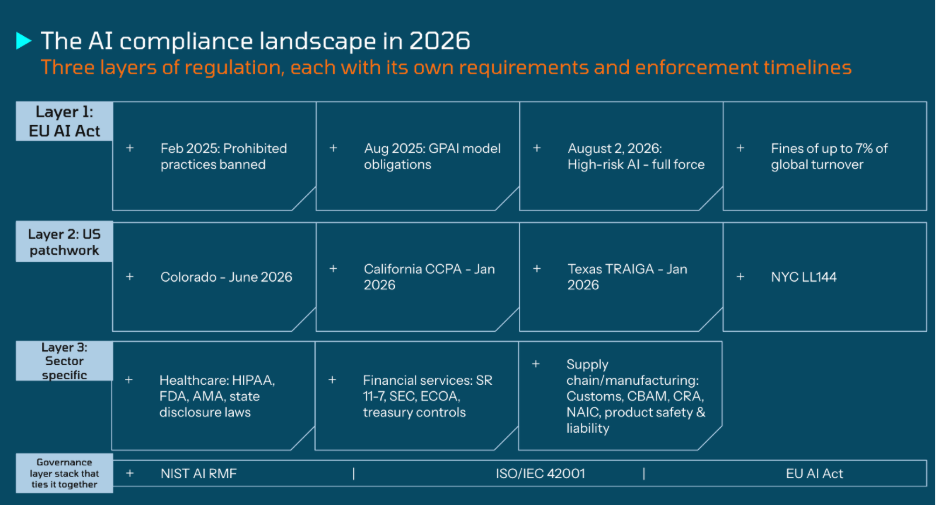
For years, AI ethics guidelines were voluntary: organizations followed them if they wanted to. Then, the EU AI Act entered into force in stages: enforceable prohibitions in February 2025, general-purpose AI obligations in August 2025, and full high-risk provisions in August 2026. Penalties for violations exceed even GDPR fines. By 2030, AI regulation is expected to apply across 75% of the world's economies. 77% of companies now rank AI compliance as a top priority: the cost of ignoring it has made the decision easy.
The cost of non-compliance became painfully evident
Regulatory fines across banking, healthcare, and technology exceeded $12 billion in 2024 alone. AI misuse incidents are linked to 15 to 20% customer churn annually. Non-compliance can force organizations to suspend AI systems entirely, disrupting up to 75% of their operations. Over 72% of public companies now mention AI risks in their Securities and Exchange Commission (SEC) annual filings because boards and investors started asking questions.
Deployment kept outpacing governance
As AI exposure grew, the absence of infrastructure to manage it became impossible to ignore. Only 4% of organizations had a dedicated team responsible for AI oversight. And 63% of organizations that experienced AI-related breaches either had no governance policy or were still developing one when the breach happened.
What does the regulatory landscape look like in 2026?
In 2026, there's still no single rulebook for AI compliance. And for organizations deploying AI across countries, industries, or use cases, that ambiguity is a compliance risk. While the EU has a single binding framework, the US has no federal AI law – instead, 1,999 AI bills have been introduced across 50 states.
Sector-specific agencies (FDA, SEC, OCC, EEOC, FTC) apply authority to AI in the domains they govern. And the AI compliance standards that govern a healthcare AI system, a financial trading algorithm, and a supply chain routing tool are almost entirely different from one another.
The EU AI Act
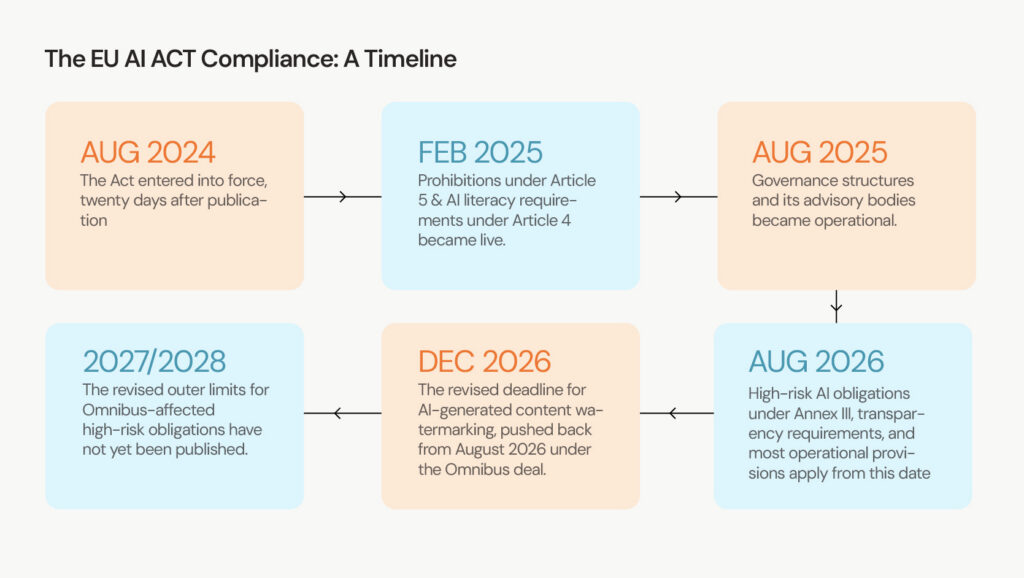
The EU AI Act is the world's first cross-sector law. It classifies AI systems into four risk tiers:
- Unacceptable risk systems (social scoring, manipulative AI targeting vulnerabilities) are banned outright
- High-risk systems (used in hiring, credit decisions, medical diagnosis, critical infrastructure, law enforcement, and education) face the strictest requirements: risk management documentation, training data governance, continuous monitoring, human oversight mechanisms, and registration in EU databases
- Limited-risk systems like chatbots must disclose that users are interacting with AI.
- Minimal-risk systems, such as spam filters or AI video games face no specific requirements
Today, around 35% of enterprise AI systems in the EU are classified as high-risk, accounting for the bulk of compliance investment across the continent. Large enterprises spend approximately $1 million annually on AI Act compliance programs.
The US patchwork
The United States has no equivalent to the EU AI Act. Instead, compliance is shaped by a patchwork of state laws, federal agency guidance, and existing regulations stretched to cover AI.
In March 2026, the White House released its National Policy Framework for Artificial Intelligence. It recommends federal preemption of state AI laws that impose "undue burdens," and establishes an AI Litigation Task Force within the Department of Justice to challenge state laws on constitutional grounds. However, until federal legislation is passed, states are setting the rules.
Colorado's AI Act, taking effect on June 30, 2026, will cover high-risk AI applications in healthcare, insurance, employment, and financial services, requiring documentation, impact assessments, and disclosures. An update to California's Consumer Privacy Act (CCPA), effective January 1, 2026, added risk assessment obligations. Texas enacted the Responsible AI Governance Act on the same date, while NYC Local Law 144 requires bias audits for AI tools used in hiring decisions.
For organizations deploying AI across multiple states, the result is overlapping and sometimes conflicting requirements with no single authority to resolve issues.
One landscape, many rulebooks
What makes the overall AI compliance landscape difficult is that there are too many layers that compound.
A healthcare AI system faces FDA authorization, HIPAA, state-level disclosure requirements, and professional standards simultaneously. A financial trading algorithm faces SR 11-7, SEC disclosure requirements, fair lending law, and the EU AI Act if it touches European markets. Supply chain AI faces customs authorities, import/export regulations, and safety standards that change with every jurisdiction goods pass through.
How does AI compliance work in healthcare?
Healthcare combines compliance layers that include federal authorization, data privacy law, state-level disclosure requirements, and professional standards, all applying at the same time. In practice, that means a single AI deployment can trigger obligations from the FDA, HIPAA, and state legislatures simultaneously.
The AI healthcare compliance landscape has three pillars:
FDA authorization
By the end of 2025, the FDA has authorized 1,451 AI-enabled medical devices, including 295 new clearances in that year alone. Radiology remains the primary focus, accounting for 76% of all authorizations, followed by cardiovascular applications at approximately 9% and neurology at 5%. In March 2026 alone, the FDA cleared 24 AI and machine learning applications, roughly one every 31 hours.
Most AI devices are cleared through the FDA's 510(k) pathway, which requires proving that the AI is "substantially equivalent" to a previously cleared device. Beyond that, the FDA is moving toward a Total Product Life Cycle (TPLC) approach that requires submissions to include model descriptions, bias analysis, and monitoring plans. For adaptive AI models, Predetermined Change Control Plans (PCCPs) manage model updates without requiring a full premarket review each time.
The pathway a system takes through the FDA determines what’s possible for clinical AI deployment. While diagnostic AI requires clearance, documentation tools typically do not unless they cross into diagnostic territory. However, as AI becomes more capable, these distinctions are blurring for agentic systems that do not fit neatly into current medical device categories.
HIPAA and data governance
HIPAA applies on top of FDA requirements to every AI system that handles protected health information (PHI). HIPAA's Privacy and Security Rules require covered entities (hospitals, insurers, and their partners) to conduct a risk analysis, ensure AI vendors sign Business Associate Agreements (BAAs), implement access controls, and maintain audit trails.
Large Language Models (LLMs) process, generate, and may retain PHI. And they often do so across vendor infrastructure that the covered entity has limited visibility into. While many AI systems limit the PHI they process, their architecture must still be verified and documented.
Regardless of the safeguards in place, the compliance obligation remains, and the penalties for falling short are severe. Federal civil fines can exceed $2 million annually, and criminal penalties for knowing violations reach up to 10 years in prison.
HIPAA compliance is also particularly complex for cloud-deployed AI. Organizations must verify the physical storage location of PHI, ensure data does not cross jurisdictional boundaries, and confirm that the cloud provider’s security controls meet HIPAA standards.
Responsible AI and clinical governance
Healthcare AI compliance is no longer something you do once and file away. Continuous monitoring is now the baseline expectation, driven by a clear reality: patient populations shift, regulations update, and the clinical context changes in ways the model wasn't trained on. A major development is the ARPA-H's ADVOCATE program, designed to create the first FDA-authorized agentic AI system for clinical care, embedded with a supervisory AI layer for safety and oversight.
Continuous governance means having automated monitoring of model performance across demographic groups, validation against clinical outcomes, audit trails for AI decisions, and accountability for AI-assisted clinical judgment.
The shift from periodic reviews to continuous monitoring reflects a hard lesson from early deployments: a model that performs well at launch can degrade quietly as patient populations change. And by the time a scheduled audit catches it, the clinical impact has already accumulated.
Only 35.7% of healthcare managers feel adequately prepared for EU AI Act compliance and 19.4% describe themselves as poorly prepared. The reality is that regulation moved faster than most organizations could build for. Closing the gap requires engineering support to build compliant data architectures, regulatory pathways, and monitoring systems that don’t depend on someone to run a quarterly check.
How does AI compliance work in financial services?
The financial services AI compliance environment is the most established of any sector, and paradoxically, the most volatile. Banking regulators have enforced model oversight, explainability, and audit requirements for over a decade, giving institutions a valuable head start. Despite that head start, 157 AI-related regulatory updates hit the sector in a single year, nearly double the previous volume.
This volatility means that while financial institutions lead the AI governance market, their programs are in a permanent state of catch-up. Their existing infrastructure is both an asset and a liability: they have the tools, but regulators expect more from them because of it.
Model risk management
Model Risk Management (MRM), the framework requiring any model used in financial decision-making to be validated, documented, and monitored, is the bedrock of AI compliance in finance.
In practice, any AI model involved in credit decisions, fraud assessment, trading, or customer recommendations must be independently validated before deployment, continuously monitored once live, and formally retired when replaced.
An outdated model that keeps influencing decisions is both a regulatory liability and a source of technical debt - reason enough to make decommissioning a formal step.
The main challenge for institutions with existing MRM programs is adapting governance designed for predictable statistical models (which behave the same way every time) to dynamic AI systems, such as LLMs, which learn, drift, and can produce different outputs for similar inputs.
AML, KYC, and fraud compliance
Anti-money laundering (AML) and Know Your Customer (KYC) are where AI compliance delivers the clearest financial value. AI systems monitor transaction patterns, flag suspicious activity, and verify customer identities far faster and more accurately than human analysts.
The power of AI in fraud detection also creates regulatory risk. A false positive that freezes a customer's account, or a false negative that allows a fraudulent transaction, both create liability. Regulators require financial institutions to show that the AI works, how it works, why it flagged a transaction, and what happens when it's wrong.
SEC and investment compliance
The SEC is enforcing disclosure and cracking down on "AI washing" - companies overstating their AI capabilities to investors. The agency examination priorities cover how investment advisors use AI across portfolio management, trading, marketing, and compliance.
For investment compliance, the requirements are clear, even if meeting them isn’t. The AI's role must be documented separately from how it's described in marketing materials, a distinction regulators are actively checking. AI-driven recommendations must meet the same fiduciary standards as human advisors. And every time an AI output influences an investment decision, the institution must be able to show exactly how, which requires logging infrastructure that captures the connection between model output and human action.
Across all financial AI systems, whether traditional models, machine learning classifiers, or LLMs, the compliance obligation is the same. If an AI contributed to a decision (e.g., credit scoring, fraud detection, advisory), the institution must be able to explain how the decision was reached, prove that the explanation is accurate, and show that a governed process was followed throughout.
How does AI compliance work in supply chain, logistics, and manufacturing?
Supply chain and manufacturing compliance is governed by international rules, including customs, trade, safety, and environmental regulations.
Trade and logistics compliance
The compliance obligations in trade and logistics share one consistent principle across jurisdictions: legal responsibility for customs declarations stays with the filer, not the AI system. Organizations must maintain records of the AI's inputs, confidence levels, and rationale for every decision, along with documentation of what a human reviewer did with that output.
One of the hardest challenges is the pace of regulatory change. Tariff schedules, sanctions lists, and trade channel requirements shift faster than most compliance programs are designed for, which is why continuous monitoring rather than periodic review is increasingly the baseline expectation.
In 2026, there are three new obligations worth paying attention to. The EU Carbon Border Adjustment Mechanism (CBAM) requires emissions data at the product level. The EU Deforestation Regulation (EUDR) requires lot-level traceability for covered commodities. The Cyber Resilience Act (CRA) requires manufacturers to build cybersecurity protections throughout the product’s lifecycle.
Manufacturing compliance
Manufacturing adds its own compliance requirements on top of trade and customs obligations. Most manufacturers deploying AI in production environments use human oversight and real-time monitoring as the baseline. The problem is that compliance readiness hasn’t kept pace with deployment speed.
Most production AI systems have never been stress-tested against failure scenarios as only 7% of manufacturers conduct adversarial testing or red teaming.
Third-party risk is the emerging blind spot. AI failures from suppliers, logistics partners, or vendors now create direct compliance exposure for manufacturers, something traditional supplier audits were never built to catch.
Insurance sector compliance
The business case for AI in insurance is strong (faster claims processing, more consistent risk assessment, lower manual review costs). That said, the compliance obligations that come with it mirror those in financial systems. If an AI system denies a claim or raises a premium, the insurer must explain why, with the same specificity a credit denial requires from a bank.
Regulators across every jurisdiction have converged on one principle: AI-only data is not an acceptable single source of truth for compliance. Human-reviewed, supplier-verified data must accompany every AI output that forms part of a compliance record. That applies whether the AI is classifying a shipment, assessing a property claim, or flagging a safety issue on a production line.
What does a practical AI compliance strategy look like?
Across every sector covered in this article, the answer is the same: compliance works when it's built into how AI systems are developed and deployed, not reviewed at the end.
All frameworks covered in this article work as a layered system. Today, most enterprise compliance programs use all of them, which means the starting point is understanding which layer is weakest in your organization. Four operational practices help answer that.
Start with an AI inventory
The first step is cataloging every AI system the organization deploys or uses, including third-party tools, APIs, and embedded AI features in existing software. For each system, you must map what you want to govern: what it does, what data it accesses, what decisions it influences, and what risk category it falls into under applicable frameworks.
Embed compliance in your development pipeline
Treating compliance as a final review before launch is how problems get caught late and cost far more to fix. Use platforms that embed governance checks into the AI development pipeline, including automated risk classification, bias testing, documentation generation, and audit trail management as the model is built, not retrospectively.
Assign a senior owner
Most organizations fragment responsibility across legal, IT, data science, and business units, which means accountability lives nowhere and decisions stall. Assign a named senior owner with authority across functions and a budget to match.
Build for LLM-specific risks
General-purpose LLMs introduce failure modes that standard model governance doesn’t catch, including training data copyright exposure, prompt injection attacks, and outputs that change with context in ways that are hard to predict or audit.
The emerging standard addresses each of these directly: guardrails around output validation and content filtering, retrieval-augmented generation with source verification, mandatory human review for high-stakes outputs, and logging that captures the full chain of prompts and reasoning steps. For sensitive compliance tasks, smaller, specialized models outperform general-purpose LLMs on accuracy and auditability.
Getting ahead of AI compliance is cheaper than catching up to it
We can expect that the regulatory pressure will only grow. By 2030, AI regulation is expected to cover three-quarters of the world's economies. The US state-level patchwork will keep growing until federal legislation arrives, and even then, sector-specific requirements from the FDA, SEC, OCC, and dozens of other agencies will remain. The EU AI Act is the most immediate deadline, but it's one layer of a compliance environment that is getting increasingly complex.
Building compliance infrastructure provides legal protection and operational value. It creates the governance structures needed for AI to scale, audit trails to protect against regulatory exposure, and monitoring systems to catch model drift before it becomes a liability. Governance as a design constraint, a named senior owner, specialized models, and measured baselines before deployment - none of that is sector-specific. It applies whether the organization is a regional hospital, a global bank, or a mid-sized manufacturer.
If you're building AI systems that need to operate in regulated environments and want engineering solutions for compliance architecture, governance infrastructure, and auditable deployment, Svitla's AI and machine learning engineering team builds AI that works within the rules, not around them.
FAQ
What is responsible AI?
Responsible AI in the enterprise is the practice of developing, deploying, and governing AI systems in ways that are ethical, transparent, fair, safe, and accountable. It addresses legal compliance and whether AI systems behave in ways that earn trust from users, regulators, and the public. Learn more about Svitla’s AI solutions that drive responsible AI forward.
What tools help meet AI compliance standards?
The enterprise AI compliance market has matured, offering three main platform types: governance and risk, runtime enforcement, and compliance automation. Choosing the right tool depends on your organization’s regulatory needs, AI maturity, and whether you prioritize legal documentation or technical enforcement.
How to audit AI systems for ethical compliance?
Auditing AI for ethical compliance involves four dimensions, though most organizations currently examine only one or two. These dimensions include data governance, which ensures training data is legally sourced, properly documented, and representative of the populations the AI serves. The audit also covers model behavior, observing whether the AI produces biased outcomes across demographic groups and maintains consistent performance. Next is decision traceability, which evaluates if the organization can explain why the AI made a specific decision and verifies that it was properly documented. Finally, the governance process validates whether a formal structure exists for reviewing, approving, monitoring, and eventually decommissioning AI systems.
How to use AI to prepare for compliance audits?
AI is increasingly being used to automate the compliance process itself. In practice, this means LLMs scanning regulatory updates and mapping them to internal policies. Automated documentation tools maintain technical files reflecting the current system state, along with AI-powered evidence to keep organizations in a state of audit readiness. AI agents monitor model performance and bias on an ongoing basis rather than waiting for a scheduled review.
How has AI changed financial compliance?
In financial services, AI has had a dual impact. It has improved efficiency and reduced costs in areas like onboarding and settlement for institutions using specialist teams. At the same time, the sector saw a record number of AI-related regulatory updates in a single year, highlighting a much heavier oversight burden.