


Article summary: See why regulated industries outperform on AI ROI, where the returns are materializing in supply chain, finance, and healthcare, and what the AI ROI data reveals about the link between governance discipline and predictable results.
Most organizations investing in AI can’t tell you if it’s working. They’ll point to productivity gains or a handful of automated workflows, but in financial terms, they struggle to give an answer that adds up.
IBM found that only 29% of executives across all industries say they can measure ROI of AI confidently. The rest are spending, sometimes heavily, without a reliable way to connect that spending to measurable outcomes. And without proper measurement, there’s no improvement loop. There’s just cost accumulation and the hope that the results show up eventually.
Here’s what makes this interesting: the industries that have cracked this problem aren’t the ones you’d expect. Supply chain, financial services, and healthcare (three of the most regulated, compliance-heavy industries in the economy) are producing some of the strongest AI returns in the market.
The ROI of AI in supply chain management should, by all logic, be harder to capture than in less regulated fields. Supply chains involve dozens of vendors, cross-border compliance, perishable inventory, and real-time coordination across systems that were never intended to talk to each other. And when you add regulatory requirements on top of that, the barriers to AI adoption stack up fast.
The same is true for finance and healthcare. Every AI deployment in a bank needs compliance review, audit trails, and regulatory sign-off. Every clinical AI system faces FDA clearance, HIPAA limitations, and liability questions that consumer-facing AI never has to answer.
As it turns out, the returns keep showing up in the same places, and the common thread is the one factor everyone assumes is slowing things down: regulation.
These highly-regulated industries match each other's discipline. Supply chain organizations are generating returns that dwarf traditional ERP benchmarks. Banks are connecting AI directly to billions in measurable savings. Healthcare is producing positive ROI within 14 months despite operating in a system where the most valuable outcomes rarely show up cleanly on a financial statement.
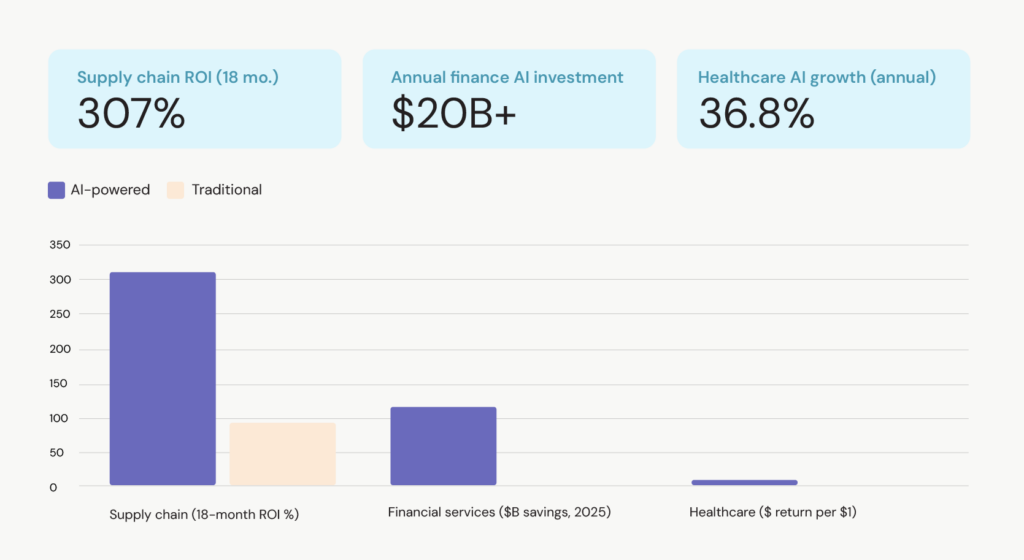
Regulatory institutions require organizations to own their AI systems, monitor performance, and prove outcomes. These sectors have the most restrictive AI infrastructure, which eventually produces returns through timely embedded measurement, governance, and accountability.
In this article, we explore AI ROI across supply chain, finance, and healthcare, paying attention to financial results and making the case for why governance is the real driver of long-term AI returns.
Why do regulated industries get better AI returns?
The instinct is to assume that stricter regulatory policies slow AI adoption and thin returns. The data says the opposite, and the reason is that regulatory policies require organizations to do four things that most companies only do after something goes wrong:
- measure outcomes before deploying
- build specialized models
- assign ownership
- maintain data discipline
Each one independently predicts better AI returns, and in regulated industries, all four are required simultaneously.
Measurement
In healthcare, a clinical AI system can't be deployed without proven efficacy. In finance, a fraud detection model needs documented accuracy metrics and false positive rates before a compliance officer signs off. In logistics, a routing algorithm that crosses customs jurisdictions needs auditable decision records. What this means in practice is that regulated organizations define what success looks like before the model goes live, and not after the budget has been spent, wondering why the results aren’t showing up.
Governance
Organizations have to build governance deliberately, yet most don’t until something breaks. In regulated industries, C-suite involvement was never optional, and it probably never will be. Deloitte found that in only 10% of organizations, the CEO leads the AI agenda. That structure (clear ownership, accountability, escalation paths) is exactly what McKinsey, BCG, and PwC consistently identify as the defining trait of the 5 to 12% of organizations that capture greater AI returns. On top of that, companies with a formal AI change management plan are 2.7x more likely to achieve ROI within the first 12 months, and in regulated industries, that plan is there because the framework demands it.
Specialization
In regulated environments, the difference between a generic model and a domain-specific one is clear-cut: one passes compliance review, and one doesn't. Financial regulations require models that understand specific terminology, risk weighting, and documentation standards.
Similarly, clinical standards demand imaging models pre-trained on pathology categories, while international trade compliance requires forecasting models built to navigate tariff volatility. At the end of the day, a general-purpose model deployed in any of these environments is bound to underperform and create compliance risks.
McKinsey's State of AI report found that industry-specific models deliver results up to 40% faster than general-purpose ones, because they're pre-trained on the data patterns that matter for that domain. How did regulated sectors figure this out? Because compliance requirements made it impossible to deploy a generic model and hope for the best.
Data discipline
In regulated industries, data quality standards have existed well before AI came into the picture. For example, HIPAA governs how patient data is stored, accessed, and shared, while Basel III (international banking standards) and the Sarbanes-Oxley Act (SOX, US financial reporting law) define how financial data is tracked, reported, and audited. Likewise, supply chain operators crossing customs jurisdictions maintain records of every shipment, classification code, and tariff to comply with regulators.
By the time an AI system is applied to these environments, the data infrastructure should already be in place. This is because data readiness, the process of moving from fragmented, poor-quality data to well-structured, properly labeled datasets, should have been addressed earlier as a compliance requirement. That gives regulated industries a head start over the ones where data readiness is often the first thing that must be built (oftentimes, under pressure) once an AI initiative is underway.
What does AI ROI look like in supply chain and logistics?
Supply chains generate structured data at a scale most industries don’t come close to: shipment records, inventory counts, demand signals, pricing, lead times, weather patterns, and more. Every decision that AI improves maps to a cost line that finance teams already track, and that combination of data volume and financial visibility is why the evidence here is so clear.
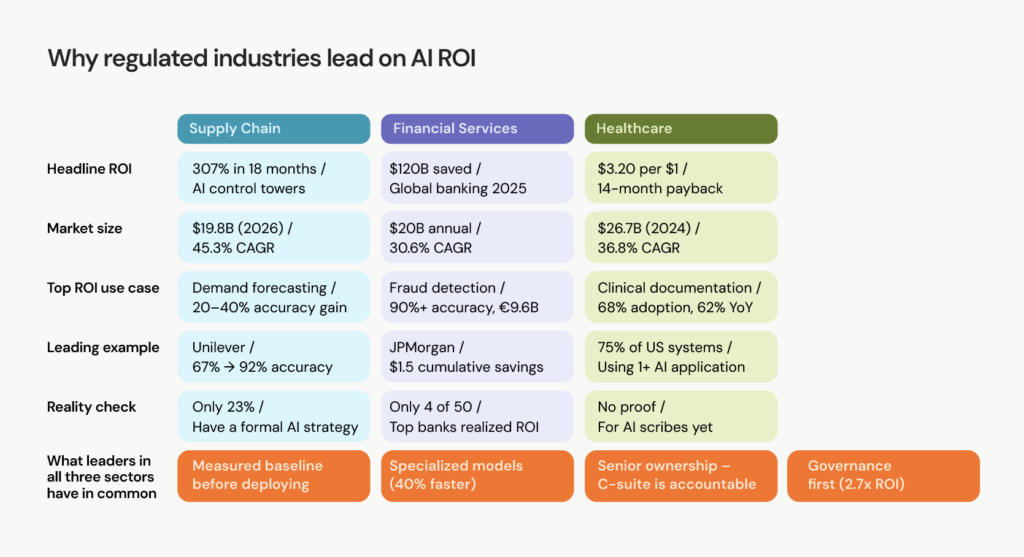
The global AI market for supply chain reached $19.8 billion in 2026, up from $6.5 billion in 2022, growing at 45.3% annually. Retail and e-commerce lead adoption at 83%, followed by manufacturing at 76% and transportation and logistics at 72%.
Three use cases with the most documented returns
Demand forecasting
Traditional forecasting relies on historical sales data and seasonal patterns, which works well until demand becomes volatile, seasonal patterns shift, or a competitor makes a move. AI-powered forecasting can integrate 200+ variables per product, including weather data, social media sentiment, local events, competitor pricing, and macroeconomic signals.
Industry benchmarks highlight an accuracy improvement of 20 to 40% over traditional methods, a range that sounds modest until you consider what a 20% reduction in forecast error means for a supply chain carrying millions in stock.
Unilever's AI forecasting platform, for example, integrated 26 external data sources and improved forecast accuracy from 67% to 92%, reducing excess inventory by $348 million while maintaining 99.1% service levels.
The same pattern repeats at Coca-Cola, which processes 600+ variables per product-market combination, predicting demand with 85% accuracy up to 12 weeks in advance and reducing forecast error by 30%. In both cases, more variables meant tighter accuracy, and tighter accuracy meant direct cost reductions.
Inventory management
Carrying costs are one of the largest and most underestimated cost categories in any supply chain. AI-driven inventory management targets this directly, reducing carrying costs by 20 to 30% through improved demand forecasting and dynamic stock adjustments.
For example, Home Depot's AI demand sensing technology analyzes 160 terabytes of daily transaction data, enabling real-time inventory adjustments. This improves in-stock availability by 15% while cutting excess inventory costs by $1.2 billion annually.
For a $10 billion revenue enterprise, AI-driven inventory optimization typically frees $400 to $600 million in working capital, providing financial flexibility that goes well beyond the direct cost savings and shows up on the balance sheet.
Transportation and route planning
Transportation costs drop 15 to 25% through smart route planning and load consolidation. UPS’s ORION route optimization system processes 30,000 route optimizations per minute, saving 38 million liters of fuel annually and preventing approximately 100,000 metric tons of CO2 emissions.
XPO Logistics uses AI-powered freight matching that connects 99.7% of loads without human intervention, reducing transportation costs by 15%. Across the sector, AI logistics platforms report 27% shorter order lead times and 25% higher labor productivity.
That said, Gartner reports that 72% of supply chain organizations have deployed GenAI, yet most are experiencing average results. Only 23% of supply chain leaders have a formal AI strategy, while the rest are running AI on a project-by-project basis, which Gartner warns results in fragmented architectures that delay returns. All in all, this comes to show that the discipline to successfully deploy an AI strategy is still catching up.
Where is AI delivering returns in financial services?
In financial services, regulatory scrutiny drives high AI ROI by demanding the measurement and specialization that make returns predictable. This discipline helped the banking industry save $120 billion in 2025, with projections reaching $500 billion by 2030.
The catch is that those savings aren’t evenly distributed. In 2025, only 4 of the 50 largest banks reported realized ROI from AI. The rest are spending heavily, with industry-wide AI investment exceeding $10 billion annually, but have yet to connect that spending to measurable outcomes. The use cases producing documented returns cluster around four areas, and they share a common trait: every one of them has a measurable baseline that existed long before AI arrived.
Fraud detection
AI-based fraud systems are projected to save global banks approximately $12 billion in 2026, with banks using AI-powered models reporting detection accuracy exceeding 90%.
JPMorgan Chase directs roughly $2 billion of its $18 billion technology budget to AI, capturing $1.5 billion in cumulative savings and running a fraud detection system at 98% accuracy across 400+ use cases. Morgan Stanley's fraud detection system, now in its tenth generation after more than a decade of refinement, processes $1.2 trillion annually across 8+ billion transactions at 2-millisecond latency, maintaining the industry's lowest fraud rates for 14 consecutive years. The consistency of those results is the product of a feedback loop that financial regulation made mandatory.
Compliance automation
In financial services, some of the most grueling tasks include anti-money-laundering monitoring, regulatory reports, and data audits across millions of transactions per day. These tasks have historically required large analyst teams to review alerts manually.
BCG found that institutions adopting AI through specialist teams see up to 60% efficiency gains and 40% cost reductions in areas like onboarding, compliance, and settlement. The result is that AI agents now handle what previously required analysts to review manually (monitoring transactions, auditing data trails, flagging compliance breaches). What used to take a team working through queues now runs continuously in the background.
Wealth management and advisory
Robo-advisors now manage over $1.2 trillion in assets globally, and they've cut wealth management fees from 1.5% to approximately 0.25% of assets under management. In investment management, 68% of hedge funds use AI for market analysis, while 82% of investment firms rely on it for algorithmic trading. Morgan Stanley's deployment illustrates what advisory AI looks like at scale: 15,000 advisors use AI tools for client engagement, combining portfolio analysis, market intelligence, and personalized recommendations to increase advisor capacity and client retention.
Lending and credit decisioning
AI has cut loan risk assessment from 2 days to 5 minutes, changing the entire customer experience and the economics of lending. 68% of US credit unions use AI for loan origination, reporting 25% higher approval rates alongside lower default risk. Further along the adoption curve, Bradesco, the 82-year-old Latin American bank, deployed agentic AI for fraud prevention and personal concierge services, boosting efficiency enough to free 17% of employee capacity and cut lead times by 22%.
The strongest returns come from applications where the outcome is measurable, the feedback loop is tight, and the regulatory framework forces governance. In each case, the measurement is a regulatory requirement, and that requirement is what makes ROI visible and improvable over time.
How is healthcare measuring AI ROI?
Healthcare AI is growing 36.8% per year, faster than any other industry. And according to NVIDIA's 2026 State of AI in Healthcare survey of over 600 professionals, 70% of healthcare organizations globally are actively using AI. What makes healthcare interesting from an ROI perspective is the measurement challenge baked into the sector itself.
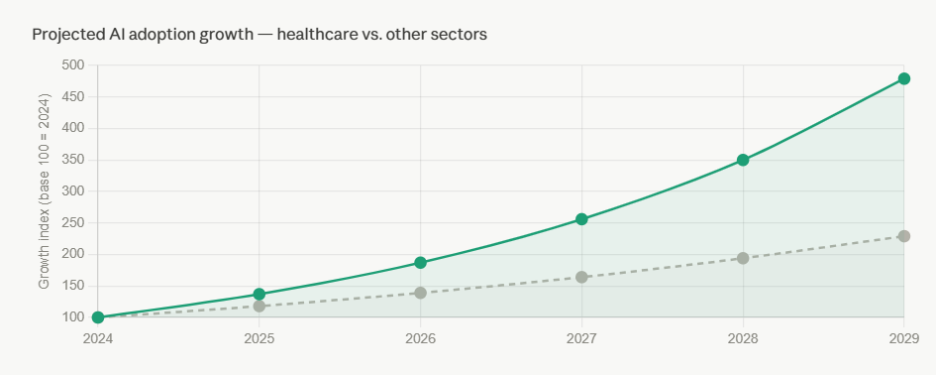
Even though healthcare operates in a system where the most valuable outcomes (a cancer caught earlier, a readmission prevented) don't always show up in financial statements, the ROI for AI is $3.20 for every $1 invested. That number shows that healthcare has learned to measure ROI across four distinct models, none of which map to a direct line on a financial statement.
Cost avoidance
Cost avoidance (proactive strategies that prevent future medical expenses and operational losses from occurring) is one of the clearest ways AI generates returns because it reduces the operational overhead that consumes clinician time.
Clinical note-taking and ambient listening reached 68% adoption in 2026, growing 62% year-over-year. AI-generated operative reports achieved 87.3% accuracy compared to 72.8% for surgeon-written reports, reducing discrepancies and cutting documentation time.
At Yale New Haven Health, clinicians kept approximately 80% of AI-generated notes as final, a finding that reflects the models' accuracy, and the trust clinicians placed in output that matched their own workflow and terminology. Nurses currently spend 15 to 20 minutes every hour on administrative tasks. AI documentation tools help cut that, freeing time for patient care where it belongs.
Clinical outcome improvement
Beyond operational savings, clinical outcomes tell a different kind of ROI story. NVIDIA's survey found that 57% of medical technology respondents reported ROI from AI in medical imaging. AI-generated diagnostics showed a 14.5% improvement in accuracy over assessments written by physicians in a 2025 study of 158 cases, a margin that means a lot when the outcome is a diagnosis.
Interestingly enough, the financial impact of clinical improvements can depend on the payment model. In fee-for-service, preventing readmissions can reduce revenue, while in value-based care, it improves quality metrics and lowers penalties. Calculating healthcare AI ROI requires understanding the organization’s payment structure because the same outcome sends different financial signals based on how a provider is paid.
Voice AI and the documentation burden
Voice AI is one of the fastest-growing applications in healthcare, and the ROI of healthcare voice AI is tied directly to the documentation burden that drives clinician burnout. Ambient AI scribes that listen to doctor-patient conversations, generate structured clinical notes, and populate EHR fields are now standard.
The ROI measurement challenge with voice AI is that its main benefits (reduced burnout, improved clinician satisfaction, lower turnover) are indirect. They don't appear on an income statement, but actively lower turnover in a sector where replacing a nurse can cost ~$85,000.
Drug discovery and research
Drug discovery is producing a different category of returns. 46% of pharmaceutical and biotech respondents in NVIDIA's survey reported ROI from AI in drug discovery.
AI models that screen molecular compounds, predict protein structures, and optimize clinical trial design can reduce the cost of bringing a new drug to market by hundreds of millions to billions of dollars, shortening timelines that previously spanned a decade into something measurably shorter.
What separates organizations that get returns from those that don't?
The technology gap between regulated and unregulated industries is smaller than most assume. For example, JPMorgan and a mid-sized regional bank can access the same foundation models, the same cloud architecture, and the same orchestration tools. What JPMorgan has that the regional bank most likely doesn’t is the measurement infrastructure, governance structure, and workflow discipline around all of those tools. Across supply chain, finance, and healthcare, five organizational traits consistently highlight what it takes for organizations to capture returns.
Measurement before deployment
Organizations that chose use cases where the baseline was already tracked are seeing strong AI returns. For example, the supply chain teams that chose demand forecasting, where forecast accuracy was already measured weekly.
The banks that connected AI to savings focused on fraud detection, where false positive and false negative rates were already monitored to the decimal. The healthcare systems that chose clinical documentation, where time-per-note and clinician satisfaction were already benchmarked.
In each case, the organization knew what "before" looked like, which made calculating the "after" a lot easier.
Specialized models over generic ones
A fraud detection model trained on a specific institution's transaction patterns outperforms a generic model because it understands what normal looks like for that customer base, flagging what doesn't fit.
For example, a clinical documentation model trained on a health system's specific EHR format and special terminology produces output that clinicians accept rather than rewrite. This level of specialization is a compliance requirement in regulated industries.
Workflow redesign
McKinsey identifies workflow redesign as the single strongest predictor of AI value capture. High performers are three times more likely to rebuild processes from scratch rather than just adding AI to existing ones.
For example, successful supply chain teams replaced weekly forecasts with continuous demand sensing, and financial firms redesigned intake and resolution around autonomous AI capabilities. While some organizations may feel tempted to simply layer AI over old methods, the ones seeing positive returns are those that rethink their processes entirely.
Senior ownership
As the Deloitte data covered earlier showed, direct CEO ownership is rare across industries. However, in regulated industries, C-suite sign-off is foundational. Senior ownership resolves the cross-functional conflicts that kill AI projects in other contexts like data access disputes between IT and business units, budget fights between departments, or the change management that no one wants to lead. Without a named senior leader, those conflicts slow everything down until the initiative loses momentum.
Governance as design infrastructure
Organizations in regulated industries view compliance reviews, audit trails, and monitoring dashboards as the infrastructure that makes AI trustworthy enough to scale.
Johann Beukes, Chief AI Officer at Svitla Systems, summarized it this way: "The assumption is that once it works in a demo, it's ready. In reality, that's when the work begins." The running theme here is that regulated industries don’t treat compliance reviews, audit trails, and monitoring as overhead. The best practice should be to build governance into the infrastructure before the first model goes live.
| Trait | What it looks like in practice |
| Measurement before deployment | Choose use cases where the baseline is already tracked: forecast accuracy, fraud rates, documentation time |
| Specialized models over generic ones | Train on your institution's own data, terminology, and formats instead of a general-purpose model |
| Workflow redesign | Rebuild processes around what AI can do, not around what already exists |
| Senior ownership | Name a C-suite leader accountable for outcomes |
| Governance as design infrastructure | Enforce compliance reviews, audit trails, and monitoring from day one |
Regulated industries were built for better AI returns
The sharp spike in supply chain ROI, the billions of dollars saved in banking savings, the return on every dollar invested in healthcare…none of those results came from better models or bigger budgets. They exist because compliance requirements forced these organizations to do the things that produce returns: measure the baseline before deploying, build specialized models instead of generic ones, assign a senior leader to own the outcome, and treat governance as infrastructure.
That’s the uncomfortable implication for everyone else. Without the external pressure of compliance, most unregulated industries have been running AI experiments by adopting tools without measuring baselines, deploying generic models without domain tuning, and distributing ownership across teams without clear accountability.
Discipline isn't exclusive to regulated industries. Any organization can choose to measure before deploying, build governance from the start, and redesign workflows around what AI can do. Regulated industries proved this works by being forced into it. The rest of the market can get there by choice, and get there faster than any regulator-driven timeline would allow.
If you're building AI systems for regulated industries and need engineering teams that understand compliance infrastructure, domain-specific model development, and governed deployment, Svitla's AI and machine learning engineering team helps organizations build AI that produces returns.