


TL;DR: An AI security assessment is the checkpoint where US enterprise and government buyers ask a vendor to prove what's inside its AI system. That proof starts with a software bill of materials (SBOM), a machine-readable inventory of components, extended for AI to cover models, datasets, and infrastructure. The work continues with supply chain controls such as signed models and testing against known AI attack patterns. Keep the inventory, the signing records, and the test reports together, and a buyer's questionnaire turns into attaching files.
Key definitions
- AI security assessment: a structured review of an AI system's models, data, code, infrastructure, and access controls, used to judge vendor risk before purchase or deployment.
- SBOM (software bill of materials): a machine-readable inventory of a piece of software's components, with versions, suppliers, and dependency relationships.
- AI SBOM (AIBOM): an SBOM extended to record an AI system's models, datasets, training properties, and infrastructure.
- Machine learning supply chain: the models, datasets, libraries, containers, and pipelines an AI system depends on, from training through deployment.
- AI governance audit: a review of whether an organization's AI policies, controls, and records match a framework or a contract.
- AI model risk management: the practice of identifying, scoring, and controlling the risks created by a model's errors, drift, or misuse.
The demo went well, the buyer's champion is on board, and then the AI security assessment lands on your desk. A procurement or security reviewer sends a questionnaire asking what is in your model, where it came from, and who can change it. Teams without ready answers watch the deal stall.
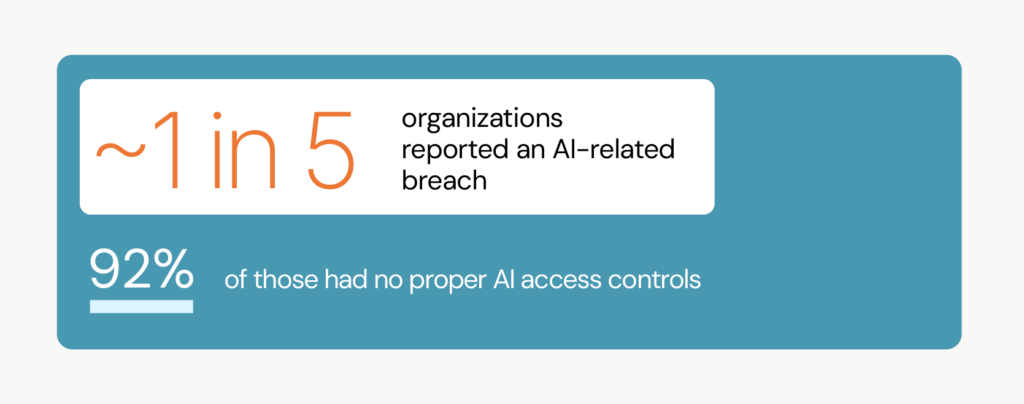
Buyers have a good reason to ask. IBM X-Force's analysis of the 2026 Cost of a Data Breach Report found that about one in five organizations reported an AI-related breach. Of those, 92% lacked proper AI access controls.
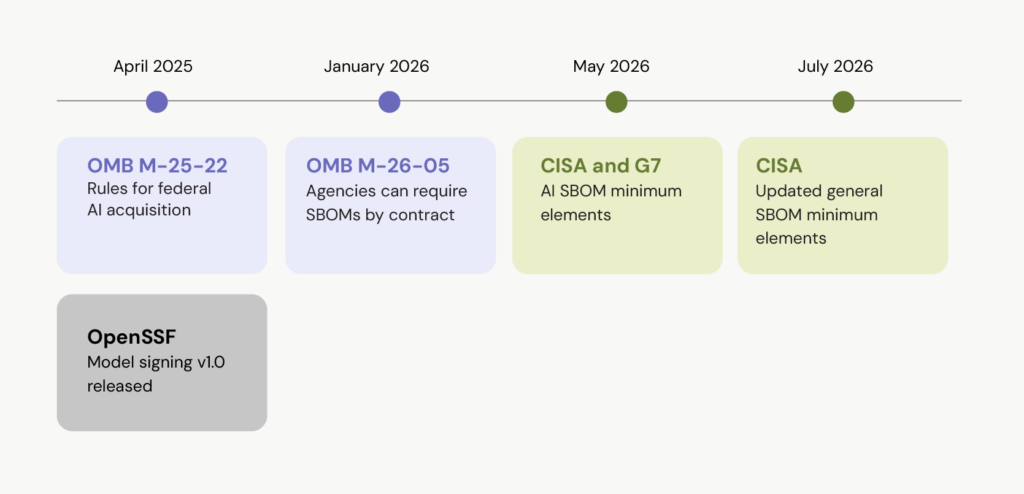
In January 2026, the Office of Management and Budget (OMB) issued memo M-26-05. It replaced the blanket requirement for vendors to sign a secure software development attestation. Agencies now take a risk-based approach and can require software bills of materials (SBOMs) through contract terms. In May 2026, the Cybersecurity and Infrastructure Security Agency (CISA) and Group of Seven (G7) partners followed with voluntary minimum elements for AI SBOMs.
Voluntary guidance turns into a practical requirement once a contract or security questionnaire cites it. Vendors who can produce evidence on request give reviewers less reason to pause the deal. In this guide, we cover how to build an AI SBOM, secure the machine learning supply chain, and test the system against known attack patterns.
What do US buyers check in an AI governance audit?
Three things carry most of the weight in a US buyer's AI governance audit:
- Alignment with a recognized framework
- A documented inventory of AI components
- Test evidence that your controls work as intended
Requirements vary by buyer. Federal agencies set the most explicit terms. In April 2025, OMB memo M-25-22 on AI acquisition directed agencies to define data rights, limit dependence on a single vendor, and monitor performance and risk. Contracts should permanently stop vendors from training commercial AI on nonpublic agency data without the agency's consent. Where relevant, agencies should also test proposed solutions before they choose one.
M-26-05 works differently. As noted above, it lets agencies request a current SBOM through contract terms. For cloud services, the SBOM should cover the production runtime environment. Because requests vary by agency, keep one master SBOM and tailor it to each request.
Enterprise buyers can send questionnaires mapped to the National Institute of Standards and Technology (NIST) AI Risk Management Framework (AI RMF), and they may ask for a System and Organization Controls (SOC) 2 report or ISO/IEC 42001 certification.
The table lists what each document covers and how much it binds a vendor.
| Document | What it covers | Status for a vendor |
| NIST AI Risk Management Framework and Generative AI Profile | Govern, map, measure, and manage AI risk, with a profile for generative AI | Voluntary framework that buyers use as a questionnaire baseline |
| NIST SP 800-218A | Secure development practices for generative AI, added to the Secure Software Development Framework (SSDF) | Voluntary profile written for model producers, system producers, and acquirers |
| OMB M-25-22 | Federal AI acquisition: data rights, vendor lock-in, testing, and monitoring | Binds agencies, which apply it to vendors through contract terms on covered federal purchases |
| OMB M-26-05 | Risk-based software security, with SBOMs available on request | Applied at each agency's discretion through contract terms, with no blanket requirement |
| CISA 2026 SBOM minimum elements | SBOM data fields | Voluntary baseline for SBOM data fields |
| ISO/IEC 42001 | Management system standard for AI | Certification a buyer may ask for |
| SOC 2 | Independent CPA examination of controls against the Trust Services Criteria (security, availability, processing integrity, confidentiality, and privacy) | Attestation report that isn't specific to AI |
The NIST AI RMF, ISO/IEC 42001, and SOC 2 become binding only when a contract cites them. In a questionnaire, they act as scoring criteria. Start your compliance plan with the frameworks your buyer names. The next sections cover the other two things buyers check: the component inventory and the test evidence.
What belongs in an AI SBOM?
An AI SBOM records everything a standard SBOM does, plus the models, datasets, and infrastructure the system depends on. The May 2026 CISA and G7 guidance, from partners in Canada, France, Germany, Italy, Japan, the United Kingdom, and the European Union, is voluntary. It applies alongside the general SBOM minimum elements, since AI systems are still software.
According to Morgan Lewis's summary, the CISA and G7 guidance groups its minimum elements into seven clusters: metadata, system-level properties, models, dataset properties, infrastructure, security properties, and key performance indicators. The elements include cryptographic hashes, model lineage, dataset provenance, and prompt injection controls.
Two open specifications support these details. CycloneDX added Machine Learning BOM (ML-BOM) features in version 1.5. It records models and training datasets as separate components and links them through the dataset field in the model card.
The second, Software Package Data Exchange (SPDX) 3.0, was released in April 2024 and adds support for AI, data, security, and build systems. Its AI profile records model type, training information, and limitations, and its Dataset profile records how a dataset was collected and what it's meant for.
AI SBOMs are still a young practice. The CISA guidance says its elements will expand over time, so treat your first AI SBOM as a baseline to refine. In July 2026, CISA and its partners updated the 2021 baseline with new general minimum elements that add component hashes, license data, the SBOM tool name, and generation context.
Which SBOM generation tools fit an AI pipeline?
No single SBOM generation tool covers every layer of an AI system. Most pipelines pair a scanner for code and containers with a separately maintained record of models and datasets. The table compares three open-source SBOM generators by what they scan and which formats they write.
| Tool | Best for | Output formats |
| Syft (Anchore) | Container images and filesystems, and it fits easily into continuous integration (CI) pipelines | SPDX, CycloneDX, and Syft JSON |
| cdxgen (OWASP) | Mixed-language projects with many package managers | CycloneDX only |
| Microsoft SBOM Tool | Large monorepos and complex build environments | SPDX 2.2 and 3.0 |
Tooling for models and datasets is less mature. Teams often write model records by hand from model cards and training logs, then merge them with the scanner output.
To keep the SBOM accurate after release, regenerate it on every build, sign it, and archive it with the release. A monitoring tool can then match newly disclosed vulnerabilities to the components running in production. The 2026 CISA elements point the same way, since they emphasize machine-processable formats that support risk management at scale.
A static SBOM scan only lists components present in the code and container images. It can't detect what an AI system calls at runtime, such as agent tools, retrieval-augmented generation sources, or external APIs. Declare those resources in the AI SBOM, then use security testing and runtime monitoring to cover what remains.
Automating these declarations keeps them current. Generate them from the configuration files that define agent tools, retrieval pipelines, and model endpoints. Fail the build when a configuration change isn't reflected in the declarations, and alert at runtime whenever the system calls an endpoint the declarations don't list.
How do you secure the machine learning supply chain?
Machine learning supply chain security means verifying every artifact an AI system loads, from model weights and datasets to libraries and container images. Model files carry a risk that ordinary data files don't. Python's pickle format, widely used for model weights, can execute code when the file is loaded. For this reason, Hugging Face scans pickle files uploaded to its Hub and flags suspicious imports, though it notes the scan is not foolproof.
Signing adds the integrity check. In April 2025, the Open Source Security Foundation (OpenSSF) model-signing project reached version 1.0. Built on Sigstore, it was developed with Google, NVIDIA, and HiddenLayer. Teams sign a model at release and verify the signature before deployment, so a swapped or tampered file fails the check. Sigstore also records each signature in a transparency log. That makes it possible to detect a model signed by a rogue insider under the company’s name, if you monitor the log for identities you don’t expect.
Datasets and dependencies need the same treatment. Pin versions, record hashes, and keep dataset sources and licenses in the AI SBOM. If a dataset later turns out to be poisoned or unlicensed, you can trace every model trained on it and retrain or retire those models. Svitla's data audit is one way to check dataset sources and licenses before they reach the pipeline.
Runtime protection also depends on the infrastructure underneath. AI infrastructure security covers graphics processing unit (GPU) hosts, vector databases, secrets management, and network paths. In the cloud, that means strict identity policies, private networking, and audit logging.
Together, these controls show where each artifact came from and who can touch it. A valid signature shows a file is unchanged since release, though only testing shows whether the model behaves safely.
How do you run an AI security assessment?
An AI security assessment tests the whole system, from prompts and model behavior to the code, data, and cloud settings around it. It starts with defining scope: the models, the data they touch, the tools they can call, and the people who can change any of them.
AI security testing then probes known attack patterns. The Open Worldwide Application Security Project (OWASP) Top 10 for large language model (LLM) applications lists the common ones, including prompt injection and supply chain vulnerabilities. MITRE ATLAS catalogs adversary tactics and techniques against AI systems, which helps testers plan realistic attack scenarios.
This part of the work, often called an AI vulnerability assessment, covers behavior that a conventional vulnerability scan can't see. A model can be coaxed into leaking data or taking actions it shouldn't. Testers attempt both with adversarial prompts and check which tools and APIs the model can call.
Infrastructure and access come next. Testers review identity policies, secrets handling, network paths, and logging. They also compare what is running against the AI SBOM, because any running component the SBOM doesn't list is a finding in itself.
Finally, AI model risk management turns findings into decisions. Each finding gets an owner, a severity, and a deadline. The results then go into the evidence pack that an auditor will request in an enterprise AI cybersecurity audit. Teams without in-house testers sometimes buy AI risk management services for this step.
Testing has limits. A clean result only covers the attacks that were tried, so retest whenever the model, system prompt, or tools change.
Build AI security evidence into every release: NIST, OMB, ISO/IEC 42001, and SOC 2
The security questionnaire described at the start is much easier to answer when the answers already exist as files. An AI security assessment moves quickly when you collect the AI SBOM, signed models, test reports, and access records as you build the system.
The NIST AI RMF and SP 800-218A shape the controls, and the CISA minimum elements shape the AI SBOM. Federal contracts draw on OMB memos M-25-22 and M-26-05. Enterprise reviewers add ISO/IEC 42001 certification and SOC 2 reports to the NIST baseline.
Still, one step is enough to begin. Svitla's cybersecurity engineers and forward deployed engineers offer secure AI deployment services, and they can help you start. Pick the control your last questionnaire focused on most, and the next questionnaire will take less work.
FAQ
What is an AI SBOM, and why is it required for US enterprise and government buyers?
An AI SBOM is an inventory of the models, datasets, code, and infrastructure behind an AI system. No single federal law requires every vendor to supply one. The requirement shows up in individual contracts. OMB M-26-05 lets agencies ask for a current SBOM through contract terms, and an enterprise buyer can add the same request to its own vendor review. A vendor who can produce the file on request gives reviewers something concrete to check.
How does an AI security assessment differ from traditional software security testing?
Traditional testing checks code and infrastructure that behave the same way on every run. An AI system produces probabilistic outputs, so the same input can return different results. Its attack surface also includes prompts, retrieved documents, and tool permissions written in plain language. Results age fast, because a change to the model, the prompt, or the data calls for another round of testing.
What are the key AI governance and compliance frameworks for US market readiness?
Federal buyers look to the NIST AI Risk Management Framework, NIST SP 800-218A, and the OMB memos M-25-22 and M-26-05. Cloud offerings sold to agencies generally also need authorization under the Federal Risk and Authorization Management Program (FedRAMP). Enterprise buyers may ask for a SOC 2 report or alignment with ISO/IEC 42001.