TL;DR: Managed operations cost less than an in-house team when the contract price falls below what that team costs in full. Payroll alone runs about 31% above annual wages once benefits, payroll taxes, and paid leave are added. A five-person team providing round-the-clock support at the U.S. median administrator wage of $99,130 costs roughly $647,000 per year in salaries and benefits alone, before accounting for turnover, tooling, or management time. That figure is the price to beat in any managed operations quote, and outage risk decides whether the cheaper quote is also the safer one.
Key terms
- Managed operations: An arrangement in which an external provider runs, monitors, and supports existing systems against agreed service levels.
- In-house ops team: Employees on the company's own payroll who run, monitor, and support the same systems.
- Fully loaded cost: Base pay plus benefits, payroll taxes, and paid leave: the total an employer spends on one employee.
- Service level agreement (SLA): The contract section that sets measurable targets, such as response time and uptime, along with remedies for failing to meet them.
- Total cost of ownership (TCO): The sum of all costs associated with a service over its life, including hiring, tooling, management time, and downtime.
- Vendor management office (VMO): The internal core function that governs outside providers, tracks their performance, and owns the contract relationship.
Managed operations and an in-house ops team can run the same infrastructure, but each shows up in a CFO’s budget differently. An in-house team's payroll is a predictable line item, but the costs that come with it, such as turnover and outages, show up in other cost centers or arrive without warning. A managed operations contract rolls most of those costs into a single fee.
We’ll compare both options using public labor data, survey research, and regulatory guidance so CFOs can benchmark the quotes they receive. The worked example relies on U.S. government wage data, which finance teams can easily adapt with their own numbers.
What does an in-house team cost, from payroll through turnover?
Round-the-clock coverage takes more than one person per seat. A week has 168 hours and a full-time employee works about 40 of them, so one seat staffed around the clock takes 4.2 full-time employees. Paid leave and training push a realistic team to five.
As of May 2025, the U.S. Bureau of Labor Statistics (BLS) reports a median annual wage of $99,130 for network and computer systems administrators. That annual figure already includes pay for vacation, holidays, and sick days. For full-time private industry workers, benefits account for 31.5% of total compensation (June 2026), and paid leave makes up 8.1 points of that share. Adding only the remaining benefits (insurance, retirement, supplemental pay, and legally required contributions such as payroll taxes) puts fully loaded costs about 31% above annual wages.
Gallup estimates that replacing an employee costs 0.5 to 2 times their annual salary. The table below assumes one administrator leaves per year.
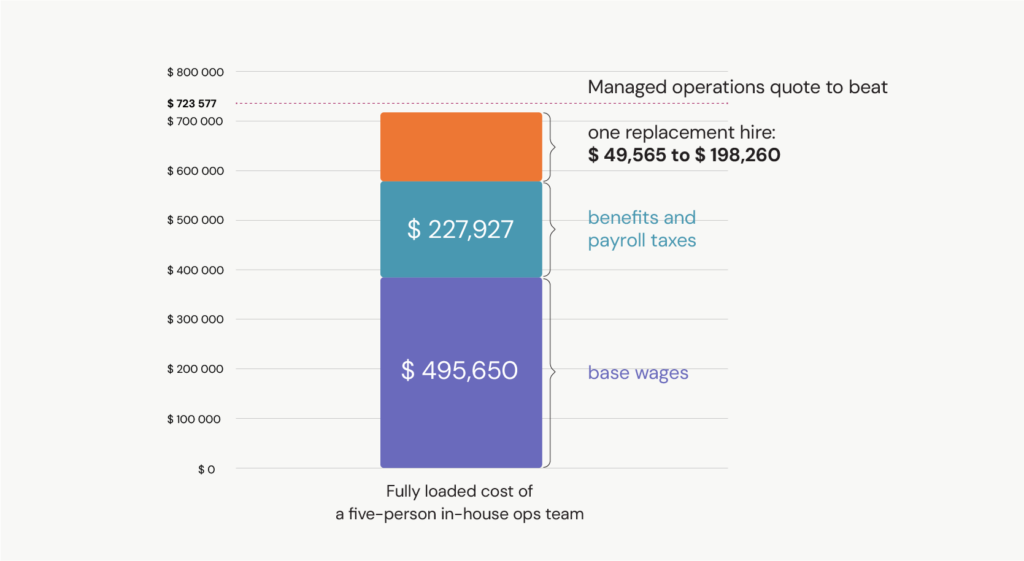
Key components of annual cost of a five-person in-house operations team (illustrative, U.S. public data)
| Cost line | Calculation | Annual cost |
| Base wages | 5 × $99,130 | $495,650 |
| Fully loaded employment cost | Annual wages ÷ 0.766 | $647,063 |
| Benefits beyond paid leave | Fully loaded cost minus annual wages | $151,413 |
| One replacement cost, low case | 0.5 × $99,130 | $49,565 |
| One replacement cost, high case | 2 × $99,130 | $198,260 |
| Employment cost plus one departure | Fully loaded cost plus low or high case | $696,628 to $845,323 |
Sources: BLS Occupational Outlook Handbook (May 2025 wage), BLS Employer Costs for Employee Compensation (June 2026), Gallup. Assumes 5 staff and 1 departure per year.
With one departure a year, the team costs between $697,000 and $845,000 in people costs, before tooling or management time. Round-the-clock teams also usually earn shift differentials or on-call pay, which the BLS averages above do not capture, so finance teams should add their own premium to these figures. Vendor fees vary by scope and service levels, so the most reliable benchmark is the in-house figure you can verify: $647,063 in fully loaded employment cost. Any quote below that number for the same scope and coverage beats the in-house team on employment cost alone. Turnover and shift premiums only widen the gap.
What does a managed operations contract replace, and what stays in-house?
A managed operations contract replaces staffed coverage: monitoring, incident response, patching, and tiered support at agreed service levels. Svitla's managed services model, for example, provides 24/7 maintenance and support across development and operations.
In a managed L1-L3 support engagement (first-line through complex, third-line issues) for a global biopharma company, Svitla's team resolved more than 100 incidents, ranging from routine to complex, within three months.
Flexera's 2026 State of the Cloud report surveyed more than 750 cloud decision-makers. It found that managed service providers still run much of the day-to-day work in cloud environments, but customers are keeping more ownership of governance and cost accountability. The same report puts wasted cloud spend at an estimated 29%, up for the first time in five years. The contract should name an owner (the provider or an internal team) for two cost-control jobs: rightsizing (matching capacity to usage) and commitment discounts (pre-paying for usage to lock in a lower rate). Otherwise, that waste stays on the customer’s bill.
In Deloitte's 2024 Global Outsourcing Survey of more than 500 executives, 70% said their vendor management office is not fully mature. The budget for a managed operations contract should cover the internal time to manage it, starting with a service owner and regular performance reviews.
How much does downtime change the math?
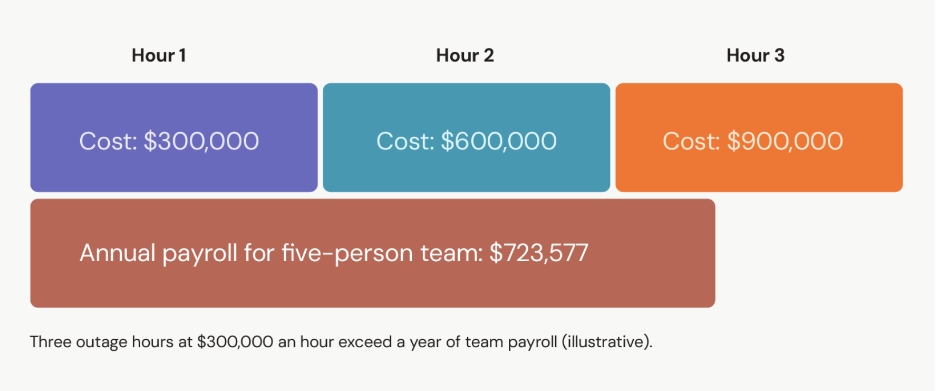
Downtime can outweigh the difference between payroll and provider fees. ITIC's 2024 Hourly Cost of Downtime survey polled more than 1,000 firms. More than 90% of mid-size and large enterprises put the cost of one hour of downtime above $300,000, and 41% of them put it at $1 million or more. These are self-reported estimates, and they exclude litigation and penalties.
ITIC also lists overworked and understaffed IT departments among the factors behind downtime. That link makes staffing a financial question, since a team running short after a resignation or during a holiday week is exposed to that exact risk.
At $300,000 an hour, three extra hours of downtime a year would cost $900,000, more than the entire fully loaded payroll in the table above. Smaller companies should substitute their own hourly figure.
Outages happen under both models, so the useful comparison is expected outage hours under each staffing plan or contract. The time it historically takes a provider and the in-house team to restore service will clarify the comparison. ITIC lists failure to track hourly downtime costs as one of the business mistakes behind outages, so a company without an incident log has no baseline for comparison.
Continuous monitoring, which shortens the time to detect problems, is offered alongside managed cloud support in Svitla's DevOps services.
Which regulatory and vendor risks belong in the budget?
Risk management and compliance are essential considerations when outsourcing operations to external vendors.
Outsourcing operations shifts work to a provider while leaving some risk with the buyer. For EU financial entities, the Digital Operational Resilience Act (DORA) makes that explicit. The regulation has applied since January 17, 2025. ESMA describes its scope as covering Information and Communication Technology (ICT) third-party risk management, including key contractual provisions, as well as an oversight framework for ICT providers that the European Supervisory Authorities designate as critical.
A CFO at an EU bank or insurer therefore prices a managed operations contract together with regulatory compliance work. That work includes contract terms that satisfy the regulation and a maintained register of information on ICT providers.
Companies outside DORA's scope can borrow the same two-part discipline: a contract review that covers contract terms, and a separate, maintained inventory of providers. Relying solely on one provider is a vendor-side exposure, and a tested exit plan limits it. Financial risk mitigation works best when legal review, provider monitoring, and exit planning each appear as a budget line.
Why are more companies blending both models?
The same Deloitte survey shows organizations moving in both directions at once. Among the executives surveyed, 80% plan to maintain or increase third-party outsourcing investment, and 70% have selectively brought previously outsourced scope back in-house over the past five years. The result is a portfolio approach, with each workload assigned to the model that suits it best.
BLS adds a labor-market signal. It projects that employment of network and computer systems administrators will decline 4% from 2025 to 2035, driven by task absorption by DevOps developers, outsourcing to Network-as-a-Service providers, and process automation of routine work. For a CFO, that means the in-house half of any staffing plan is competing for a shrinking, increasingly specialized labor pool.
One of the more practical cost reduction strategies splits the work this way: systems where institutional knowledge drives value stay with in-house engineers, while round-the-clock coverage and peak-period capacity move to an external provider. The in-house ops team vs. external agency question then becomes a workload-by-workload decision.
How should CFOs compare the two models in IT budget planning processes?
Five steps turn the figures above into a budget and resource planning decision:
- Price the current or proposed team fully loaded. Start with the 1.31 multiplier on annual wages implied by the BLS data, then replace it with actual payroll figures.
- Reserve for turnover. Multiply expected departures by 0.5 to 2 times salary, and carry both the low and high case.
- Estimate downtime cost. Calculate an hourly cost from the company’s own revenue and staffing data, using the ITIC benchmark as a cross-check. Multiply it by the unplanned outage hours logged over the last 12 months, then estimate how that total would change under each model.
- Request comparable quotes. Ask for managed operations quotes that cover identical scope, including service levels, and add the internal cost of governing the contract.
- Compare cost ranges over three years. Set review points at contract renewal or when incident volume shifts materially.
Decision factors for each model
| Decision factor | In-house ops team | Managed operations |
| Cost behavior | Payroll follows headcount | Fees follow contracted scope |
| Downtime exposure | Depends on staffing depth and holiday coverage | Depends on SLA terms and the provider’s restore record |
| Turnover risk placement | With the employer | With the provider, under the contract |
| Coverage outside business hours | Requires shift staffing | Set by the coverage terms in the SLA |
| Control over access and tooling | Direct | Defined by the contract |
| Exit cost | Severance and rehiring | Transition assistance and knowledge transfer |
A CFO should price outages and governance alongside payroll and fees
The team's fully loaded payroll sets the price a managed operations quote must beat; turnover only widens that gap. Whether a lower quote saves money depends on expected outage hours under each model and the cost of the governance that stays in-house. Finance teams that price all three items side by side, using a range for each estimate, can make the choice with the same discipline they apply to any multiyear commitment.
For teams that want a quote to test against their own numbers, Svitla's managed services cover 24/7 maintenance and support for development and support operations.
FAQ
What are the main cost differences between managed operations and an in-house ops team?
Are managed operations more cost-effective for scaling IT workloads?
What hidden costs should CFOs consider when maintaining an internal ops team?
How do managed operations help with financial risk reduction for organizations?
How do staffing shortages or turnover impact the cost of in-house ops teams?
A managed operations contract absorbs that gap directly, since coverage continues under the existing service levels while recruiting proceeds, with no single seat to backfill. Svitla's managed services model, for example, is built for teams carrying an overloaded core staff or slipping support performance, covering 24/7 maintenance and support without depending on any one specialist.