TL;DR: In this guide, Janosz Zieliński, a Senior Maestro Developer at Svitla Systems with more than six years of experience, shares the tools that help him manage stress, deadlines, focus, and fear at work. His approach combines practical methods like work journaling, task breakdown, rubber duck debugging, and brain dumps with an honest look at impostor syndrome, ADHD, and deadline anxiety.
Key terms:
- Procrastination is the habit of delaying a task even when we know the delay will create more stress later. In software development, it often appears when a task feels unclear, too large, or emotionally heavy.
- Rubber duck debugging is a problem-solving method in which a developer explains an issue out loud to a rubber duck, themselves, or another person. The act of explaining can reveal the missing step.
- A brain dump is a simple technique for clearing mental overload by writing down every task, worry, or loose thought that is taking up your attention.
- Impostor syndrome is the fear of being exposed as less capable than others believe you are. In development work, it can make asking questions feel risky, even when asking would save time.
- ADHD, or attention-deficit/hyperactivity disorder, can affect focus, motivation, habit-building, and stress. In this article, I only speak about my own experience with it.
How to stop procrastinating is often treated like a discipline problem, although for many software developers, fear is where the work begins. It's easy to let fear take over, especially when you're on your own, and experience has taught you that asking for help isn't worth it.
My name is Janosz Zieliński, and I’m a C# and Unity developer with over six years of industry experience. I currently work at Svitla Systems as a Senior Maestro Developer. Over the years, I’ve learned that the hardest part of a task is very often the moment before starting, when the problem still feels too large, too vague, or too easy to get wrong.
A difficult task can trigger stress, self-doubt, deadline pressure, and the uncomfortable feeling that everyone else knows what they are doing. Those hindrances don’t disappear because someone gains more experience. At least, they didn’t for me. What changed was my ability to recognize them earlier and build small systems around them. Some of those systems are practical, like keeping a work journal or breaking large tasks into smaller steps. Others are more personal, like learning when to ask for help, when to rest, and when my own focus needs support instead of pressure.
In this article, I'll walk through the methods I use to manage stress, procrastination, and lack of focus on complex tasks. My worst enemy, the deadline, gets its own section too.
Practical methods: how to stay motivated at work
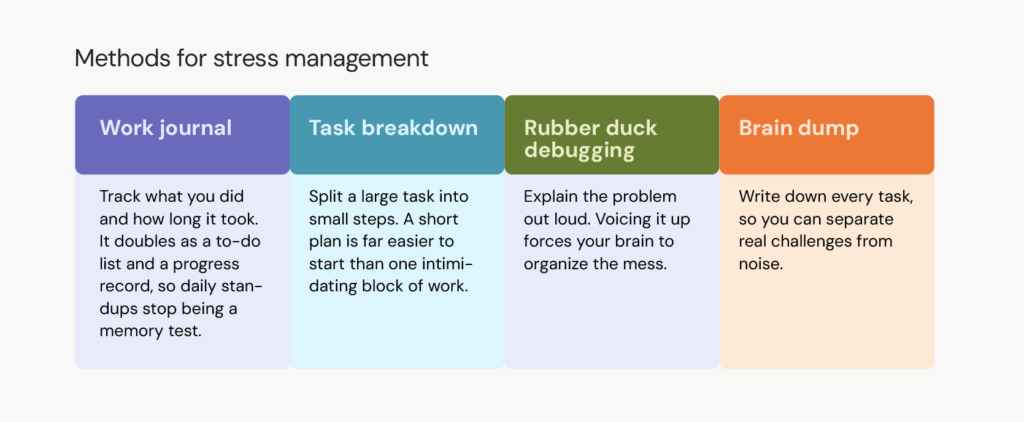
Let’s focus on methods for handling stress. These brought order to my work, which gave me a real sense of comfort.
Work journal
One tool I use regularly is a work journal that tracks the tasks I've done and the time I've spent on them. I mainly use it as a to-do list, so I don't have to spend too long figuring out what still needs doing. With the right system in place, it also gives me a record of progress. That helps during daily meetings because I don’t need to reconstruct my whole day from memory.
For note-taking, I recommend Obsidian. It's lightweight, has a large community, and offers plenty of useful plugins. I use the Timekeep plugin myself, which helps me connect tasks with the time spent on them.
Task breakdown
Another useful approach is breaking a task down into smaller parts. A big task is overwhelming. It's hard to keep a train of thought while working on it, and you often don't know where to start. Writing it out as smaller steps, essentially making a plan, helps.
Concrete, achievable steps are much easier to start than one huge task, and that shift alone brings a lot of psychological comfort. This technique works wonders for me every time.
Rubber duck debugging
The rubber duck debugging technique helps because explaining a problem out loud forces my brain to organize the mess. When a task is only sitting in my head, it can feel much bigger than it is. Once I describe what I’m trying to do, what I’ve already tried, and where the logic breaks, I often notice the missing piece before anyone else says a word.
I use the term “rubber duck debugging” broadly. Sometimes I speak to myself. Sometimes I write the problem down. Sometimes I ask a coworker if I can explain the issue for two minutes. It shifts your perspective, lets you view the problem differently, and helps you organize your thinking. Landing on an idea this way is deeply satisfying. In my experience, this method has four possible outcomes, and every one of them is positive:
- I can spend a long time feeling blocked, then hear my own explanation. It gives me a quick boost of motivation and pride because the answer came from my own reasoning.
- When I describe the problem to a coworker and land on an idea before they even respond, it usually lightens the mood. I leave with both a solution and less stress.
- I explain the problem, and my coworker sees something I missed. That outcome is also great. The task moves forward, my teammate gets to use their knowledge, and I’m reminded that asking for help at work is part of the job, not proof that I failed.
- Sometimes I explain the problem, my coworker thinks it through with me, and neither of us has an answer right away. Even then, I feel better. If two people look at the same issue and both agree it’s difficult, that tells me the task may need more investigation, more context, or more time.
Many developers waste time trying to prove they can solve everything on their own. I’ve done that too. The problem is that silence makes a difficult task feel personal. Talking about it turns it back into work.
Over time, I’ve learned that rubber duck debugging helps me ask better questions, share blockers earlier, and avoid spending hours stuck in the same loop.
Brain dump
If you're overwhelmed, whether in your personal life or at work, a brain dump can help clear your mind when several thoughts are competing for your attention. It means writing down, on paper or in an app, all the thoughts troubling you at that moment.
I mostly use it to write down the things I have to do. It helps me relax while also creating a to-do list, so nothing important slips through the cracks. Once they are outside my head, they become easier to separate. Some items are real priorities. Some can wait. Some are only noise that felt important because I was trying to remember everything at once.
That said, it's easy to forget a journal entry or skip tracking time on a task. A big task can seem simple enough that we skip breaking it into smaller parts, or we put off talking to a colleague because it takes real effort.
Even one missed day is sometimes enough to get discouraged and drop a method altogether. Staying motivated and fighting the resistance to picking it back up takes work, which is why it helps to keep things simple. Use supporting tools, but not too many and not too complicated, or the planning itself becomes another source of friction. That's also why this list stays short.
One simple program like Obsidian is enough to organize my work. For talking to colleagues and asking for help, the regular meetings everyone attends anyway do the job.
With the practical tools covered, it's worth turning to the sources of that stress.
Fears, distractors, and sources of stress: identifying what’s impacting your performance and well-being
The effects of a toxic work environment
In many cases, the first job isn't the dream one, which can have consequences later. Things quickly add up when a work environment is filled with unhelpful coworkers, no clear methodology, technical debt, tight deadlines, short-term contracts, and an unpleasant boss.
Experiences like these can easily discourage and even traumatize a young, enthusiastic worker. That person, even once conditions improve, often stays subdued and afraid to make confident decisions.
This all draws on my own experience. Looking back, I can see my early professional years were one of the causes of the fear I carried for a long time, a fear I've since managed to reduce.
The fear of asking for help
Worrying that your boss will doubt your skills if you admit you don't know something is a common experience known as impostor syndrome. Every question starts to feel like evidence against you. Over time, I learned that not knowing something is not the same as failing.
In software development, asking for help at work can be tricky because a task can be unclear for many reasons. The ticket may be missing context, the acceptance criteria may be too vague, or the person assigning the task may not know all the technical details either.
Now, I try to ask for help before the problem grows too large in my head. Sometimes that means asking a teammate to look at the logic with me. Sometimes it means confirming the requirements with a manager. Sometimes it means saying, “I understand the goal, but I’m not sure about this part,” which can save hours. Asking questions is almost always better than staying in the dark, and it shows that you care.
A manager will appreciate the initiative and the attention to detail behind a good clarifying question. The goal is to remove the uncertainty that blocks progress.
One video worth watching on this topic is aimed mainly at a male audience, since the creator works primarily with men. Its message about reclaiming a sense of agency applies to anyone, though: “How to Regain Effectiveness and Improve the Quality of Your Life.”
The fear of missing a deadline
“Technical problems are acceptable. A lack of transparency is not.” That line, said to me many years ago, has stuck with me ever since. To this day, giving an inflated time estimate makes me anxious. In my first job, overestimating a task once earned me a warning that I could be fired.
Looking back, I recognize that response was toxic. Even though I've seen plenty of times that delays are normal, I still feel that old resistance when estimating time, and I have to actively work against it.
Story points offer real advantages over traditional time estimates, and I've read plenty on why, but they're not an option on every team. When they're not, open discussion, real-time to estimate, and a buffer, something like forty percent on top of the initial number, can make a big, positive difference.
The estimate is yours to set. Your manager asks for it because they need your judgment, not a guess meant to please them. If the time turns out to be too long, let your manager know early. Together, you can work out the next steps.
Re-estimating is also normal, especially when a task turns out to be more complicated than expected. You can't always tell how complicated something will be before you start, no matter how much experience you have.
Keeping your manager informed as you go matters more than it might seem. I learned that the hard way once. I set myself an unrealistically short deadline, badly underestimated the task, and said nothing as the deadline crept closer, even though I knew I wouldn't make it.
The day before the client presentation, I finally admitted there was still a long way to go. My project manager's first question was simple: “Why didn't you say something earlier?”
Self-doubt and comparing yourself to others
Watching others share their work and assuming they did it faster or better than you is a common trap. Remember that people mostly show their good side, just as social media does. You see the successes: the promotions, the vacations, a great night out, but that's a small slice of someone's whole life. It's easy to forget that while scrolling.
Work can feel the same way. You see a coworker's results, not what went into them. Someone finishing a task twice as fast doesn't necessarily mean they're twice as capable. Maybe they asked for help early. Maybe they'd solved something similar before. Maybe they'll need more revisions later because they skipped over details, or maybe they were just slow on another task.
It's easy to judge by the result alone without seeing the whole process behind it. Sometimes, everyone spends too long on a task and ends up doubting their skills. Regular communication helps here. Without it, tasks simply take longer to finish.
This happened to me often. I'd worry that something was taking forever, when asking about details and requirements earlier would have speed things up considerably. It's also worth remembering that doubt is frequently a sign of real knowledge, not a lack of it.
People are generally poor judges of their own skill level or others', and that tendency often runs counter to actual competence. This is known as the Dunning-Kruger effect. The more you know about a field, the more you notice how much is still left to learn, which is why deep expertise so often comes paired with real doubt.
Undiagnosed ADHD
A quick note: this section is based solely on my personal experience and is not medical advice. It’s also not a replacement for speaking with a qualified doctor. I’m only describing what changed for me after I was diagnosed with ADHD.
For a long time, I had trouble building habits and keeping them. I would start a new routine with good intentions, follow it for a while, miss a day or two, and then feel like I had failed. The harder I tried to force myself back into the routine, the heavier it felt. In fact, I can't remember the last time I successfully adopted a healthy habit and kept it to this day.
About a year ago, I was diagnosed with ADHD. That diagnosis helped me look at my work and daily life with more patience. It also removed some of the guilt I had carried for years, because I had often assumed that my focus issues meant I was lazy, careless, or simply not trying hard enough.
For most of my adult life, I'd been trying to force my brain into a neurotypical routine. I blamed myself every time it didn't work, convinced I just wasn't trying hard enough. Hearing the diagnosis was a relief, and it gave me a clearer sense of direction toward work that fits how my brain operates, not against it.
For me, ADHD can make procrastination, impostor syndrome, work stress, anxiety, and distraction harder to manage. A task with unclear requirements can feel very challenging to start. A long habit-building process can feel fragile. A small interruption can pull me away from work much faster than I expected.
At the same time, understanding this helped me adopt coping strategies and build more realistic support around my work. I rely more on external systems, like notes, timers, task lists, and written next steps. I also try to notice when I am blaming myself instead of adjusting the process.
For me, the diagnosis gave me language, context, and a better starting point. That alone made work feel less like a fight against myself.
Why procrastination wins when fears, stress, and distractions take over
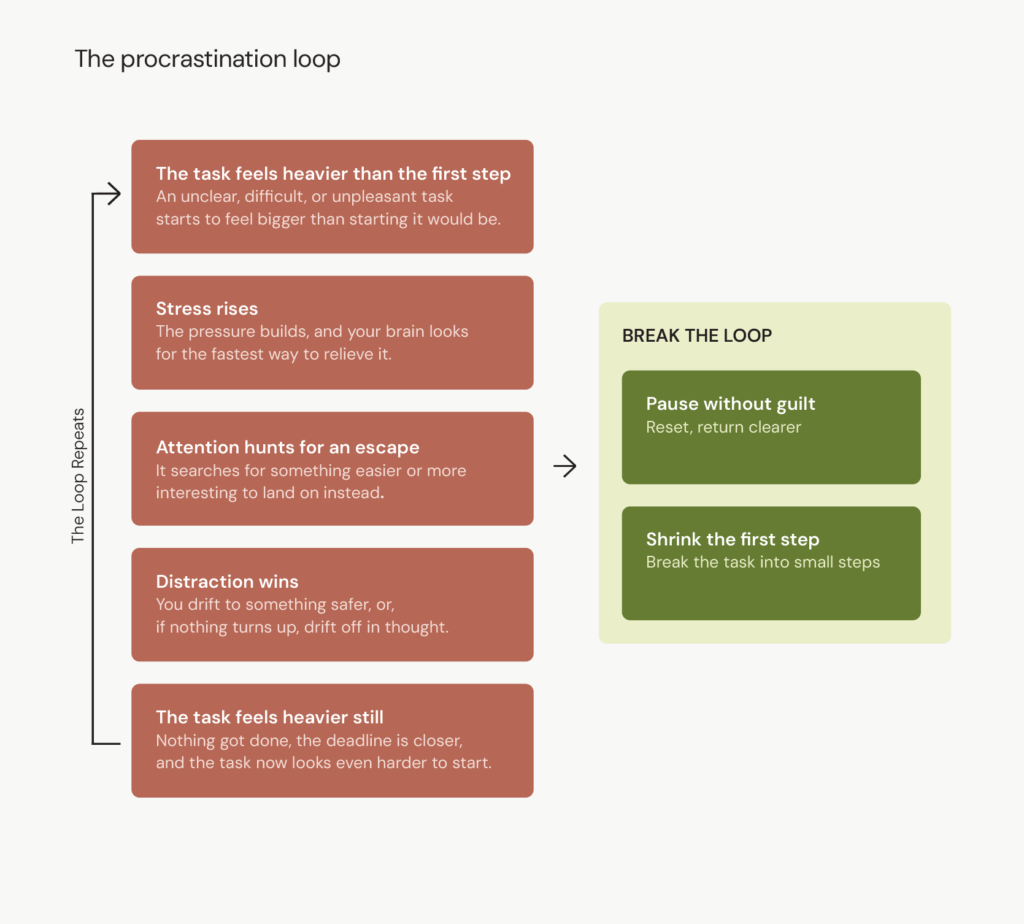
Everyone procrastinates, and the resistance to starting work shows up in every field. I think every developer knows this moment. You hit an obstacle, the stress rises, and suddenly, doing almost anything else feels easier than staying with the problem.
For me, this feels like my brain is trying to reduce pressure as quickly as possible. If the task is unclear, difficult, or unpleasant, my attention starts looking for a safer place to go. That usually means hunting for more interesting, easier distractions, and if none turn up, drifting off in thought instead. If that state catches up with you, don't fight it head-on. What helps me more is to pause without guilt. A short break can reset the pressure enough for me to return with a clearer head.
Breaking the problem into smaller steps often makes it feel far less daunting. Starting is the hardest part. Once you find a rhythm, the rest gets easier.
Once you've started, the next challenge is putting the phone down, turning off social media, and sticking to music that helps you focus if you need background noise. Limiting the more interesting stimuli around you makes concentration a lot easier.
Not to forget, remote work makes work-life balance hard. While at home, it's easy to drift away from work, and just as hard to fully leave it behind since it happens in the same space.
Wrapping up personal matters before starting the workday helps. When that's not possible, scheduling them for a specific later slot lets your brain focus on the task at hand. Writing down what's nagging at you, essentially a brain dump, makes a real difference here.
The same logic works in reverse. Before finishing for the day, wrap up what you can. For what's left, set a concrete plan for tomorrow: note what got done, define exactly what didn't, and move it forward deliberately so nothing lingers unresolved. Turning off notifications from work apps keeps them from creeping back into your evening.
Closing as many loops as possible keeps you calmer and more focused. Vague, unfinished tasks, thoughts, or worries are what let procrastination win.
Why it’s hard to control your focus at work
Forcing focus rarely works. Limiting distractions is often the best you can do, and that alone improves your odds considerably. Some tasks just won't pull you in, no matter what. In those moments, don't push, and don't blame yourself for struggling to concentrate.
If you have ADHD, you'll likely recognize this lack of control even more clearly. Focus works differently for a neuroatypical brain. It arrives on its own schedule, so let it come, and give yourself permission to step away in the meantime.
Hyperfocus is common among neuroatypical people: getting so pulled into a task that stepping away feels impossible. I fall into this often. I dig in and won't stop until something's fixed, sometimes ignoring basic needs like food or rest along the way. It can look better than procrastination from the outside, but it's mentally exhausting, and I usually feel drained afterward.
If this sounds familiar, keep an eye on it. Work done this way loses steam fast. Also, it’s easy to lose perspective, which can trap you in a cycle of pushing an approach that clearly isn't working.
Focus, to a large degree, comes down to dopamine, the neurotransmitter behind motivation. It's what makes certain activities feel worth doing. Bigger rewards trigger a bigger dopamine release, which makes you more likely to repeat that effort later.
That's worth using deliberately. Watch out for instant gratification pulling complete focus away from work (limiting the stimuli mentioned earlier helps with this, too). After work, a real reward helps your brain associate effort with something worthwhile.
Dopamine is well worth reading more research about. It's an interesting neurotransmitter tied to a lot of what drives us day to day.
The pursuit of psychological safety: fear shrinks the moment you start
These are the methods that matter most to me. I build systems and routines that clear my head, I talk things through with others, and I've learned to notice when I'm hyperfocusing too hard. When the stimuli and responsibilities pile up, I let myself rest instead of pushing through.
Everyone has to find their own version of this. Reading about it helps, and staying open to new approaches helps too, but real learning happens by doing it.
No amount of reading replaces firsthand experience in this industry. After years of doing this work, my stress looks nothing like it did early on. That sense of agency brings a sense of calm that no article can give you.
Fear rarely goes away completely. Look at what's driving it, ask where it's coming from, and figure out what's within your control. Sometimes, a few honest questions are enough to shift your whole reality.
FAQ
How to stop procrastinating with ADHD?
Procrastination with ADHD often comes down to a dopamine gap: tasks that don't feel immediately rewarding get pushed aside in favor of something more stimulating. Breaking work into small, concrete steps and cutting down nearby distractions are resources that make it easier to start, and building in a reward after finishing helps reinforce the habit. A proper diagnosis and guidance from a doctor helps too. They point toward strategies built around how your focus really works, not a routine that was never going to fit.
How to stay motivated in your career?
Motivation holds up best when it's backed by simple systems. A work journal, a short daily plan, or the habit of breaking big goals into smaller steps that demonstrate visible progress all help. For example, talking through problems with colleagues instead of struggling alone also keeps motivation from draining away, and it's a form of psychological safety. Comparing your process to someone else's results, meanwhile, is one of the fastest ways to lose it.
How to ask for help at work effectively?
Asking for help works best when it's specific: describe what's already been tried, where things got stuck, and what kind of input would move things forward. Framing the question around an unclear task or ambiguous requirement, rather than a personal skill gap, also makes it easier to ask without it feeling like an admission of failure.
What are some productivity tips for software developers to stop procrastinating?
Effective developer productivity relies on implementing systems that mitigate negative consequences such as cognitive friction and mental overload. Keep a work journal to track your tasks and get a clear record of progress, simplifying daily status meetings and preventing you from having to reconstruct your day from memory. Break down complex tasks into small, concrete, and achievable steps to make starting feel much less daunting. Use rubber duck debugging when you feel stuck, and explain the problem out loud (whether to a rubber duck, a colleague, or yourself). This process forces you to organize your thinking and often reveals the missing solution mid-explanation. Practice brain dumps when you feel overwhelmed by writing down every thought or task. This clears mental space, separates noise from priorities, and helps you relax.