TL;DR: Modernizing legacy logistics systems is often evaluated against the wrong baseline: project cost instead of the cost of standing still. Developers report spending 42% of their time on maintenance and technical debt rather than new work, and nearly a third of CIOs say more than 20% of their budget for new development gets redirected to fixing existing technical debt instead. A cost-benefit framework must weigh that ongoing drain, plus the hidden operational costs of delay, against the cost of modern technologies. Cloud migration also impacts accounting, shifting spend from upfront capital expense to ongoing operational expense.
Key terms
- Technical debt: the accumulated cost of shortcuts, patches, and workarounds in a legacy system, paid back in the form of slower changes and rising maintenance spend over time.
- Total cost of ownership (TCO): the full cost of a system over its lifetime, including licensing, existing infrastructure, maintenance, talent, and the productivity lost to working around its limitations, more than the sticker price alone.
- CapEx (capital expenditure): an upfront investment, like owned servers or a perpetual software license, that's depreciated on the balance sheet over several years.
- OpEx (operational expenditure): an ongoing, consumption-based cost, like a cloud subscription, expensed in the period it's incurred instead of depreciated over time.
- Legacy system: software still running critical systems and operations that can no longer be easily updated, integrated, or supported, often because of outdated systems and architecture, retiring vendor support, or a shrinking pool of people who know how it works.
Legacy application modernization is a yearly topic of conversation when discussing budgets, and it loses every time because the only number on the table is what the legacy system costs to keep it alive.
A legacy transportation management system, warehouse system, or dispatch platform keeps generating costs every month it stays in place: maintenance labor, the specialists it takes to keep it running, and the decisions the logistics team can't make. That bill rarely appears anywhere near the maintenance line.
That’s the other side of the comparison: what a legacy system costs you versus what it costs to fix.
Five things matter here: what a legacy system costs today, what delay adds on top of that, how to calculate an ROI case, how cloud migration changes the accounting, and what legacy system modernization returns beyond the line items in a spreadsheet.
What does an outdated legacy system in logistics cost you today?
Maintenance budgets tend to get a lot of attention, but there’s more to them. Stripe's Developer Coefficient survey found that engineers report spending roughly 42% of their work week, about 17 of 41 hours, on maintenance and technical debt rather than new development. A separate McKinsey CIO survey found that nearly a third of respondents redirect more than 20% of their new-development budget to pay existing technical debt before year-end.
For a logistics operation, maintenance is only part of the bill. A legacy transportation management system (TMS) or dispatch system that can't integrate cleanly with a modern warehouse management system (WMS), carrier API, or customer-facing tracking tool forces manual workarounds. This can include rekeying data, reconciling spreadsheets, or chasing down exceptions by phone - work that absorbs real staff capacity every week (the example later in this piece puts an illustrative number on that time, since no neutral industry-wide benchmark for it exists).
What are the hidden costs of delaying logistics software modernization?
The costs that are hardest to measure are the ones that compound until they force a migration on someone else’s schedule instead of your own. Three matter most:
- Knowledge concentration: Legacy systems accumulate specialized institutional knowledge in a small number of people, sometimes one, and that risk doesn't announce itself until someone retires, leaves, or is unavailable during an outage. Any industry running critical operations on legacy logistics software carries this same risk.
- Integration debt: Every workaround, one-off script, or manual fix patched on to keep an aging system limping along adds another point of fragility. Each one makes the eventual migration larger and riskier than it would have been a year earlier.
- Opportunity cost (specific to logistics): real-time visibility, dynamic routing, and predictive exception handling are now table stakes for shippers and their customers, and a system that can't support them is costing the business real deals and renewals, lost to competitors who modernized first.
Delays compound these costs. Teams that finally migrate two years from now will almost certainly find the system harder and more expensive to move than it is today.
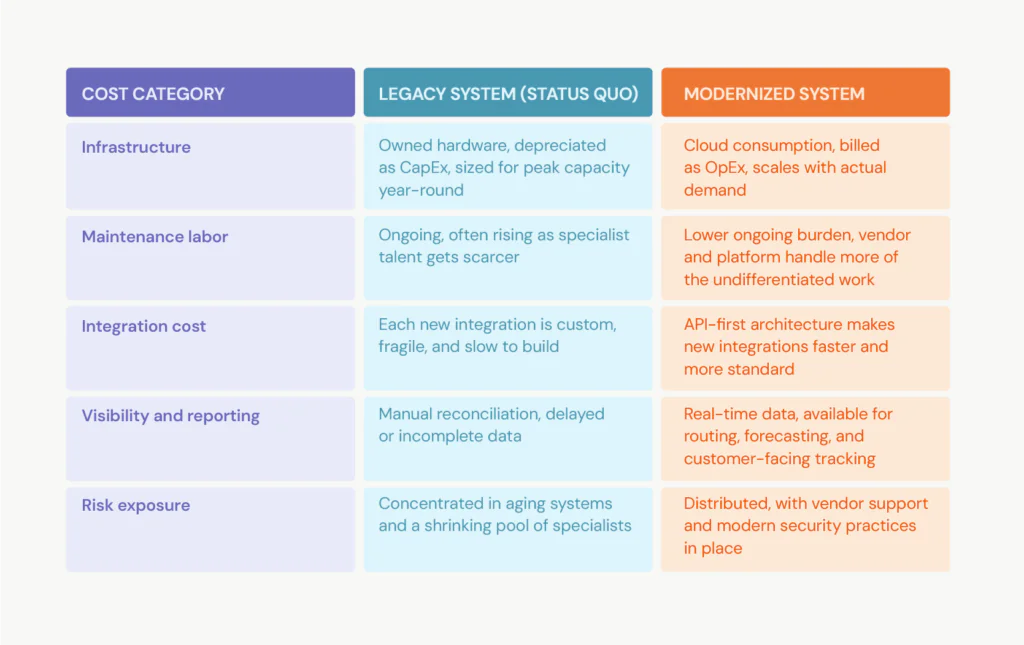
How do you calculate the ROI of modernizing a legacy logistics system?
A defensible ROI case starts with total cost of ownership on both sides. Modernizing has real costs too: implementation spend, the risk of running both systems in parallel during migration, and the retraining time a new platform requires. Weighed against what it returns, not just the savings that are easiest to quantify, is where the real number lives.
The realistic version of this framework produces a range built on the cost of the system in front of you rather than a generic industry benchmark.
| Framework dimension | Legacy system cost & risk (TCO) | Modernized system benefit |
| Infrastructure & maintenance | Ongoing maintenance spend and fixed CapEx hardware costs, sized for peak capacity year-round | Reduced maintenance overhead, shift to a consumption-based OpEx cloud model |
| Specialist talent & labor | High risk from knowledge concentration and a shrinking pool of legacy-tech specialists | Lower dependency on scarce legacy skills, easier to hire and onboard |
| Operational efficiency | Manual workarounds, data rekeying, and exception handling that absorbs staff time daily | Automated data flows, fewer billing and exception errors, faster response |
| Integrations & adaptability | Custom, fragile APIs that compound integration debt over time | API-first architecture that connects new carriers, tools, and analytics in weeks |
| Scalability & responsiveness | Sized for peak capacity year-round, with reactive issue resolution | Dynamic resource scaling and real-time visibility for proactive routing and tracking |
| Financial & market impact | Hidden costs of delay: outage risk, deals and renewals lost to faster-moving competitors | Measurable logistics cost reductions (in the 5 to 20% range) once modern, integrated systems and AI-driven routing or forecasting are in place |
| Security & compliance | Aging systems concentrate risk around customer PII, carrier API exposure, and supply-chain cyber vulnerabilities, often without modern patching or monitoring | Current security risk practices and vendor-managed patching reduce exposure across the same surface |
That bottom-row range varies depending on whether the new system supports AI-driven routing, forecasting, and exception handling, rather than simply replacing the old one with newer hardware.
What does this look like with real numbers?
The figures below are illustrative, not a benchmark. The categories and methods are to be applied to your own numbers.
A mid-size logistics operation running a legacy TMS might see a 3-year total cost of ownership around $810K: roughly $540K in specialist and maintenance labor, $93K in manual workaround labor (rekeying, reconciliation, phone-chased exceptions), and $180K in owned infrastructure and licensing.
Modernizing that same entire system might run a 3-year TCO around $670K: a $250K upfront migration cost in year one, plus $240K in ongoing cloud OpEx and $180K in ongoing maintenance labor, down from the legacy level.
The payback point, where cumulative modernized spend drops below what moving legacy systems would cost by the same month, lands around month 23, with the legacy system's flat, ongoing bill overtaking the modernized system's front-loaded-then-lower one. Net savings over the full three years land around $140K, on top of the risk this doesn't price in: the outage or integration failure the legacy application never had to survive during those three years.
How does cloud migration shift logistics IT spend from CapEx to OpEx?
An owned, on-premises logistics system is a capital expense: hardware purchased upfront, depreciated over several years, sized for peak demand that might only happen a few weeks a year. That sizing decision is expensive twice: once when you buy the capacity, and again when it sits idle outside peak.
Cloud migration turns that spend into an operational expense: a consumption-based cost that scales up during a peak shipping season and back down after it. It's expensed in the period it's incurred, which has a practical effect. Teams can approve OpEx budgets incrementally and adjust them more easily than a large upfront capital request. That means they can start small before committing to a full budget. The tradeoff is that you need to actively manage OpEx costs.
What does digital transformation in logistics deliver beyond cost savings?
Cost reduction is the easiest benefit to put on a spreadsheet, but it can undersell what modernization effort looks like operationally. Real-time visibility into shipments, inventory management, and fleet status turns exception handling from a reactive phone-and-email process into something a dispatcher can see and act on before a customer notices a problem.
Data that used to sit in disconnected systems can now feed predictive routing and demand forecasting, which a legacy system’s batch processing simply can’t support in real time.
There's also a customer-facing dimension that's easy to overlook in an internal ROI model. Shippers and end customers expect the same live tracking and proactive updates that consumer logistics platforms have normalized. A modernized system makes that possible directly, instead of forcing a second, parallel system just to expose data the core platform can't share. The real payoff is harder to put on a P&L. It shows up as deals that don't slip to a faster-moving competitor, service levels that hold during a disruption, and a platform flexible enough to take on whatever integration capabilities or analytics tool comes next instead of blocking it.
How do you modernize a legacy logistics system without disrupting business operations?
The projects that go wrong tend to be the ones that treat modernization as a single cutover instead of a sequence. A phased approach helps you control risk at every step instead of betting the whole operation on one weekend.
- Map what the legacy system does today. Years of workarounds and manual patches mean the system's real behavior has drifted from its original design. Document the actual data flows and integrations before planning what replaces them.
- Prioritize by cost and risk. The highest-maintenance, most fragile integrations are the right place to start, since they carry the most risk if left for later. Often, they're the ones held together by a single person's knowledge.
- Run the new system in parallel before cutting over. A logistics operation can't absorb downtime during a live shipping season. Running both systems side by side, even briefly, catches data and integration mismatches while the legacy system is still there as a fallback.
- Migrate by workflow. Cutting over one full process end-to-end, like carrier booking or exception handling, tends to be safer than a partial cutover.
- Treat the new system's integrations as ongoing work. A modern platform's competitive advantage is how easily it takes new integrations. That advantage erodes if the team stops treating integration work as a continuing capability once the migration itself is done.
Legacy systems run up a bill nobody's tracking.
Legacy logistics cost-benefit analyses often compare modernization to a cost of zero. Doing nothing has a real cost too, spread across maintenance budgets, specialist salaries, manual workarounds, and deals lost to a competitor who could move faster. Once both sides of that comparison are on the table, the “cheaper” option is seldom the one that looks cheaper on the maintenance line item alone.
That's a harder analysis to build than a simple project quote, and most logistics teams don't have the bandwidth to run it alongside daily operations. Svitla works with logistics and transportation companies on this kind of modernization, from the initial cost assessment through a phased migration that keeps operations running throughout.
See how Svitla supports logistics and transportation software development.
FAQ
How long does it typically take to see tangible financial returns after modernizing legacy logistics systems?
It depends on what's being measured. Operational gains, fewer manual workarounds, faster exception handling, tend to show up within the first few months after a workflow goes live on the new system. Once the migration cost is factored in, full financial payback more commonly falls in a six-to-eighteen-month range, depending on how entangled the legacy system was and whether the migration ran in phases or as one large project.
Should a logistics company modernize in phases or replace the whole system at once?
Phased almost always carries less risk, particularly for a system a logistics operation depends on daily. A full replacement can be justified when the legacy system is so tightly coupled that partial migration isn't realistically possible, but that's the exception.
What's the difference between modernizing a legacy system and simply migrating it to the cloud?
A lift-and-shift migration moves the existing system onto cloud infrastructure without changing how it works. This can reduce some infrastructure costs but leaves the underlying integration and maintenance problems in place. Modernization means rearchitecting the system, or replacing parts of it, so it can take real advantage of what cloud infrastructure enables, like real-time data and seamless integrations, instead of just running the outdated technology on newer hardware.
Do smaller logistics or trucking companies see the same ROI as large enterprises?
The proportions tend to favor smaller operators more. A smaller company tends to have fewer, less deeply entangled integrations. This makes the migration faster and less risky. The operational gains also tend to matter more competitively for a smaller operation, particularly around exception handling and real-time visibility, since it can't absorb service failures the way a larger competitor might.
What's the biggest reason logistics modernization projects fail to deliver their expected ROI?
Treating the migration as a one-time project instead of an operating shift. A team can modernize the platform and still fail here, if it doesn't change how it plans capacity, manages integrations, or reviews cost on an ongoing basis. Within a few years, it often ends up rebuilding some of the same technical debt, just on newer infrastructure. Svitla's cloud development team works with logistics operators on the operating model, since the migration itself is only the first step.