


Semantic point mapping
Maps vendor point names to Brick or Project Haystack tags.
Suggests tags automatically with AI and lets engineers confirm them.
Builds the equipment hierarchy from zone to plant.
Flags missing, frozen, or out-of-range sensors.

A building automation system raises alarms when a value crosses a limit. It doesn’t explain why. A warm zone could mean a failed actuator, a bad sensor, or a chiller sequence fighting itself. Operators chase symptoms, and many faults never trigger an alarm.
Svitla builds fault detection and diagnostics (FDD) software that continuously reads your trend data. It tests equipment against engineering rules and learned baselines, isolates the likely cause, and estimates each fault’s cost. Your team gets a short, ranked list instead of an alarm flood.
You need to know what to fix today and where to start. FDD points to the equipment and the probable cause, not just the symptom.
You run ongoing commissioning for many clients. FDD gives you one place to monitor every site and prove your service value.
You run chillers, boilers, and thermal storage for many buildings. FDD watches plant efficiency and flags drift before it shows up in kW per ton.
FDD has a strong track record. Berkeley Lab found that organizations using FDD tools reached 9% median annual energy savings after two years of use. The gap is between finding faults and fixing them.

We start with the decisions your team makes every week and the questions behind them. Each one becomes a requirement.
We map source systems, data owners, and quality gaps. Where we can, we fix problems at the source.
We agree on definitions with operations and finance, then build each one once in the shared data model.
Below, Svitla shares a sample feature set that forms the core of a fault detection and diagnostics solution. Each real-life use case is unique, so you should elaborate on the functionality and tailor it to your equipment, BAS vendors, and maintenance process.
Maps vendor point names to Brick or Project Haystack tags.
Suggests tags automatically with AI and lets engineers confirm them.
Builds the equipment hierarchy from zone to plant.
Flags missing, frozen, or out-of-range sensors.
Covers air handlers, rooftop units, VAV boxes, chillers, and boilers.
Includes economizer, valve leakage, and simultaneous heating and cooling rules.
Lets engineers edit thresholds and add custom rules.
Versions every rule change for audit.
Learns normal behavior for each piece of equipment.
Adjusts for weather, occupancy, and schedule.
Flags slow drift and unusual patterns.
Explains which signals drove each anomaly.
Links symptoms across zone, air handler, and plant levels.
Ranks possible causes by likelihood.
Suppresses downstream faults caused by one upstream problem.
Shows the trend evidence behind each diagnosis.
Estimates energy waste per fault in kWh and dollars.
Weighs comfort, equipment wear, and occupant complaints.
Sorts the fix list by impact.
Tracks how long each fault has been open.
Creates work orders in your CMMS with the diagnosis attached.
Confirms the fix from post-repair data.
Reopens faults that come back.
Reports verified savings by site and fault type.
Answer a few simple questions to find out whether you should choose a custom solution or a pre-built fault detection and diagnostics platform.
Do your operators ignore most BAS alarms because there are too many?
Do you run buildings with BAS systems from more than one vendor?
Are your point names inconsistent across buildings?
Have you tried an FDD tool that flagged faults nobody acted on?
Do you need faults to create work orders in your CMMS automatically?
Do you have custom equipment or sequences that standard rule libraries miss?
Would AI-based anomaly detection help you catch faults without rules?
Do you need to prove verified energy savings to leadership or clients?
Thank you! We will be in touch soon.
Below, Svitla outlines the ROI factors a fault detection and diagnostics solution typically affects. Results depend on your buildings, equipment age, and starting point, so model them on your own data.
Less simultaneous heating and cooling.
Fewer schedules left in override.
Economizers that actually use free cooling.
Less time spent on troubleshooting.
Fewer repeat visits.
Parts ordered before the truck rolls.
Less short cycling and hunting.
Early warning before wear turns into failure.
Better input for replacement planning.
Better occupant satisfaction.
Stable conditions in critical spaces.
Fewer hot and cold calls.
Verified savings for leadership reports.
Evidence for utility incentive programs.
Clear value for commissioning service clients.
FDD lives or dies on data quality and false alarms. Point names vary by contractor, sensors drift, and every building runs its own sequences. A tool that cries wolf gets ignored within weeks, so the build focuses on trust.
We inventory your BAS networks, point lists, and trend settings. We tag points to Brick or Project Haystack and build the equipment hierarchy. We fix trend intervals where data is too sparse to diagnose.
We apply a fault library to your equipment and run it against historical data. Engineers review every early finding to cut false positives. Anomaly models learn each unit’s normal behavior across seasons.
We connect findings to your CMMS, define who gets which faults, and build the operator and manager views. We calibrate cost estimates with your meter data and utility rates.
We pilot on a few buildings, measure verified savings, and tune the rules. We then roll out to the rest of the portfolio with a repeatable onboarding process.
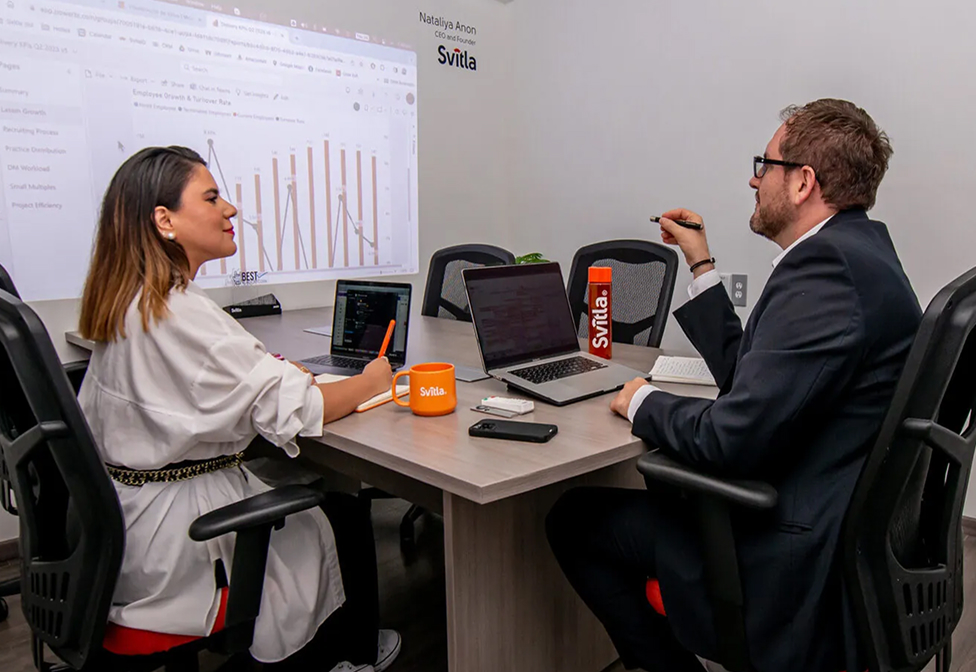
A focused FDD tool for one campus or a small client base typically costs $90,000 to $180,000. It covers one or two BAS protocols, a core rule library for air-side equipment, and CMMS ticketing. A multi-site platform with plant diagnostics, AI anomaly detection, savings verification, and multi-tenant access typically costs $200,000 to $450,000. The final cost depends on the number of protocols, equipment types, and sites.
Want to understand the cost of your fault detection and diagnostics software?
Calculate the costAnswer a few questions about your buildings and goals. We’ll prepare a tailored cost estimate for your project.
Thank you! We will be in touch soon.
What our clients say about us

Discover how we modernized an ESG risk management platform by optimizing deployments, cutting disaster recovery time from an hour to 10 minutes, and enhancing observability. This led to better performance, scalability, and data protection for enterprises worldwide.
Discover how we transitioned a US solar energy supplier to a new business model focused on energy management, developing a comprehensive platform for payment estimation and billing, integrating seamlessly with external systems.

Uncover how we modernized a leading fuel management platform, transitioning from a monolithic to a microservices architecture, developing cross-platform mobile applications, and enhancing security features, significantly improving system reliability and user experience.
With 23 years of experience in engineering energy software and practical knowledge of 10+ industries, Svitla offers full-cycle consulting and engineering services to deliver effective fault detection and diagnostics solutions.
We review your BAS data, alarm practices, and maintenance workflow, then define an FDD scope with a clear savings case.
We build FDD software around your equipment, protocols, and work order process.
We audit your current alarm setup or legacy analytics tool and plan the move. The new system adds root cause ranking the old one lacked. We migrate site by site and confirm fault accuracy after cutover.
BAS alarms fire when one value crosses a limit. FDD looks at many points over time and across systems. It finds faults that never trip an alarm and explains the likely cause.
We run every rule against your historical data first. Engineers review early findings, and we tune thresholds to your equipment. A fault must also persist before it reaches your team.
It’s the normal starting point. AI suggests tags for each point, and engineers confirm them. Once mapped, the same rules work across every building and vendor.
It can for some faults, such as schedule overrides or setpoint drift, if you allow write access. Most clients start in read-only mode. Automatic correction is added rule by rule, with clear limits.
The system checks sensors against related readings and physical limits. The system flags a suspect sensor as its own fault. Rules that depend on it are paused, so one bad sensor doesn’t create a flood of false findings.
Yes. We can build multi-tenant access, client-branded reports, and per-site billing data. Each client sees only their own buildings.