The most common answer to the AI software development cost question is a range so wide it is useless: $10,000 to $5 million, depending on what you are building. That answer is technically accurate, but it tells you little about your project or what sits underneath it.
Behind that range, there's almost always the same set of problems. Data that looks clean enough for a demo turns out to need months of preparation before a model can use it. Integration work, initially scoped as a few sprints, balloons into a full engineering engagement once someone maps the systems involved. Inference costs modeled at pilot volume look very different at ten times the load.
Gartner found that 60% of AI projects will be abandoned through 2026 because they lack AI-ready data. The bottleneck is frequently found on models that are trained on or depend on data, and that data tends to be messier, more expensive to prepare, and harder to govern than any initial scope assumes.
Five decisions determine where the budget goes. Get them right early, and the cost ranges below start to make sense.
What do AI cost estimates miss, and why do costs vary so much by project?
The quote and the final invoice rarely match. Cost estimates typically cover only the development phase: engineering hours, model selection, and initial infrastructure setup. Budget is spent to ensure the prototype runs reliably, at volume, and with the governance the business requires.
Only 48% of AI projects reach production, according to a Gartner survey. The other 52% burn the budget, produce a prototype, and stop there. Projects get approved on prototype economics. The integration, data governance, and infrastructure work that follows costs more than the prototype did and almost always more than planned.
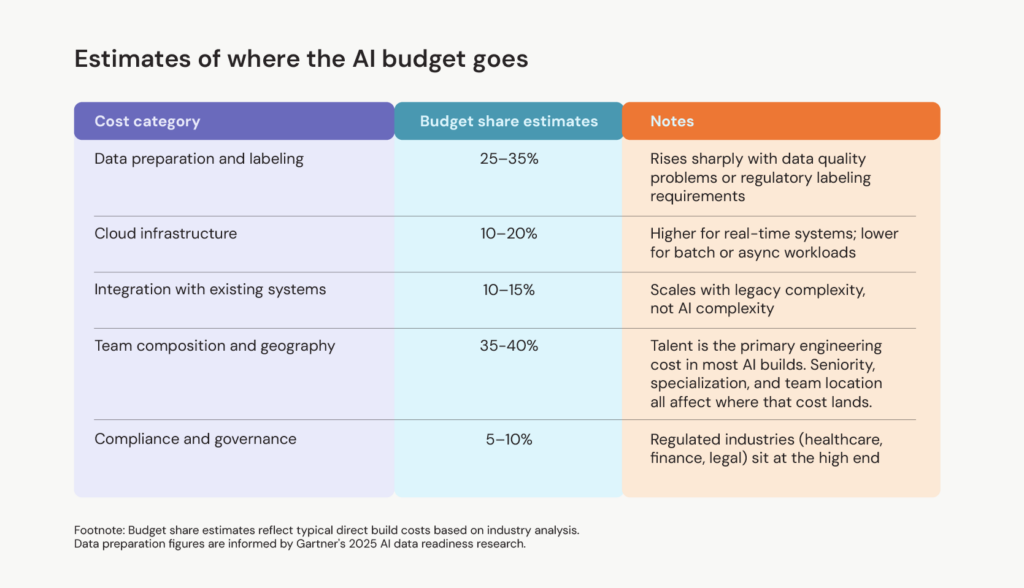
The exact cost depends on five variables: data readiness, infrastructure, integration depth, team location, and compliance environment.
Data quality and preparation
Data preparation is the line item most AI budgets get wrong. It usually costs more than the estimate and takes longer than the rest of the work combined.
Gartner found that 63% of organizations either lack the right data management practices for AI or aren’t sure whether they have them. A data audit and AI readiness assessment closes that gap early in the project, rather than mid-sprint, when course correction is expensive.
Cloud infrastructure
Infrastructure compute splits into two costs: inference and training. Inference is ongoing and occurs every time the model produces an output. Training is a one-time cost when you build the model, plus periodic costs each time you update it.
AWS cut H100 GPU pricing by approximately 44% in mid-2025, reducing training costs, according to AWS EC2 pricing data. Inference costs at production scale are a different story. Many enterprise AI projects run into financial issues after launching because the inference cost curve was never stress-tested at production volumes. You should plan for inference at 1x, 10x, and 100x expected load before the architecture is finalized.
Integration depth
Integration costs scale with the complexity of the stack you're integrating into. An AI model that has to read from proprietary databases, write into legacy systems, and trigger workflows in a third-party platform requires deep integration of engineering. In greenfield environments with modern API architecture, integration work remains relatively contained.
Team composition and geography
AI engineer contractor rates range from $65–$130 per hour in the US to $30–$55 per hour in Central Europe and $40–65 per hour in Latin America, according to 2026 market data from Glassdoor and lemon.io.
Offshore teams in Eastern Europe run 35–55% below US contractor rates, according to the same market data. Nearshore teams in Latin America run 20–40% below, according to GoGloby's 2026 Applied AI Engineer analysis. The savings hold when project management, code review, and requirements handoff are handled well, and evaporate when they aren’t.
Compliance and regulatory requirements
Compliance adds cost in two ways.
- Documentation: regulated industries require audit trails, explainability reports, and behavioral logs proving the system operated within defined parameters.
- Architecture: compliance rules dictate what data you can train on, where model weights can live, and which inference providers you can use.
Both require additional engineering work, and it’s hard to add them later once the system is built. It’s much cheaper to include compliance from the start than to fix issues after an audit.
What does AI software development cost by project type?
Breaking cost down by project type is the clearest way to see where the money goes. The use case shapes the architecture. The architecture shapes the data requirements. And the data requirements determine where most of the budget goes.
AI solution development cost by project tier (2026)
| Project tier | Development cost range | Typical timeline | Primary cost drivers |
| Proof of concept | $70,000+ | 8–10 weeks | Scoping, model selection, basic data pipeline |
| AI chatbot or assistant | $30,000–$150,000 | 6–12 weeks | NLP integration, guardrail architecture, CRM/system integration |
| Custom ML system | $80,000–$400,000 | 12–20 weeks | Real-time infrastructure, labeled training data, and compliance explainability |
| Enterprise AI platform | $300,000–$1.5M+ | 8–18 months | Multi-system integration, governance layer, custom model training, security |
Footnote: These ranges represent typical industry costs based on publicly available 2026 market data. Actual costs vary by data readiness, integration complexity, and team geography. Engineering costs only; data preparation, infrastructure, and inference are additional.
Proof of concept (PoC)
A well-scoped PoC validates whether the AI approach works on client data, whether the use case is technically feasible, and whether the projected ROI holds under real conditions. At $70,000+ and 8–10 weeks, it is the lowest-cost way to get a go/no-go signal before committing to a larger investment. Svitla's Proof of Concept delivers a working solution on client data within that window.
AI chatbot or assistant
A chatbot or assistant built on a pre-trained model with basic question-and-answer functionality runs $30,000–$150,000. Costs climb quickly when the system needs to pull from proprietary knowledge bases, maintain guardrails in regulated environments, integrate with CRM or HRIS systems, and handle edge cases. The guardrail architecture, the layer that prevents the model from producing outputs the business cannot stand behind, is frequently underestimated as a cost item.
Custom ML system
Machine learning systems for specific business problems (fraud detection, demand forecasting, quality control, clinical decision support) occupy the widest cost range at $80,000–$400,000. They vary most by data requirements and regulatory context. A fraud detection system needs real-time decisions, large volumes of labeled data, and explainability that holds up in front of internal risk teams and external regulators. A demand forecasting model needs historical, granular data and integration with supply chain systems. The engineering cost is the smaller variable. Data and compliance costs drive the range.
Enterprise AI platform
Enterprise AI platforms cover the full stack: custom model training, multi-system integration, governance layer, security architecture, and production infrastructure. At $300,000–$1.5 million or more, this is where data preparation, integration, and compliance costs multiply quickly. The upfront cost is substantial at this tier. So is the payback when the system is scoped and built correctly.
There is one planning rule that applies across every tier: the ranges cover engineering only. Data preparation, cloud infrastructure, and ongoing inference costs are additional and, in some tiers, will exceed the engineering budget.
What does AI model training cost?
Training and inference are two budget problems, and confusing them is one of the most common reasons AI budgets break once the system goes live.
Training
Enterprise AI development projects typically go one of two routes: fine-tuning a foundation model on proprietary data or connecting one to internal knowledge bases through retrieval-augmented generation (RAG). The second requires no training at all.
When fine-tuning is the route, the method sets the cost. LoRA and QLoRA update only a small subset of a model's parameters, or run them in quantized form, so they use far less compute than a full fine-tune, which updates every parameter.
For a 7-billion-parameter model, a LoRA or QLoRA run often costs a few thousand dollars, while fully fine-tuning the same model runs several times higher because it needs more GPU memory and longer training time. Training a foundation model from scratch is a different category of spend altogether, well above what any single enterprise use case would justify.
Inference
Inference accounts for 80–90% of the lifetime cost of a production AI system, according to
NVIDIA and Hakia industry analyses on AI infrastructure economics. Training is a periodic capital investment. Inference is an ongoing operational one. Training costs are finite and predictable, while inference costs grow with usage and are harder to cap.
The unit cost of inference has dropped sharply. The Stanford HAI 2025 AI Index tracked the cost of querying a model at the GPT-3.5 performance level and found it fell from $20 per million tokens in late 2022 to $0.07 per million tokens by late 2024.
Cheaper tokens don't automatically mean a lower bill. Gartner found that agentic AI models require 5–30 times as many tokens per task as a standard GenAI chatbot. As systems get more capable and more autonomous, they consume more tokens to complete each task. Token unit costs are falling. Token volume is rising faster.
The distribution of AI compute costs is also shifting. Inference workloads now account for roughly two-thirds of all AI compute in 2026, according to a recent AI infrastructure analysis. Organizations that built their infrastructure planning around training costs are finding themselves under-resourced for the workload that dominates production AI.
What ongoing costs should you plan for after deployment?
IDC’s Global 1,000 panel of large enterprises will underestimate their AI infrastructure costs by 30% through 2027, according to IDC research reported by CIO.com. Those overruns almost always come from operational costs, which become visible after the system goes live.
For a $400,000 mid-market project, operational costs are big enough to change the business case if they were not modeled at the point of approval.
Four ongoing costs drive most post-deployment spending.
- Model retraining
AI models degrade over time as the data they were trained on diverges from the data they encounter in production. That divergence is called model drift, and it requires periodic retraining cycles to correct. Retraining frequency depends on how quickly the underlying data changes. A fraud detection model in financial services may need monthly updates. That schedule belongs to the operating budget from day one.
- Monitoring
A production AI system needs four types of ongoing observation: output quality checks, performance benchmarks, anomaly detection, and behavioral alerts. All of this requires tooling and on-call engineering time to handle alerts. Regulated industries need documented monitoring logs on top of that. Organizations that deploy AI without a monitoring plan discover problems through customer complaints. That is the most expensive way to discover a broken model, and the most damaging to the brand.
- Infrastructure maintenance
Cloud pricing for AI compute continues to fall, which helps the ongoing cost picture. Infrastructure still requires active management: right-sizing compute to workload, switching between on-demand and spot instances as usage patterns shift, and evaluating whether new hardware generations change the economics. Left unmanaged, cloud AI infrastructure drifts toward over-provisioning.
The FinOps Foundation's 2025 Annual Report found that organizations reporting AI as an active cost management concern jumped from 31% in 2024 to 63% in 2025, the fastest two-year increase the Foundation has tracked. Most enterprises were not actively managing these costs until very recently.
- Compliance and governance upkeep
Regulatory requirements for AI systems are dynamic. New requirements emerge, and existing ones get revised. The audit trail you built twelve months ago may no longer meet current expectations. Keeping the governance layer current is an ongoing cost that sits outside most initial project scopes and inside post-deployment budget surprises.
Svitla's AI Leadership and Strategy service covers this dimension, building the governance and cost management framework that keeps AI investment defensible at every budget cycle, starting before the first one.
How does the build vs buy vs partner decision affect the total cost?
Team structure shapes the budget as much as system architecture does. Enterprise buyers have three paths available, and each has a different cost profile, risk, and ceiling for what the system can eventually become.
In-house
Building in-house makes sense when the AI program is a long-term strategic investment, when the data involved cannot leave internal systems, and when the organization has both the engineering depth to staff the team and the retention story to keep them.
US-based AI specialists earn base salaries of $150,000–$300,000 annually, according to Glassdoor and ZipRecruiter data from early 2026. A production-grade team needs ML engineers, data engineers, cloud architects, and integration developers. Five people at senior US rates put fully loaded costs above $1.5 million a year.
The risk is a timeline slip. Pilots can spend 18 months trying to reach production because the team keeps being pulled into other priorities, a pattern that is common across enterprise AI programs.
Off-the-shelf
Buying off-the-shelf is the fastest path to first value milestone for standardized use cases with clean data and simple integrations. Subscription-based AI tools range from entry-level no-code builders to enterprise platform contracts that reach six figures annually.
The risk is the customization ceiling. Off-the-shelf products are typically built for the median use case. When requirements sit at the edges (proprietary data formats, legacy integrations, regulated environments, specific output controls), the platform starts to show its limits in implementation. Every customization becomes a professional services engagement, and those costs are not included in the headline subscription price.
Partnering with a development company
Working with a development partner sits between those two options in cost, speed, and customization range. A partner with engineering teams in Eastern Europe runs 35-55% below US-staffed engagements, while Latin America runs 20-40% below, as covered above.
The risk is dependency: a partner who builds something the client cannot maintain creates an arrangement that keeps paying the partner long after the engagement was supposed to end.
That said, the decision between the paths is not permanent. Many enterprise AI programs start with a partner-built proof of concept, validate the approach, and then decide whether to build the production system in-house, extend the partnership, or augment an internal team with specialist support.
Budget for production. The AI software development cost is just the start.
Enterprise AI budgets get approved on the strength of the build estimate. They get tested on the strength of everything that comes after it. Planning an AI investment well means modeling the full cost picture: data preparation, production-grade infrastructure, integration depth, ongoing inference, compliance upkeep, and retraining.
Those costs are consistently underweighted at the stage when they are least expensive to account for. A proof-of-concept that validates data readiness, architecture fit, and ROI is where that uncertainty gets solved.
The ranges in this article are starting points. Every AI cost estimation exercise eventually narrows to the specifics of your organization's data, team's integration requirements, and use case compliance obligations. What stays consistent across every project is where the money goes and when the surprises arrive, so it’s always recommended to plan for both.
Svitla's AI practice offers Bright AI Sessions that are designed for that planning stage: structured working sessions that map use cases, data readiness, and integration complexity to a cost model before development commitments are made.
FAQ
How much does it cost to build an AI solution?
A proof-of-concept runs $70,000+ and takes 8–10 weeks. A chatbot or assistant runs $30,000–$150,000. A custom ML system costs $80,000–$400,000. An enterprise AI platform runs $300,000–$1.5 million or more. Those ranges cover engineering only. Data preparation, infrastructure, and ongoing inference are additional. The more useful planning exercise models what the system costs to run at production volume.
What is the financial impact of using privacy-preserving AI techniques?
Privacy-preserving techniques, including federated learning, differential privacy, and secure multi-party computation, add engineering costs at the build stage and reduce compliance costs and risks downstream. Federated learning trains models across distributed data without centralizing it, which requires more complex infrastructure. Differential privacy adds noise to training data to protect individual records, requiring model evaluation to keep the privacy-accuracy trade-off within acceptable bounds.
How does data availability impact AI development pricing?
Data availability has one of the widest impacts on total project cost. The cost impact runs in two directions. The first is direct: data cleaning, transformation, labeling, and validation are billed as engineering hours. The second is indirect: data problems that surface mid-build require architecture changes that cost more once engineering decisions are set.
Svitla’s Data Audit and AI Readiness assessment maps the data gap from the beginning, when it can still be planned for.
What is the cost difference between custom AI and off-the-shelf AI solutions?
Off-the-shelf AI tools offer lower upfront costs and faster time-to-first-value. Subscription pricing ranges from entry-level no-code tools to six-figure enterprise platform contracts. Customization for edge cases (proprietary data, legacy integrations, regulated environments, specific output controls) has vendors billing at rates comparable to custom engineering. Custom AI development costs more upfront and pays off when the use case falls outside what standard products cover. The cost difference between the two paths narrows considerably once customization fees are fully accounted for.
What ongoing costs should be considered after AI deployment?
Four categories account for most post-deployment spending. Model retraining recurs on a schedule tied to how fast the underlying data changes. Monitoring requires tooling and engineering time to observe output quality and catch performance degradation. Infrastructure management involves right-sizing compute to workload and evaluating whether pricing changes shift the economics. Compliance and governance upkeep maintain the audit trail current as regulatory requirements evolve.