TL;DR: FinOps for AI workloads applies budget discipline to a cost line that moves with every prompt, rather than resetting after a single provisioning decision. In 2026, Gartner expects AI inference infrastructure spending to overtake AI training spending for the first time, a signal that inference is now the bigger number CTOs must defend. This means AI's operating cost is the bigger number CTOs must now defend. This piece explains why inference behaves differently from a normal cloud bill, how that spend leaks into a typical AI stack, and how model routing and basic AI budget management bring it back under cost management control.
Key terms
FinOps for AI: Applying FinOps's cost accountability and forecasting practices to AI workloads, where usage-based billing and unpredictable demand break most of the assumptions built into traditional cloud budgeting.
Inference: The stage where a trained model processes a request and returns an answer. Unlike training, which happens periodically, inference cost accrues continuously with every query.
Token: The basic unit a language model processes, roughly four English characters. Providers bill input and output tokens separately, and output tokens typically cost three to five times more.
Model routing: Send each request to the least expensive model that can handle it, and reserve the most expensive frontier models for tasks that need their extra reasoning depth.
Unit economics: Measure cost per query, per user, or per completed outcome, not as a single aggregate bill, so a team can tell whether AI spend buys more business value or just more volume.
FinOps for AI workloads starts with an uncomfortable number. Gartner's August 2026 forecast on AI-optimized cloud infrastructure shows inference spending overtaking training spending for the first time in 2026, $23.3 billion against $19 billion
That said, the figure covers GPU instances and other cloud infrastructure, not the model-provider API spend this piece focuses on. It still signals the same shift: inference, not training, is now where AI compute dollars are headed. Model-provider API bills follow the same pattern for a different reason: a usage-based cost that never stops accruing once a model is live.
Training cost is mostly a one-time budget line that a finance team already knows how to forecast. Inference has no such schedule. Its cost scales with usage, growing with each user prompt and each agent step, including the tokens an agent feeds back into its own context.
FinOps for AI projects has gone from a niche concern to a mainstream practice almost overnight. Yet engineering and finance teams still struggle to say what sits behind the inference total on the invoice, and which part of it pays for something the business needs.
Svitla's guide to measuring AI ROI covers the value side of AI spend. This piece covers the cost-efficiency side: what drives inference spend, where it leaks, and how model routing and a working FinOps practice bring it back under control.
AI cost management is becoming as central to AI adoption as the technology choices themselves. As AI vendors push cutting-edge AI technologies and more teams stand up AI initiatives, the question stops being whether to invest. It becomes how to govern AI spend well enough that the investment keeps paying off.
Why does inference cost behave differently than training cost?
Inference cost scales continuously with usage, while training cost is set by a planned compute decision. Three mechanics drive most of that scaling: token volume, context length, and agentic call chains.
Providers bill each request separately for the tokens a model reads and the tokens it generates. According to FinOps Foundation's token economics guidance for AI and SaaS billing, output tokens consistently cost more than input tokens. With every new message, the application resends the full conversation history to the model, so each turn costs more than the one before it, and total cost grows faster than the message count.
Agentic workflows push this further. A single user request can trigger a chain of model calls as an agent plans a task, calls a tool, and checks its own output, all before the user sees one reply. Gartner points to this kind of continuous, multi-step execution as why it expects inference spending to overtake training spending, and why a model that looks cheap per call can still produce an expensive workload once wired into an agent.
Where does the AI budget leak, causing budget overruns?
AI budgets leak wherever spend runs ahead of visibility, and that blind spot is wider than most finance teams assume. Only 13% of technology executives surveyed say they have the cost transparency needed to make informed decisions and sound optimizations, according to Bain's Tech Maturity Assessment Survey.
The missing visibility shows up in a handful of familiar patterns. Capacity gets reserved ahead of expected demand and then sits idle. Prompts and chat histories tend to grow longer with every release, and teams rarely go back to trim them.
On top of that, requests hit a model again for an answer that a cache could have served the first time. Several teams quietly settle on the same frontier model for routine work, each reaching that decision on its own because no one owns the model-selection decision across the organization.
Beyond the patterns above, several bigger leaks don't show up on any per-query estimate. The infrastructure wrapped around the model call, orchestration, vector databases, logging, and retries runs 40% to 60% of total advanced feature spend. And none of it appears on the provider's invoice, according to FinOps Foundation's token economics guidance.
Agentic loops compound the problem. An agent that calls itself, or gets stuck in a tool chain it can't exit, can burn through millions of tokens in minutes.
A third leak sits entirely outside any dashboard. FinOps Foundation reports that engineers pay provider invoices on personal or team credit cards that finance never sees, and calls the resulting shadow spend larger than most finance teams realize.
Reasoning models add a quieter leak on top of the rest. A single reasoning or agentic task can use five to thirty times the tokens of a standard exchange. Each visible answer hides many internal reasoning tokens the model generates first.
No single decision causes this. The bill simply lands twice as high as anyone expected, and no one can point to the moment it went wrong.
How does model routing cut inference AI cost without hurting output quality?
Model routing is one of the highest financial-impact and operational-impact inference cost optimizations available. The FinOps Foundation estimates it can cut average cost per query by 60 to 80% without lowering quality where it matters. Routing matches each request to the cheapest model that can do the job, instead of defaulting to the most capable, most expensive option. Holding that quality line takes active checking of routed answers, not just trusting the threshold to work on its own.
Coinbase offers one of the clearest public examples. In a June 2026 post on X, CEO Brian Armstrong described an internal gateway that classifies each engineering request and defaults routine work to lower-cost control models. Premium models stay reserved for tasks that need their extra reasoning depth. Paired with more aggressive caching of repeated requests, Coinbase's LibreChat deployment saw its cache hit rate rise from 5% to 60%. Total AI spend fell to roughly half its earlier level even as token consumption kept growing.
Routing works only if the classification step is tuned carefully. If too much traffic or traffic spikes go to the cheaper tier, that model starts returning confident, wrong answers on tasks that needed more reasoning. Set the threshold too conservatively, and routing barely saves anything, since almost everything still defaults to the expensive model out of habit. Teams catch quality drift by sampling a share of routed responses for review, rather than trusting the threshold alone.
For a wider view of how chained agent calls are reshaping AI workloads beyond cost, see Svitla's overview of agentic AI trends.
Where the cost reductions come from
| Cost lever | Typical cost savings range |
| Model right-sizing (matching task to the cheapest capable model) | 60% to 90% |
| Prompt caching (reusing cached portions of repeated requests) | 50% to 90% of the cached portion |
| Batch processing (grouping non-urgent requests) | about 50% |
| Context management (trimming conversation history and prompts) | 20% to 60% |
| Output length control (capping response length) | 10% to 40% |
| Volume-based provider discounts | 10% to 30% |
Source: FinOps Foundation, Token Economics for AI and SaaS Models working group guidance. Ranges vary by workload and provider. Model right-sizing produces the largest gains because it changes which model handles the request, not just how the request is formed.

What does a FinOps for AI practice look like when delivering business value?
A working FinOps for AI practice treats inference spend as a managed budget line with clear ownership. Without it, AI becomes an open tab that finance reconciles after the fact. That is AI spend governance in practice: cost visible to the teams generating it, and a budget enforced by something stronger than a quarterly review.
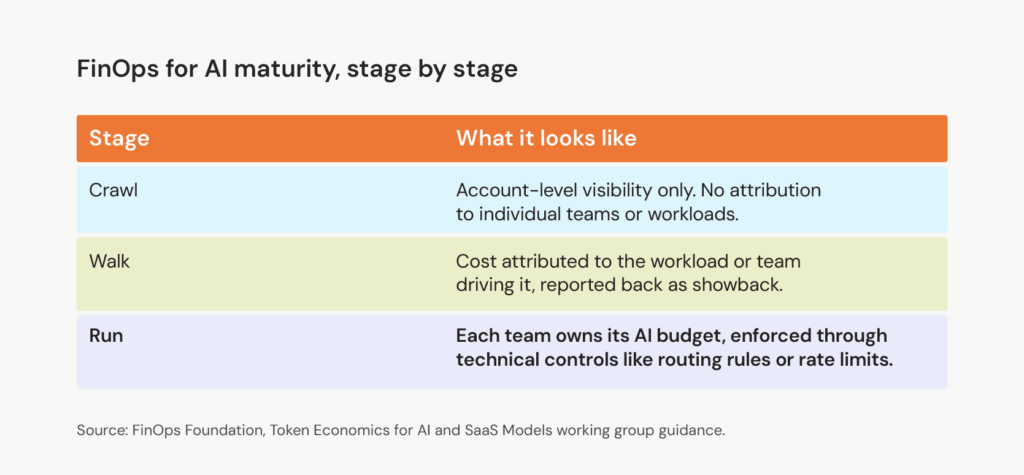
FinOps Foundation frames the shift in three stages. Crawl starts with account-level visibility into what AI is costing overall, with no breakdown by team or workload yet. Walk attributes that cost to the specific workload or team generating it and reports it back to them, before any budget gets enforced. Run assigns each team its own AI budget, backed by technical controls, such as routing rules or rate limits, that keep spend from drifting past what was agreed. That means pairing cost allocation with resource allocation: tracking which team’s workload drove the spend, and adjusting pricing models or infrastructure plans when they stop making sense.
None of this requires waiting to start. Instrumenting routing and cost visibility belongs in the architecture from day one. Hard budget enforcement is the layer that gets added later, once there's enough spend history to set it well. Making any of this stick depends on tracking cost per query, cost per active user, and cost per completed outcome, the measurement FinOps Foundation recommends for AI spend. An aggregate bill can rise for good reasons, like more usage from a feature that's working, or for reasons no one has caught yet. Teams building this governance framework can start with Svitla's AI readiness checklist, which covers the organizational groundwork a FinOps practice depends on.
Measuring cost this way only helps if the goal is sustainable spending, not just lower spend. Cost governance can slow AI down rather than make it sustainable if a team chases the number without checking what it's buying. As Johann Beukes, Svitla's Chief AI Officer, put it, "AI should strengthen the core business. Not compete with it."

AI inference cost is permanent. Plan the AI spending budget accordingly
Training cost tends to level off once a model is stable and reused across workloads. Inference cost never works that way, because it scales with exactly what makes AI worth deploying: people using it. That is the real argument for FinOps for AI workloads: treat it the way a company treats its electricity bill, a predictable cost to budget for, not a surprise to react to each month. AI inference deserves that same permanent budget discipline, built in from the start rather than bolted on after an overrun.
Spending the least is not the goal. Being able to explain where every dollar of AI spend goes, and defend that it bought something worth having, is the actual bar FinOps for AI sets. Building that habit alongside the AI roadmap, rather than bolting it on after the first budget overrun, is where Svitla's AI and machine learning team spends most of its client conversations lately.
FAQ
What is FinOps for AI?
FinOps for AI applies the cost accountability, forecasting, and governance practices FinOps teams already use for cloud spend specifically to AI workloads. The difference is that AI spend runs on token-based, usage-metered billing that moves with every request, which breaks the provisioning-based assumptions most cloud budgeting was built around.
Which tools support FinOps for AI?
Most teams start with whatever usage dashboard their model provider offers, then add a gateway or proxy layer to enforce routing rules and caching across providers, rather than relying on each team to apply them individually. FinOps Foundation's working groups, rather than any single vendor, are a more reliable place to track which tooling categories are maturing, since the tooling itself is still changing quickly.
How do you implement FinOps for AI workloads?
Start with visibility: you need to know what AI costs before you try to change it. From there, the most effective early steps are usually model right-sizing and caching, since both cut costs without much architectural change. Governance, giving teams their own budgets backed by enforced controls, comes later, once you have enough historical spend data to set a reasonable budget.