TL;DR: A forward deployed engineer (FDE) builds and deploys software inside a client’s environment. A solutions engineer demonstrates product fit before the sale. A software engineer builds the core product used across the customer base.
In McKinsey’s 2026 State of AI survey, nearly three-quarters of AI high performers reported fundamentally redesigning workflows, compared with about a quarter of other respondents. When that redesign must happen inside a client’s operations, an FDE can help—though not every AI project needs one.
Key terms
- Forward deployed engineer (FDE): A software engineer who builds, deploys, and adapts software inside a client’s environment. In AI projects, the role connects the product to real workflows.
- Forward deployed software engineer: Another title for an FDE, emphasizing responsibility for writing and shipping production code rather than only configuring or advising.
- AI forward deployed engineer: An FDE who specializes in getting AI models, agents, and data pipelines into production at a client site.
- Solutions engineer: A technical presales specialist who uses discovery, demos, and proofs of concept to show how a product meets a prospect’s needs.
- Customer solutions engineer: A related title some companies use for post-sale technical support.
- Solutions architect: A role focused on designing the client’s target system, usually without owning the build. At some companies, solutions engineering also includes this work.
- Software engineer: An engineer who designs, writes, tests, and maintains a product's code, usually for a product many customers share.
- AI engineer: A software engineer who builds products on top of machine learning models, working across prompts, retrieval, evaluation, and guardrails.
- Deployment engineer: A role focused on installing, configuring, and releasing software into production, usually with less custom building than an FDE.
- Proof of concept (PoC): A small, time-boxed build that tests whether an idea works on real data before a larger investment.
- Minimum viable product (MVP): The smallest working version of a product that real users can test.
- Svitla Forward Deployed Engineering: Svitla Systems' service that embeds senior engineers in a client's environment to redesign a workflow around AI through go-live.
Adding AI tools to an existing workflow is not the same as redesigning it around AI. Someone must rethink the decision rules, controls, and data flows inside the client’s environment. A forward deployed engineer takes on that work, making the AI’s output reliable enough to use in day-to-day operations.
Getting an AI product to a customer involves three distinct responsibilities: proving it fits, building the product, and making it work in the customer’s operations. Solutions engineers, software engineers, and FDEs cover those responsibilities, respectively. Titles vary by company, but ownership is the clearest way to tell the roles apart.
This guide compares what each role owns, explains what AI changes, and helps you decide whether your project needs an FDE.
What is a forward deployed engineer?
A forward deployed engineer is a software engineer who works inside a client’s environment and owns the deployment until the AI product runs reliably in production. A forward deployed engineer works closely with customer teams, often on site. FDEs combine technical expertise with business understanding to optimize technology solutions and ensure measurable business outcomes. A product engineer, by contrast, builds features that work the same way for every customer. The role is now common at AI companies and enterprise software vendors that sell complex products to strategic customers.
Companies hire an FDE when the gap between a working demo and a working deployment is the main risk. The gap is the widest at mid-size and enterprise companies that run complex or regulated operations, and narrower at smaller companies with standardized processes. The buyers are usually executives at traditional companies that still run on legacy systems. Their digital transformation depends on AI that works with existing infrastructure. Svitla structures its engagements around this gap. Each engagement is staffed by a small pod: an outcome lead, a technical lead, and a cloud and platform engineer, with specialists rotating in as needed.
In practice, discovery on an FDE engagement goes well beyond a standard project kickoff. The FDE and business stakeholders work closely to understand the business problems behind the request. Together, they map how work happens today, what data the AI can access, and where a human must sign off before the model acts. The FDE then builds, tests, and helps deploy AI solutions in very short cycles, often starting with a PoC.

What does a solutions engineer do, and where does a solutions architect fit in?
A solutions engineer is a technical presales specialist who shows prospects how a product fits their use case before they sign. The work centers on discovery calls, tailored demos, and technical questionnaires. It pairs technical knowledge with strong communication skills, because the solutions engineer explains technical concepts to buyers who are not engineers. For AI products, it often includes a short PoC on the prospect’s own data.
The handoff after the deal closes is the clearest dividing line between the two roles. A solutions engineer scopes how the product fits the prospect’s workflow, passes that scope to a delivery team, and moves on to the next deal. An FDE stays embedded through go-live and leaves a running system the client’s team can maintain and extend.
Some companies also hire customer solutions engineers for post-sale technical support. That role is closer to an FDE’s, but it’s usually limited to configuring the product and advising the customer.
A solutions architect usually takes the technical design further than a solutions engineer, mapping how new components fit existing systems, but rarely builds the system. In AI deployments, the FDE often turns that design into a working system, so a signed-off design doesn’t sit in a queue waiting for a build team.
Svitla’s Forward Deployed Engineering offering uses a delivery model that removes that handoff. A short qualification step confirms the executive sponsor, the success metric, and data access. From there, the same core pod scopes and builds the workflow. The technical lead who sets the architecture during the two-week diagnostic also writes the first code and takes the workflow to production, so the client never has to re-explain its business between phases.
What does a software engineer do?
A software engineer builds and maintains the core product that every customer uses, from enterprise software to consumer apps, shipping new features and fixing bugs. When that product is built on AI, the work also covers the model layer: model updates, prompt changes, and the evaluation that keeps quality at scale. Success means building features that serve the whole customer base. That’s the opposite of the FDE’s single-customer focus.
For that reason, software engineers rarely change the core product to fit one customer’s edge case. Every special case adds code the team has to maintain and test across the entire product. They rely on FDEs, support teams, and product managers to flag which customer problems come up often enough to justify a product change.
In custom software development and other professional services work, the team builds the product for a single client from the start. Software engineers on these teams work much closer to the client, often building an MVP and demoing progress every few weeks. That blurs the line between software engineer and FDE. However, two things still separate them: location and ownership. An FDE works inside the client’s operations and is responsible for getting the system into production and into daily use.
A software engineer on a custom development team usually works on the vendor’s side and owns the codebase.
How do FDEs stack up against solutions engineers and software engineers?
Side by side, the roles differ across six dimensions.
FDE vs solutions engineer vs software engineer
| Dimension | Solutions engineer | Software engineer | Forward deployed engineer |
| Main goal | Prove the product fits and win the deal | Build and improve the core product | Get the product working in one client's operations |
| When they engage | Before the sale | Continuously, across releases | After the sale, through go-live |
| Where they work | Sales calls and demo environments | Inside the product team | Inside the client's environment, often on site |
| Customer focus | Many prospects | All customers at once | One customer at a time |
| Typical output | Demos, PoCs, and a target architecture | Features, releases, and platform code | A production system, plus patterns that carry into the next deployment |
| Responsibility after launch | Usually none after handoff to delivery | Product quality for every customer | Adoption in the client's workflow, until the client's team takes over |
Titles vary by company: some solutions engineers build deeper prototypes, and some FDEs spend part of their time on presales. This table reflects the role descriptions above and Svitla’s Forward Deployed Engineering service page.
Two other titles often get mixed into the comparison. A deployment engineer installs and releases software on cloud infrastructure but does far less discovery or custom development than an FDE. For an AI product, a deployment engineer usually ships a model update rather than rebuilding the operating environment around it. The solutions architect, covered above, usually designs the system without building it. Neither role covers discovery, development, and adoption the way an FDE does.
Beyond that, when an FDE hits a recurring integration issue, the solutions engineer needs to hear about it, so the next demo doesn’t promise what the product can’t yet do.
How is an AI engineer different from a software engineer?
So far, the comparison has covered software in general. With artificial intelligence, a machine learning model sits underneath the product, and that changes how an engineer’s work is tested. Traditional code returns the same output for the same input, so a passing test suite strongly suggests the feature works.
A model's output, by contrast, can shift with the prompt, the data, or a provider update. That's why AI engineering adds work that traditional software rarely needs, such as evaluation sets, retrieval quality checks, guardrails, and drift monitoring. This work should be standard in any AI and machine learning development.
As Johann Beukes, Svitla's Chief AI Officer, says, "We're treating AI like traditional software. And it isn't." A team that tests an AI feature the way it tests a login form tends to ship something that passes review, then drifts once users arrive.
Inside a client's environment, an AI forward deployed engineer faces that risk plus a few more. The hardest problems there are often undocumented decision rules, data spread across older systems, and approval steps a model can't skip. Much of the effort goes into fitting the model to how the client’s team operates, with human checks wherever judgment is required.
What are the essential skills of a forward deployed engineer?
The forward deployed engineer role combines key skills from engineering and the business. On the technical side, FDEs need technical skills in system design, cloud computing, and production-grade code, along with the technical depth to debug complex systems. Many also work across full-stack systems. A computer science background helps, and many AI FDEs add data science, computer vision, or prompt engineering experience.
Business skills carry equal weight. Translating business needs into technical solutions is the daily work, and it depends on strong communication skills. An FDE also explains design choices to non-technical stakeholders and keeps real business outcomes in view. Adapting to each customer environment, with its own tools and constraints, is part of the job.
Because the job title varies by company, the hiring process should test both sides. Ask candidates to walk through real-world projects that went from prototype to production, and to explain the trade-offs to a non-technical audience. Many FDEs reach the role through a software engineering career path, and some move over from solutions engineering or technical consulting.
When does a company need a forward deployed engineer?
A company needs an FDE when the hard part of an AI project is fitting it into the company’s own operations. Workflows with many handoffs, decision logic that lives in people's heads, scattered data, and strict audit requirements all point to embedded engineering. Svitla's Forward Deployed Engineering service is built around those conditions, with senior engineers who stay through go-live.
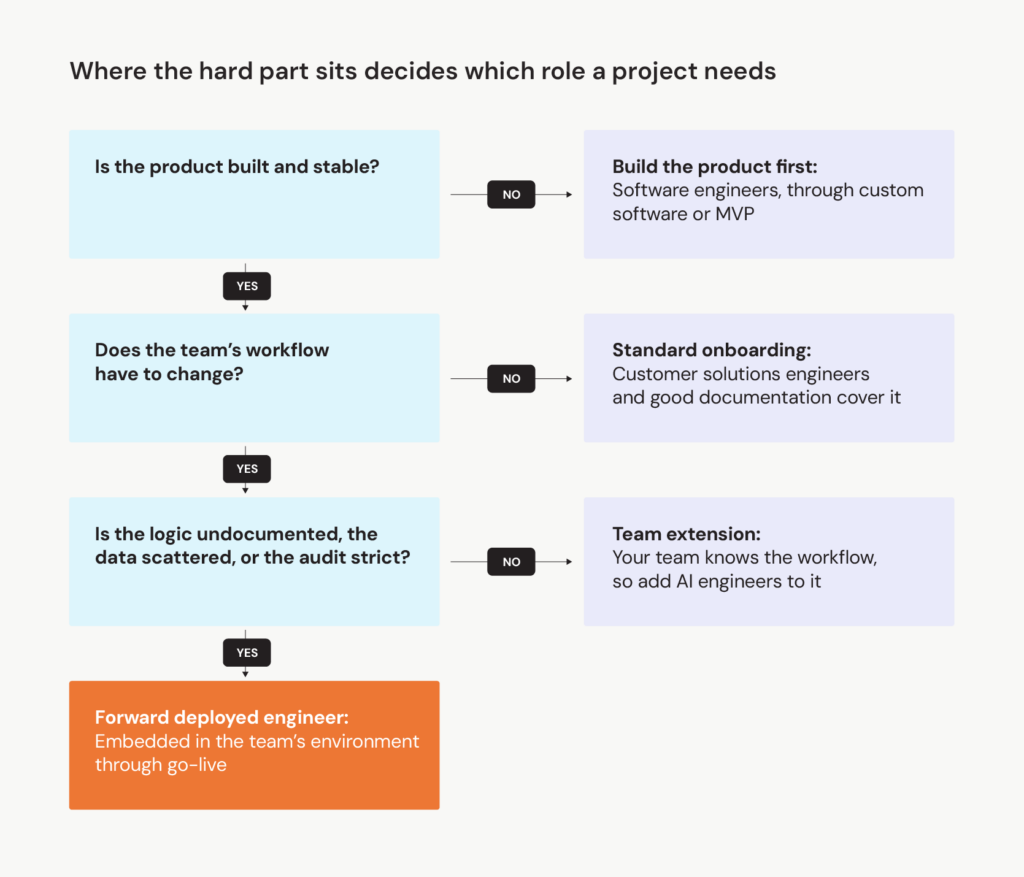
This is a simplified guide, and many projects combine more than one role.
Even so, plenty of AI work doesn’t need an FDE. An AI meeting summarizer, a chatbot over a well-documented help center, or a spam filter on clean email data rarely changes how a team operates. There’s no operating logic to embed AI into, and nothing worth leaving behind as a repeatable capability. For those projects, standard technical onboarding and good documentation usually cover what’s needed.
Some companies fall between those two cases. They have a clear target workflow and an internal team that knows it. What they lack is enough engineers with AI production experience to embed AI into daily operations and leave a repeatable in-house capability behind. For those companies, a team extension model fills that gap with engineers who have the missing skills. The company keeps ownership of the workflow and the code.

Match the role to where your AI project gets stuck
Software engineers build the product, and solutions engineers ensure it fits the client’s environment before the deal is signed. Then it's the FDE's job to get it into the client's operations and keep it there until it's used every day.
With AI, that final bit is normally the trickiest. You can have a highly accurate model, and it'll still go nowhere if the people whose decisions it impacts don't trust it. That trust has to be earned within the business by testing the system in the real world, with the client's own experts reviewing the output.
Before you go and hire anyone, look at where your last AI project got stuck. Was it the tool selection? Was it building the tool? Or was it getting your team to work with it?
If it's the last one, our Forward Deployed Engineering offering can help. You’ll work with a small senior team that goes into your environment and takes one workflow (tied to a very clear business metric) all the way through to production. We include a cloud and platform engineer from the start, since deployment is where so many pilots get stuck. The same people stay with you from discovery through launch, so you don't have to explain your business repeatedly. At each stage, you decide whether to continue, change course, or stop.
FAQ
What does FDE stand for?
FDE stands for forward deployed engineer, a role that builds and deploys software inside a client’s environment. Job listings also use variants such as forward deployment engineer and forward deployed software engineer. If you’re hiring or comparing vendors, search all three titles. Whatever the title, check whether the role writes and ships code at the client site, since that’s what separates an FDE from advisory roles. Gartner has warned that some providers now relabel ordinary consulting as forward deployed engineering, so this check matters.
What is a forward deployed software engineer?
A forward deployed software engineer is another name for an FDE. The longer title stresses that the person writes and reviews production code, unlike customer-facing roles that only configure or advise.
What does a forward deployed engineer do?
Day to day, an FDE runs discovery with the client’s team, builds integrations and custom features, deploys them, and watches how people use them. The work also covers technical onboarding, so the client’s staff can run and adjust the system after the FDE moves on. A good engagement leaves behind assets the next project can build on: integrations, cleaned-up data, shared business definitions, evaluation test sets, and runbooks.
How is an AI FDE different from a traditional software engineer?
The biggest difference is what each one is measured on. A traditional software engineer ships deterministic features for every customer and is judged on product quality. An AI FDE is judged on business results for one client: whether the workflow runs in production, moves the metric it was built for, and gets used every day.
How do AI FDEs connect custom client requirements to core product development?
They work in both directions. On site, AI FDEs build what one client needs, from a custom data connector to a review step for a specific approval rule. Back with the product team, they flag recurring requests so software engineers can build them into the core product instead of maintaining one-off code. In a services engagement, the same habit turns custom work into reusable pieces, so the second workflow takes less effort than the first.
How do FDEs speed up time to value for AI products?
They mostly remove the waiting. An FDE who sits with the client’s team answers data, security, and workflow questions directly, without routing them through tickets. Having deployment expertise on the team from the start also helps, since that’s where many pilots stall. At Svitla, a one-day onsite session ends with a candidate first workflow, and a diagnostic of about two weeks sets the baseline, so the client tracks progress against its own numbers.