AI is only as good as the instructions you give it. The tool is almost beside the point, your thinking matters more.
Today, almost every company has already deployed AI tools across their teams. Costs are lower than expected, and productivity numbers look decent on paper. But the outputs are generic. The decisions built on those outputs carry hidden risk. And nobody can quite explain why.
The gap is input.
AI does not interpret intent. It responds to structure. And when the structure is vague, the model fills the gaps with whatever is statistically plausible, whether or not it is accurate.
AI is only as good as your instructions
There is a simple truth about working with AI that most people figure out the hard way: the quality of what you get back is almost entirely determined by what you put in.
Large language models do not retrieve facts. They predict the most probable next word based on patterns in their training data. That is a huge distinction.
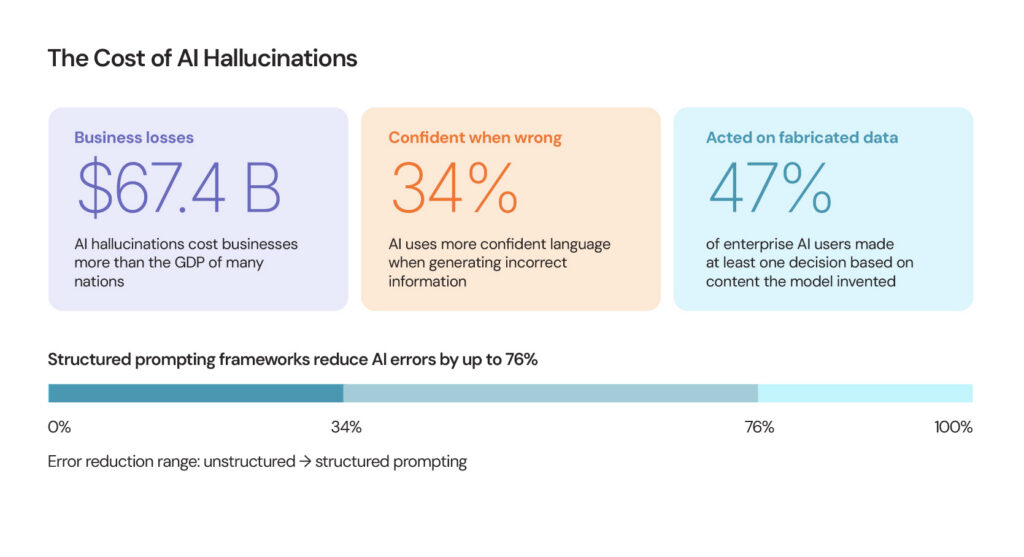
So, these systems can produce outputs that sound authoritative, flow logically, and cite plausible sources while being entirely wrong. MIT researchers found that AI models use 34% more confident language when generating incorrect information than when generating correct information. We should understand that the model does not know if it is wrong.
Of course, this is not a reason to avoid AI. However, it is a reason to approach it with structure and verification from the very beginning. That is where prompt thinking comes in.
What is prompt thinking?
There is a difference between typing a question into an AI tool and thinking through what you need before you type anything.
Prompt thinking means doing cognitive work first. You define the outcome you want, identify the limitations, supply the relevant context, and specify the format. Only then do you write the prompt.
For example: a vague brief to a junior colleague produces a vague deliverable. A specific one -here is the goal, here is the audience, here are the limitations, here is what success looks like - indeed produces something you can use. AI works exactly the same way.
A useful structure is Role, Context, Task, Format. Instead of:
"Give me an analysis of our Q3 performance."
Try:
"Act as a business analyst reviewing SaaS metrics. Our Q3 revenue grew 12%, but churn increased from 4% to 6.5%. Identify the three most likely causes and suggest one corrective action for each. Use plain language. Keep the response under 300 words."
The second prompt leaves little to interpretation, and that is the point.
Organizations that implement structured prompting frameworks report average productivity improvements of 67% across AI-enabled processes, compared to informal approaches that see minimal gains despite similar technology investments.
Dr. Janna Lipenkova, an AI researcher who studies how organizations build prompting into scalable practice, puts it directly: “Prompts that solve recurring problems can be the seed of reusable AI workflows. The prompts your team writes today are proofs-of-concept for the processes of tomorrow.”
Why this matters: how AI works
To understand why prompt thinking is extremely important, first of all, we need to figure out how modern AI systems generate output.
As you know, artificial intelligence has evolved over several stages. Machine learning-powered systems detect patterns in data. Deep learning extended this through layered neural networks, making it possible to process text, images, and speech.
From there, models split into two broad types: discriminative models, which classify inputs, and generative models, which create new content.
Large language models belong to the latter category. They generate text by predicting the most probable next token based on patterns learned during training. This leads to an important point: AI does not inherently evaluate truth. It generates outputs based on probability and pattern matching.
According to a study by AllAboutAI, AI hallucinations cost businesses $67.4 billion in losses. And a Deloitte survey found that 47% of enterprise AI users made at least one major decision based on content the model fabricated.
Air Canada discovered the price of AI mistake when a tribunal forced the airline to honor a bereavement discount its AI chatbot had invented and confidently told customers about.
AI fails predictably when inputs are vague or underspecified. This is also why small changes in phrasing can affect the output. The model is sensitive to structure. The more you give it, the more reliably it delivers what you need.
Prompt thinking in practice: externalizing your thinking
AI works only with the information it is given. Think of the context window as a form of short-term memory: the more relevant and well-organized your input, the more focused is the output.
Prompt thinking requires you to make your reasoning explicit. Instead of expecting the system to figure it out, you guide it step by step toward the desired outcome.
Good prompts rely on the same things that make human communication work, covering clarity, specificity, and context. The only thing you can skip with AI is empathy as the model does not need to feel understood. It just needs the right instructions.
One effective framework to simplify the process includes four components:
- Role - who the AI should act as
- Context - relevant background information
- Task - what needs to be done
- Format - how the output should look
Prompting as a process, not a one-time action
One of the most common mistakes teams make is treating prompting as a single event. Write the prompt, get the output, move on. In practice, effective prompting is iterative. You generate an output, evaluate it, refine your instructions, and repeat.
Consider how a financial analyst at a mid-size firm might work. They ask the model to summarize competitor pricing. The first output is broad and lacks the regional specificity they need.
They refine the prompt to specify the geography, the customer segment, and the pricing dimension they care about. The second output is sharper. They push further, asking the model to surface its assumptions and flag where it is uncertain. Now they have something they can verify and act on.
Each iteration reduces ambiguity. Each pass makes the output more aligned with the initial goal. The analyst is thinking through the problem more clearly because of querying it.
The act of structuring a prompt forces you to clarify what you want in the end. The query sharpens your own thinking before the model produces anything.
The right technique for the right task
Different prompting approaches suit different problems. None is universally correct.
- Zero-shot prompting works when the task is clear and simple. Ask the model to summarize a document, reformat data, or draft a routine email. It is fast and requires no setup.
- Few-shot prompting improves consistency for tasks that require a specific style or format. Provide two or three examples of the output you want, and the model adapts to that pattern.
- Role-based prompting controls tone and expertise level. Telling the model to act as a senior legal reviewer produces a different output than asking it to act as a plain-language editor. Both can be useful for different audiences.
- Chain-of-thought prompting asks the model to show its reasoning step by step. This is useful for complex analysis, but it is a debugging tool, not a trust signal.
Chain-of-thought: useful, but not magic
Yes, asking AI to think step by step can improve outputs because it externalizes its reasoning. This works for complex tasks, and it lets you inspect how an answer was constructed, not just what the answer is.
Lipenkova compares this to how people work through difficult problems: instead of jumping to a conclusion, you decompose the problem into substeps and address each one. For the model, this translates into more tokens and more opportunity to reason explicitly before committing to an answer.
However, if an early assumption is wrong, the rest of the reasoning can still appear coherent, built on a flawed foundation. A clean chain of reasoning built on a bad premise is still wrong.
A more reliable approach is combining structured reasoning with explicit uncertainty:
"Show your reasoning and indicate where you might be unsure."
Chain-of-thought improves transparency but it doesn’t affect correctness.
Thinking is not trust: why verification is a must
This is the point that saves companies real money. AI sounds 100% certain regardless of whether it is right. Stanford's Human-Centered AI Institute found that AI models hallucinate on legal queries between 69% and 88% of the time, depending on the model and the question type. Even purpose-built legal AI tools hallucinate more than 17% of the time.
Courts have imposed sanctions exceeding $10,000 in multiple cases involving AI-generated fabricated citations and by May 2025, most of those cases involved practicing lawyers, not self-represented parties who might be excused for not knowing better.
Verification at a practical level means checking facts independently, confirming that cited sources really exist, and asking the model directly what assumptions it made and where it might be wrong. A good thing to do is rephrase the same question differently, so if you get a totally different answer, be skeptical of both.
The most useful prompt you can add to any high-stakes output:
"Review your response. Identify any claims you are not confident about, any assumptions you made that I did not explicitly confirm, and any areas where a different interpretation of my question might produce a different answer."
That single follow-up prompt surfaces more useful information than most teams get from three rounds of generic questioning.
At a basic level:
- Check facts, numbers, and claims independently
- Verify that cited sources exist and support the argument
At a deeper level:
- Ask the model to surface its assumptions
- Rephrase the same question to test consistency
- Compare outputs across different prompts or sessions
What good looks like in practice
A healthcare technology company using AI for clinical documentation reduced its output-review time by 40% after implementing structured prompt templates across its documentation team.
The templates specified in the clinical context, the required format, the audience, and a mandatory uncertainty flag for any claim the model was less than certain about.
An e-commerce retailer cut content production time by 73% using few-shot prompting for product descriptions but only after investing two weeks in building a validated prompt library with clear brand-voice examples. The upfront investment paid back in the first month.
A legal team at a professional services firm stopped using AI for first-draft research after a hallucinated citation made it into a client brief. They rebuilt the workflow with a verification step: every AI-generated reference gets cross-checked against an official legal database before it moves forward.
In each case, someone thought it through first and didn't just take the output at face value.
Data privacy: a practical reminder
Keep in mind that AI systems are not secure environments. Inputs can be processed or stored in ways you do not fully control. It is easy to overlook, and often costly when people do.
Avoid putting into any AI tool:
- Personal data, such as names, addresses, identification numbers
- Financial information
- Medical records
- Credentials, e.g., passwords, API keys
- Confidential business data
Use incognito or temporary chat modes when you can and check your organization's data retention settings. Getting better results from AI is part of it, but so is not being careless with what you share.
What this comes down to
What this comes down to
Here is the sobering truth: most teams are getting poor results because they are treating a thinking problem like a technology problem.
AI does not rescue unclear thinking in any way but only scales it. Feed it a half-formed question and it returns a half-formed answer confidently, fluently, and fast enough that you might not notice until it is already in a deck or a brief or a decision.
The teams that have figured this out are not doing anything exotic. They just define what they need, not just what comes to mind first. They push back on the first output instead of accepting it. Over time, that habit compounds and their prompts get sharper and their workflows get tighter.
That is what prompt thinking really is. It is the discipline of bringing your best thinking to the tool instead of expecting the tool to do that work for you.
So, before the next prompt, take an extra sixty seconds. Define the outcome, set the limitations, and give the model something real to work with.