TL;DR: Telehealth software delivers measurable ROI, but only when a platform gets the fundamentals right: a workflow narrow enough to validate before you scale it, HIPAA-compliant architecture from the start, and financial metrics tracked from day one. This guide covers how to scope an MVP without over-committing capital to unvalidated features, balance AI capability with clinical safety, navigate cross-state licensure rules, and track the metrics, from reimbursement capture to reduced clinical burden, that separate a platform that pays for itself from one that doesn't.
Key terms:
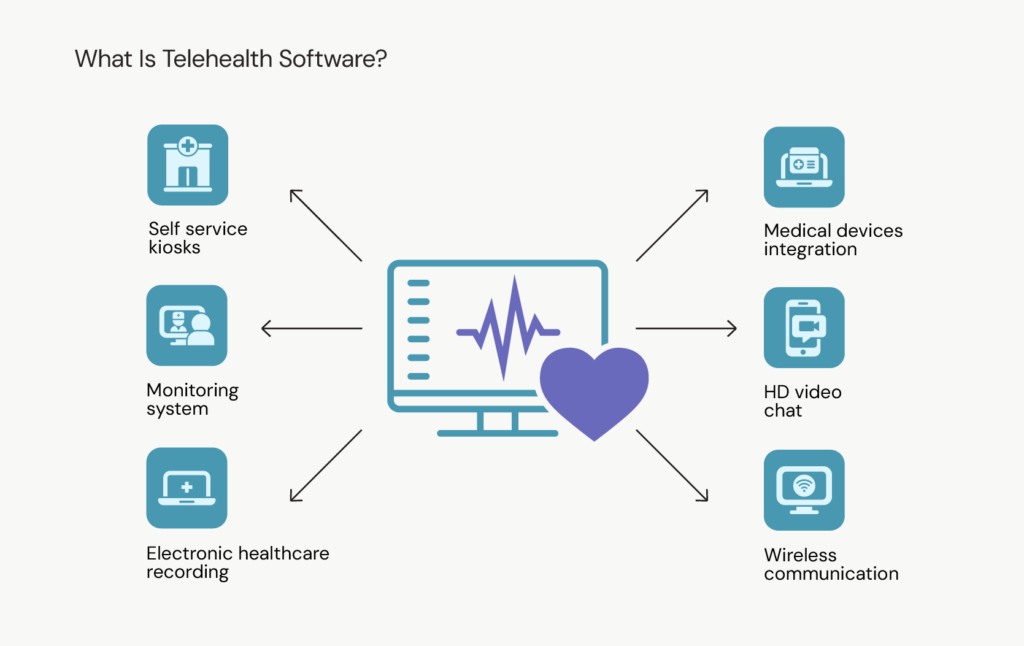
- Telehealth software: An operational system that connects patients, clinicians, scheduling, clinical documentation, billing, devices, identity, and compliance controls.
- Custom telehealth software: A telehealth platform built or configured around a specific organization's clinical workflows, patient population, and compliance requirements, as distinct from an off-the-shelf platform used largely as sold.
- Telehealth MVP: The smallest version of a telehealth platform that supports one clinical workflow end to end, used to validate demand and workflow fit before building additional features.
- AI ambient scribe: Software that listens to a clinical encounter and drafts a structured note for a clinician to review and finalize, reducing manual documentation time.
- Remote patient monitoring (RPM): Connected devices that transmit a patient's health data, such as weight, blood pressure, or glucose, to a care team between visits.
- Interstate Medical Licensure Compact (IMLC): An agreement among participating states that speeds up the process of obtaining an individual medical license in each member state. It does not replace the requirement to hold a valid license in the state where the patient is located.
Telehealth software development is often framed around features such as video visits, messaging, e-prescribing, and a patient portal. This leads to platforms that struggle to address harder problems: compliance, licensure, reimbursement, and clinical trust.
Off-the-shelf software works fine when the workflow is standard, and there's no reason to build custom just to prove a point. It starts to strain the moment things get harder to standardize: multiple states, remote monitoring at scale, a patient population that doesn't fit a generic template, or a real need for control over historical data and workflow rules. That's the point where custom development starts being the only option that works.
We explore telehealth software from the business and clinical sides: what delivers value, what artificial intelligence and machine learning can and can't be trusted to do unsupervised, and what the architecture must enforce before a single patient is seen across a state line.
How do you scope a telehealth MVP without over-engineering it?
A telehealth MVP should support one clinical use case end-to-end, such as a single-specialty follow-up visit, before it supports ten use cases halfway. It should not attempt to reproduce every function of a hospital information system. The most common telehealth build mistake is starting with a platform instead of a workflow. A practical scoping sequence follows these steps:
- Pick one workflow: Choose one service line, patient group, or visit type, with sufficient volume to quickly generate usage data. This could include behavioral health follow-ups, post-discharge monitoring, chronic care check-ins, or specialist consultations. The first release should make the workflow safe and usable from intake through follow-up. If you go broad too early, every support ticket will get harder to trace back to a cause.
- Define the minimum compliant path: The MVP should usually include identity verification, consent, scheduling, secure communication, visit documentation, clinician escalation, audit logging, and basic reporting. Advanced personalization, complex automation, multiple device ecosystems, and broad marketplace capabilities can follow after the initial workflow is validated.
- Define measurable launch criteria: Set acceptance thresholds before development begins. Examples include appointment completion, connection success, documentation turnaround, patient support volume, clinician adoption, and reimbursement submission accuracy.
- Build for expansion: A narrow MVP should not require a narrow architecture. Use modular interfaces for identity, scheduling, clinical data, payments, communications, analytics, and AI services so that later releases can add capabilities without rewriting the core system.
What does a custom telehealth build cost, and how long does it take to pay back?
A narrow MVP, one workflow, the compliance essentials, and core integrations, typically runs four to eight months for a mid-size healthcare organization, depending on electronic health records (EHR) integration complexity and whether identity and licensure verification are built from scratch or licensed from a telemedicine app development services vendor. Broader platforms with multiple service lines, device integrations, and AI features extend that timeline, often by a year or more.
Modeling payback means comparing the build cost, software engineering, compliance review, integration work, and the first year of operating cost, against the financial benefits in the ROI section below: recovered no-show revenue, captured reimbursement, and reduced administrative cost per encounter. A platform serving a single high-volume workflow spreads its fixed compliance and integration costs over more billable encounters, which is the arithmetic behind why narrow, focused builds tend to reach payback sooner than platforms spread thin across several lower-volume service lines.
What ROI can telemedicine apps deliver for healthcare providers?
A 2025 meta-analysis in BMC Health Services Research, pooling results across many studies and settings, found the odds of missing a telehealth appointment were 39% lower than for an in-person visit. A separate analysis of nearly 2 million outpatient encounters within a single health system found a larger effect (see table below). Single-system studies often show bigger swings than pooled meta-analyses, since they reflect one organization's scheduling and reminder practices rather than an average across many settings. Either way, the direction is consistent: telehealth reduces missed appointments.
Reimbursement rules changed again in 2026. Medicare telehealth flexibilities, including the removal of geographic and originating-site restrictions for most non-behavioral care, are now extended through December 31, 2027, under the Consolidated Appropriations Act of 2026. CMS also revised how it sets payment rates for some remote monitoring services starting in 2026. Software that isn’t keeping up with these changes will miscalculate what a visit or monitoring program is worth, showing up later as denied claims and underbilled care.
Track utilization, no-show rate, reimbursement capture rate, cost per encounter, and RPM billing-threshold compliance as the core financial metrics. Telehealth reduces overhead costs for clinics and travel expenses for patients. Benefits should be tied to measured changes: a lower no-show rate creates value only if the recovered capacity is used or the associated cost is avoided.
| Metric | Finding |
| No-show odds, telehealth vs. in-person | 39% lower (pooled meta-analysis) |
| No-show odds, single health system | 72% lower |
| Medicare telehealth flexibility window | Extended through Dec 31, 2027 |
| RPM billing threshold | Lowered starting in 2026 |
Sources: BMC Health Services Research (2025), npj Digital Medicine (2024), HHS Telehealth Policy Updates, CMS 2026 Physician Fee Schedule.
How does predictive analytics turn remote monitoring data into actionable alerts?
UMass Memorial Health–Harrington Hospital reported a 50% reduction in 30-day readmissions for congestive heart failure using an AI-powered remote monitoring platform from Brook Health, according to a company and hospital press release. No peer-reviewed study accompanies the figure, so treat it as a vendor-reported program result rather than independently validated research. Nationally, the 30-day heart failure readmission rate runs close to 1 in 4 patients, so a program that reliably intervenes earlier addresses a real, well-documented cost driver, even if this specific result hasn't been independently verified.
Remote patient monitoring can produce a high volume of readings. The business value comes from converting those into prioritized actions for the right clinical team. A useful alerting workflow should define:
- Which data sources are accepted
- How readings are normalized and validated
- Which thresholds indicate a possible issue
- How patient context changes alert priority
- Who receives each alert
- What response is expected
- When the alert is closed or escalated
- How the outcome is recorded
Predictive analytics should reduce alert fatigue by ranking signals, grouping related events, and suppressing duplicates where clinically appropriate. The model and workflow should be evaluated using sensitivity, specificity, false-positive rate, false-negative rate, time to review, escalation rate, and clinical outcomes. A prediction is only an operational improvement if it triggers a clear action.
How do AI ambient scribes handle clinical documentation during telehealth visits?
An AI ambient scribe can listen to an authorized encounter, identify relevant content, and prepare a draft clinical note. The clinician must review, correct, and sign the final record.
The Permanente Medical Group deployed an ambient AI scribe across 17 medical centers and 7,260 physicians between October 2023 and December 2024, covering more than 2.5 million patient encounters. A peer-reviewed analysis published in NEJM Catalyst found physicians using the tool collectively saved more than 15,700 hours of documentation time over the study period.
A separate, larger study painted a more modest picture. Research reported by STAT followed 1,800 clinicians across five academic medical centers from 2023 to 2025 and found scribe users saved about 16 minutes of documentation time per eight hours of patient care, with inconsistent use across the sample. The Peterson Health Technology Institute has separately cautioned that clear financial ROI from ambient scribes remains unproven at scale, even where clinician satisfaction improves.
Overall, the ambient scribe workflow should clearly separate the AI-generated draft from the final clinical record. It should show source context where appropriate, preserve edits, and prevent automatic signing. Important design questions include:
- Was the patient informed and consent obtained where required?
- Is the recording stored, or is only the draft retained?
- Which model and vendor process the information?
- How are the speakers distinguished?
- How are unsupported statements flagged?
- Can clinicians correct terminology and templates?
- Is the final note linked to the encounter audit trail?
Recording consent isn't governed by HIPAA alone. About a dozen states require all parties to consent to a recorded conversation, not just the patient, which means an ambient scribe listening to a telehealth visit needs a consent workflow that adjusts by state, the same enforcement problem as the licensure rules covered earlier. Encounters touching substance use treatment carry an additional layer: 42 CFR Part 2 governs that data separately from HIPAA, with stricter redisclosure rules, so an ambient scribe operating in a behavioral health or addiction treatment context needs its own review before deployment.
Measure documentation time, correction rate, note completeness, clinician satisfaction, unsupported-content rate, and downstream coding or billing impact.
How accurate are AI triage and symptom checkers, and who's liable when they're wrong?
AI triage can collect symptoms, ask follow-up questions, identify urgency signals, and route patients to an appropriate care pathway. It should not present an automated assessment as a definitive diagnosis. A safe design includes:
- A clearly stated system role and limitation
- Structured intake for high-risk symptoms
- Conservative escalation rules
- Immediate emergency guidance where appropriate
- Clinician review for defined categories
- Complete conversation and decision logging
- Monitoring for demographic and language-related performance differences
Accuracy is only one part of the risk assessment. Physician-panel reviews of one widely used symptom checker, Ada, found it overtriaged emergency department cases, recommending a higher level of urgency than necessary in roughly 25% to 55% of cases across separate studies. A 2025 systematic review in npj Digital Medicine concluded that symptom checkers and large language models should be neither universally recommended nor discouraged for self-triage, and that their reliability depends heavily on the specific use case.
Overtriage carries its own liability risk, distinct from a missed diagnosis. Sending patients to urgent or emergency care creates financial and safety costs, so "conservative" escalation should mean well-calibrated caution. A system that escalates everything is no safer than one that escalates nothing, once clinicians stop trusting the alerts.
Liability follows a consistent line. Under FDA guidance updated in January 2026, software that provides a clinician with a recommendation they can independently review and understand generally falls outside the FDA's medical device regulations. Software that substitutes for or directs a clinician's judgment, rather than informing it, is treated as a regulated device.
When AI technology or an AI tool isn't classified as a device, the treating clinician's judgment remains the primary basis for liability, which is why every clinical AI feature in a telehealth platform needs a clear, documented point at which a human can review and override the output.
How do you build HIPAA compliance into telehealth architecture?
HIPAA compliance is a set of administrative, physical, and technical safeguards that must shape architecture, operations, and vendor management. The HIPAA Security Rule remains in effect, but HHS proposed a major update in January 2025, and, as of this writing, it has not been finalized. The proposal would eliminate the current distinction between "required" and "addressable" safeguards, making encryption of electronic protected health information at rest and in transit mandatory, along with multifactor authentication, regular vulnerability scanning, and annual penetration testing.
What you can do to build HIPAA compliance
- Identity and access: Use strong authentication, role-based access, least-privilege permissions, session controls, and administrative approval workflows. Provider, patient, support, and organization-admin roles should not share the same access scope.
- Data security and protection: Protect PHI in transit and at rest. Define where data is stored, how keys are managed, how backups are protected, and how data is deleted or retained.
- Auditability: Log access to sensitive records, administrative changes, authentication events, data exports, clinical actions, and AI-assisted operations. Logs should support investigation without exposing unnecessary health information.
- Vendor and integration controls: Review business associate agreements, subprocessors, hosting environments, EHR connections, communication providers, analytics tools, and AI systems. A compliant application can still create risk through an uncontrolled third-party integration.
- Operational safeguards: Maintain incident-response procedures, vulnerability management, access reviews, disaster recovery, workforce training, and regular data security testing.
AI models need their own governance layer, separate from HIPAA. A clinical AI feature can degrade over time as patient populations, documentation habits, or the model itself change, a problem generally known as drift. Production AI features need scheduled performance monitoring against a fixed benchmark, not a one-time validation at go-live, along with periodic bias audits across demographic groups, since a model that performs well on average can still underperform for specific patient populations.
For AI features that qualify as regulated medical devices under the FDA framework described above, the FDA finalized guidance in early 2025 on Predetermined Change Control Plans (PCCPs), which let a manufacturer pre-specify how a model is allowed to change after approval, monitoring metrics, retraining triggers, performance thresholds, without filing a new submission for every update. A platform building or integrating a regulated AI feature should ask any vendor whether they have an authorized PCCP and what it covers, since an unmonitored model is a compliance gap even when the underlying HIPAA architecture is sound.
What does telehealth software have to enforce for multi-state licensure?
A clinician must hold a valid license in the state where the patient is physically located at the time of the visit, not the state where the clinician is sitting. For example, the Interstate Medical Licensure Compact speeds up the licensing process in participating states, but it does not create a single portable license.
Controlled substance prescribing runs on a separate, more fragile timeline. DEA telemedicine flexibilities that allow prescribing Schedule II-V medications without a prior in-person exam are currently extended only through December 31, 2026, pending a permanent rule. A platform's prescribing workflow needs to enforce this rule independently of general visit licensure, since the two can expire on different schedules.
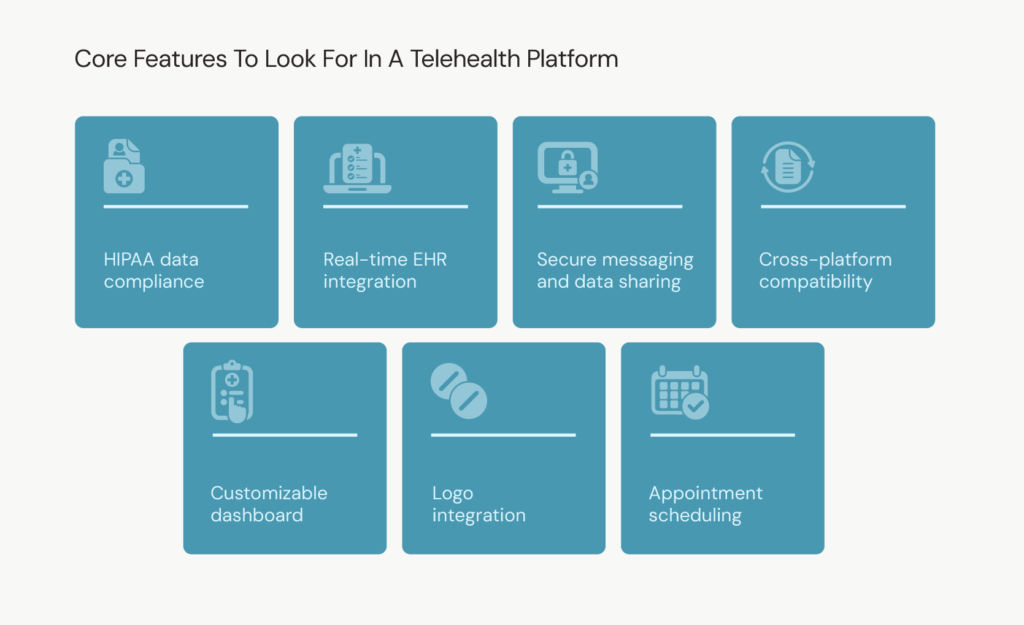
The software should not make legal assumptions. It should enforce the organization’s approved rules and direct uncertain cases to qualified compliance or clinical staff. A cross-state workflow may need to:
- Capture and verify the patient’s location at the time of service
- Store the provider’s licensed states and credential status
- Match the visit type to jurisdictional requirements
- Block or route appointments when a rule is not satisfied
- Record consent and required disclosures
- Apply state-specific documentation and prescribing rules
- Support audit reports for completed encounters
What should you look for in a telehealth software development company?
When evaluating a telemedicine app development company or development partner, look for:
- Direct experience with HIPAA-covered systems, including signed business associate agreements on past projects
- A track record of building licensure and eligibility checks into scheduling logic, not just documentation about compliance
- Clinical AI features that route to human review by default, with that review point documented
- A build approach that starts with one workflow and expands, rather than a full feature set launched at once
- Familiarity with current reimbursement rules, since a platform that miscalculates billing eligibility creates financial risk regardless of how well it performs technically
Choosing the best telehealth software approach
The best telehealth software approach depends on the organization’s operating model.
| Situation | Likely approach | Main consideration |
| Standard visits with limited differentiation | Configured commercial product | Speed and vendor coverage |
| Specialized clinical workflow | Custom modules or extensions | Workflow fit and integration |
| Multi-state, multi-audience operation | Custom platform with a rules engine | Governance and maintainability |
| Remote monitoring at scale | Platform plus device integrations | Alert quality and clinical response |
| Narrow AI features with mandatory human review | Controlled AI services | Evaluation, safety, and human review |
| Existing digital ecosystem | Integrated platform | Identity, data, and workflow consistency |
Custom development is most defensible where it improves a critical workflow, differentiates care delivery, or enables integration and control that packaged software cannot provide.
Custom telehealth software enforces what generic platforms skip
Custom development is worth the cost in the situations the table above already points to: multi-state operations, remote monitoring at scale, AI-supported clinical workflows. A custom platform can confirm where a patient is, check whether a clinician’s license or prescribing authority still applies, and route AI output to a person before it reaches anyone. Off-the-shelf systems usually skip at least one of those checks. A standard visit workflow doesn't need any of it, meaning that an off-the-shelf solution works in that scenario.
AI can improve documentation, triage, remote-monitoring operations, and patient navigation. It should be introduced in a way that lets the organization evaluate accuracy, manage liability, and protect health information, while keeping clinicians in control of consequential decision making.
Svitla's healthcare software development and digital transformation teams work with healthcare organizations on this combination: custom telehealth platforms built around real clinical workflows.
FAQ
What is a telehealth appointment?
A telehealth appointment is a scheduled healthcare interaction delivered through communication technology rather than an in-person visit. It may use video, audio, secure messaging, remote monitoring, or another approved digital channel.
How does telehealth work?
Telehealth connects a patient and a clinician via a secure platform for a virtual visit or for asynchronous messaging. For lower-acuity needs, video consultations can shorten the time between question and response. Real-time video and audio consultations require stable, encrypted communication channels. The visit typically includes identity verification, consent capture, the clinical encounter itself, and documentation, with the platform handling scheduling, billing codes, and, where applicable, e-prescribing in the background.
Which states allow telehealth across state lines?
Cross-state telehealth requirements vary by state, provider credentials, patient location, service type, and applicable exceptions or interstate compacts. A telehealth platform should capture patient location and provider licensure, then apply the organization’s current compliance rules rather than assume that one rule applies nationwide.
What are telehealth services?
Telehealth services are healthcare services delivered remotely via video consultations, audio, or digital communication tools rather than in person. They can include virtual visits, remote patient monitoring, asynchronous consultation, secure messaging, digital intake, care navigation, and patient education.
How to use telehealth for remote patient monitoring?
To use telehealth, a patient typically schedules a visit through a provider's app or portal, completes identity verification and consent, and joins a video or audio call at the scheduled time from a phone, tablet, or computer. The provider then conducts the encounter, documents care, and gives the patient follow-up instructions.