TL;DR: AI inventory forecasting cuts demand-forecast errors by 20% to 50% versus older methods, according to McKinsey. But a Gartner survey found 55% of chief supply chain officers aren't sure their AI investments are paying off, even as AI now takes 67% of supply chain digital spending. The difference comes down to focus: forecasting built around one workflow shows results, forecasting deployed broadly without a way to measure it usually doesn't. This piece covers where AI forecasting delivers ROI, how it differs from traditional demand planning, and where it applies to transportation and logistics.
Key terms:
- AI inventory forecasting: The use of machine learning models to predict future demand and set inventory levels, using patterns in historical sales, external signals, and real-time data rather than fixed statistical rules.
- Predictive inventory management: An inventory strategy that sets stock levels, reorder points, and safety stock based on forecasted demand rather than fixed reorder rules or manual review.
- Demand sensing: A forecasting approach that incorporates near-real-time signals, such as recent orders, weather, or local events, to adjust a forecast closer to the point of consumption.
- Safety stock: The buffer inventory a business holds to protect against demand variability or supply delays. More accurate forecasts generally require less safety stock to hit the same service level.
- Forecast error (MAPE): Mean absolute percentage error, a standard metric for how far a forecast deviates from actual demand. A lower MAPE indicates a more accurate forecast.
- Model drift: A decline in model performance as customer behavior, supply conditions, product mix, or data patterns change.
AI inventory forecasting is pretty much the standard for big logistics and retail organizations today. But just because everyone is using it doesn’t mean it’s working the same way for everyone. Some companies are seeing huge wins with leaner inventory and fewer errors, while others have the tech up and running but aren’t actually sure if it’s performing any better than their old methods.
A forecast should change the decision. It should influence how much inventory a company buys, where it positions stock, how much capacity it reserves, when it expedites freight, or how planners prioritize exceptions. The core measurement chain is:
Forecast accuracy → planning decision → operating outcome → financial result
If the chain stops after forecast accuracy, the organization may have a better model but no defensible return on it.
Here, we'll review where AI improves forecasting accuracy, how that differs across inventory planning and transportation demand, and what a model needs from an organization's data before it can be trusted with a purchase order or a fleet allocation decision.
How much does AI improve inventory forecasting accuracy?
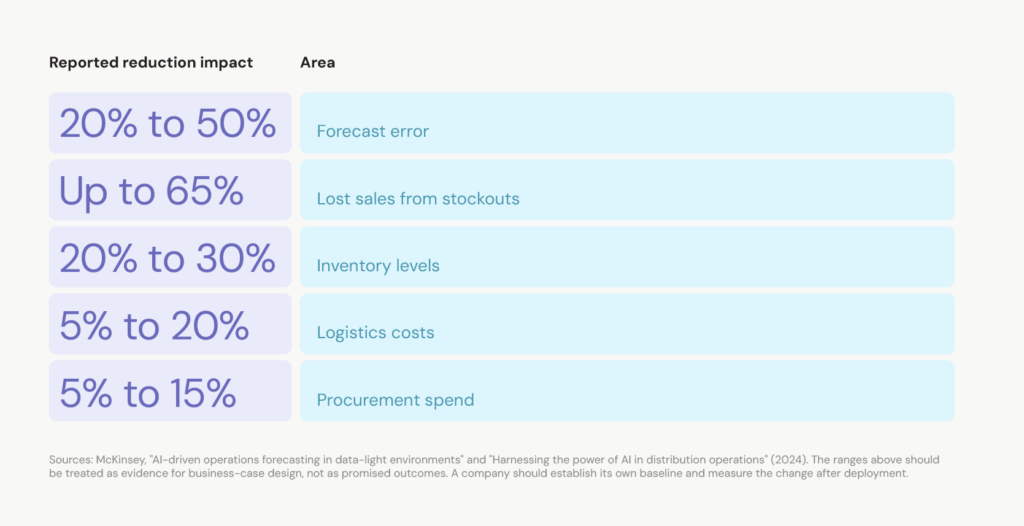
McKinsey research reports that AI-driven forecasting can reduce demand-forecast errors, commonly measured as mean absolute percentage error (MAPE), by 20% to 50% compared with traditional methods. The same research ties that improvement to a measurable drop in lost sales from stockouts. Lower forecast error translates directly into less safety stock, because the business no longer has to buffer as heavily against its own uncertainty to hit the same service level.
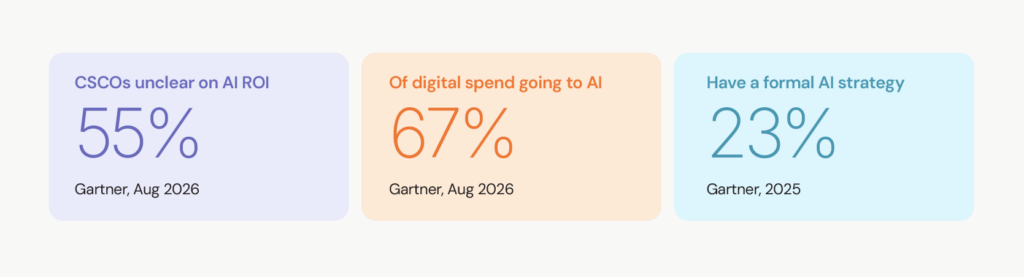
That accuracy gain doesn't automatically translate into a measurable return. A Gartner survey published in August 2026 found that 55% of chief supply chain officers are unclear on the ROI of their AI investments, even as AI now accounts for 67% of supply chain digital spending. A separate Gartner survey from 2025 found that only 23% of supply chain organizations have a formal AI strategy. The two sets of findings aren't contradictory. McKinsey's number describes what AI forecasting can do when it's targeted at a specific, well-defined problem. Gartner's numbers describe how much of the AI spending in the field isn't organized around a specific problem in the first place.
These figures are ranges, not guaranteed results for every product category or network. Accuracy depends on how clean the data is, how far out you’re forecasting, how volatile demand is, where a product sits in its lifecycle, promotions, lead times, and the quality of the workflow that uses the forecast.
A model may perform well on stable products yet add little value over a simpler statistical method, since a baseline forecast already does the job there. The most attractive opportunities are often harder cases: new-product launches, promotional demand, intermittent demand, volatile categories, and locations with changing demand patterns.
Where does AI inventory forecasting deliver the clearest ROI?
Predictive inventory management involves using forecasts to establish optimal stock levels, reorder points, and safety stock. The return shows up in five places:
Lower safety stock without lowering service levels
Safety stock scales with forecast error, not with demand volume, so cutting error in half gives a planner room to cut the buffer by a proportional amount. That reduction can become real money when inventory policies change, so the organization avoids excess stock and the obsolescence and carrying costs that come with it.
Fewer stockouts and lost sales
Getting replenishment timing and inventory placement right depends on the forecast underneath. Track lost sales, backorders, substitutions, fill rate, and stockout duration, rather than assuming that a more accurate forecast automatically means customer satisfaction.
Lower expedited freight
Forecast errors can trigger urgent replenishment and premium freight. A useful pilot should compare expedited frequency, premium freight spend, and service recovery time before and after the new forecasting workflow.
More productive planning teams
AI can automate baseline forecasts and surface exceptions. Planners can then spend more time on the judgment calls that need context: supplier constraints, promotions, new products, and disruptions. Organizations piloting this should measure planner time per cycle, exception resolution time, forecast overrides, and the share of exceptions resolved within the service target before counting it as ROI.
Better procurement decisions
Forecasts can inform order timing, supplier commitments, and purchase quantities. The value depends on supplier reliability, lead time visibility, minimum order quantities, and the organization’s ability to act on recommendations.
McKinsey's analysis of AI in distribution operations found that embedding AI into planning, warehousing, and procurement can reduce inventory levels by 20% to 30%, cut logistics costs by 5% to 20%, and lower procurement spend by 5% to 15%. These ranges reflect the difference between running a single pilot and applying AI consistently across a full planning cycle.
How does machine learning inventory management differ from traditional demand planning?
Traditional demand planning relies on fixed statistical models such as moving averages, exponential smoothing, and seasonal decomposition, applied to historical sales data. These models work well for stable, high-volume products with predictable seasonality. They struggle with new products, promotions, sudden demand shifts, and products with sparse or intermittent sales history.
Machine learning inventory management replaces or supplements fixed models with algorithms that learn patterns directly from data, including external variables that a traditional model can't easily use: weather, local events, competitor pricing, or real-time sell-through. This approach, often called demand sensing, adjusts the forecast closer to the point of consumption rather than relying only on historical trend lines.
| Dimension | Traditional demand planning | Machine learning inventory management |
| Input data | Historical sales and seasonal patterns | Historical data plus operational and external signals |
| Strongest fit | Stable, high-volume products | Volatile, promotional, new, or complex demand patterns |
| Update frequency | Periodic forecast runs and manual review | Automated updates with monitored refresh cycles |
| New-product handling | Often depends on manually selected analogs | Can use product attributes and similarity patterns |
| Planner role | Adjusts model output and assumptions | Reviews exceptions, overrides, and contextual signals |
| Main maintenance need | Rule and parameter updates | Drift monitoring, evaluation, and retraining |
Typically, supply chain organizations run both approaches in parallel rather than replacing one with the other. The right question is which method produces the lowest total cost at the required service level.
How is AI used in transportation and logistics demand forecasting?
Transportation demand forecasting is a different problem from SKU-level inventory forecasting, even though the underlying techniques overlap. Inventory forecasting predicts how much of a product customers will want. Transportation and logistics forecasting predicts how much capacity, trucks, containers, and warehouse labor will be needed to move and store it. That depends partly on the inventory forecast. It also depends on freight rates, carrier availability, and network congestion, things that inventory models were rarely built to track.
Forecasting freight capacity
A transportation model may estimate shipment volume by lane, mode, region, time window, or customer segment. The output supports decisions such as which carrier handles the freight, how tenders are planned, how a fleet is used, how warehouse labor is scheduled, and how much capacity to reserve.
Freight rates and available capacity tend to change faster than demand for a stable product. Transportation models usually need to be checked and retrained more often than demand models because the underlying conditions shift faster.
Predicting logistics exceptions
AI can flag early signals of late shipments, missed delivery windows, congestion, damaged freight, or carrier underperformance. The system should route the result to a team that can act on it.
An alert with no owner, response time, and no resolution code changes nothing.
Processing unstructured logistics data
AI can also create value outside the forecast itself. Supplier bids, bills of lading, customs documents, carrier communications, and exception notes contain information that is difficult to use when it remains in unstructured formats.
McKinsey described an industrial and electronics distributor that used generative AI to prescreen supplier bid documentation. They were able to cut review time by 90%, with two months shaved off the path from tender to project start. This example illustrates a larger logistics pattern: AI helps logistics teams predict what’s coming while moving faster on the paperwork standing between a decision and the shipment.
What data does AI forecasting need to work, and where does it break down?
An AI inventory forecasting system typically requires:
- Consistent historical sales or shipment data
- Inventory positions by location
- Product, location, and channel attributes
- Promotional and pricing calendars
- Supplier lead times and reliability history
- Purchase orders, transfers, returns, and cancellations
- Stockout and lost-sales indicators
- Relevant external signals
- A process for identifying anomalies and missing data
Where forecasting data breaks down
Common problems include inconsistent product identifiers, missing inventory positions, unrecorded stockouts that make true demand look lower than it was, inaccurate promotion dates, and changes in reporting logic.
One-time events also need to be flagged. A major promotion, pandemic disruption, supplier shutdown, or system migration should not automatically be learned as normal demand.
Forecasting models also degrade over time, a phenomenon known as drift. A model trained on pre-disruption demand patterns can perform well for months, but then those lose accuracy as consumer behavior, supplier lead times, or product mix change.
Demand shocks are harder to manage than drift. Drift is gradual and shows up in the monitoring metrics below before it does real damage. A demand shock has no precedent in the model's training data at all, so there's no historical signal for it to learn from, no matter how closely the model is watched.
Production monitoring should compare predictions with outcomes against a fixed benchmark. Monitor performance by product class, location, channel, forecast horizon, and demand pattern rather than relying on one network-wide average.
The practical design is a human-in-the-loop process. Planners should be able to add documented context, override a forecast, apply temporary scenarios, and see how the change affects replenishment or capacity decisions.
How do you build an AI-driven inventory forecasting strategy?
- Select a measurable workflow: Start with a product category, distribution node, lane, or planning cycle where forecast error, inventory cost, stockout rate, or expedite spend is already tracked. A baseline makes the business case auditable. Without one, the organization cannot distinguish AI impact from seasonality, market recovery, process change, or normal variation.
- Segment the forecasting problem: Separate stable products, intermittent demand, new products, promotions, seasonal items, and constrained supply. One model and one error metric may not serve all segments well.
- Define the decision the forecast will change: Specify whether the output will influence reorder points, safety stock, purchase orders, inventory positioning, carrier capacity, labor planning, or exception queues.
- Choose the right implementation approach: Start with a demand-planning platform that already includes machine learning. Custom development becomes more defensible when the organization needs unusual product attributes, proprietary signals, combined inventory and transportation forecasting, or specialized workflow integration.
- Design planner controls: Allow planners to review predictions, inspect drivers, record overrides, and apply approved scenarios. Capture the reason for each override so the organization can learn whether the model or the process needs improvement.
- Integrate with operating systems: A forecast that lives in an isolated dashboard may not change procurement or shipping. Connect the output to inventory, warehouse operations, transportation, order management, and enterprise resource planning systems through governed interfaces.
- Monitor after launch: Define accuracy benchmarks, drift thresholds, retraining rules, data-quality checks, alert ownership, and rollback procedures before production deployment.
Should you build or buy your AI inventory forecasting platform?
Building a forecasting model from scratch rarely makes sense simply because the capability exists. A packaged platform may offer faster implementation, standard connectors, proven forecasting methods, and vendor-maintained updates.
Custom development makes sense when the business has requirements that packaged tools cannot handle well:
- Proprietary demand signals
- Unusual product or location hierarchies
- Specialized cold-chain or regulated workflows
- Combined inventory and transportation decisions
- Existing data infrastructure that requires a tailored integration layer
- A need for organization-specific controls and explainability
The decision should compare total cost of ownership, integration effort, model performance, flexibility, operational control, vendor dependence, and time to measurable value.
How do you evaluate a forecasting platform or development company?
When comparing platforms, vendors, or development companies, look for:
- A documented baseline and post-deployment measurement process
- Support for stable and volatile demand patterns
- Data-quality validation before model training
- Drift monitoring and a defined retraining process
- Planner review and forecast/override workflows
- Integration with inventory, warehouse, procurement, and transportation systems
- Explainable outputs that support operational decisions
- Security and access controls for commercial and operational data
- A clear plan for ownership after launch
Ask for a demonstration using a realistic workflow. The evaluation should show what happens when data is missing, customer demand shifts, a planner overrides the forecast, or a downstream system rejects the recommendation.
Forecasting accuracy is necessary, but it isn't the same as ROI
The gap shows up where the measurement chain from the start of this piece breaks: the step between forecast accuracy and a planning decision. Most of the shortfall behind Gartner's numbers is a reorder point nobody rewrote, a safety-stock formula nobody touched, a planner who doesn't yet trust the new number enough to act on it. The forecast got better, but nothing downstream of it did.
The practical path is focused: establish a baseline, select a measurable workflow, segment the demand problem, integrate the output into operations, keep planners in the loop, and monitor performance after launch.
Svitla's machine learning and logistics and transportation teams work with supply chain organizations on forecasting models built around a specific, measurable workflow, with the monitoring and data pipeline needed to keep them accurate after launch.
FAQ
How do you use AI for inventory forecasting?
Use AI for inventory forecasting by combining historical demand, inventory, product, promotion, lead time, and relevant external data in a monitored forecasting workflow. The output should feed a defined replenishment or inventory-positioning decision, with planners able to review and override the result for known disruptions.
How does AI affect supply chain performance?
AI can improve supply chain performance by reducing forecast error, identifying exceptions, automating document-heavy work, and helping teams allocate inventory, labor, and transportation capacity. The business impact depends on whether the organization acts on the output and measures downstream changes in cost, service, and working capital.
How can AI optimize supply chain management?
AI can improve supply chain management by adapting forecasts to changing signals, prioritizing exceptions, supporting procurement decisions, processing logistics documents, and identifying patterns in demand and disruption. The clearest gains usually come from a defined workflow rather than an attempt to automate the entire supply chain at once.
What is the ROI of AI in supply chain inventory planning?
The ROI of AI in supply chain inventory planning can appear through lower safety stock, fewer stockouts, reduced expedited freight, improved service levels, and lower planning effort. Calculate it against a pre-AI baseline and include model, integration, data, monitoring, support, and change-management costs.
Will AI replace supply chain management?
AI is unlikely to replace supply chain management as a function. It can automate baseline forecasts, exception detection, document review, and repetitive analysis, while planners and managers remain responsible for disruptions, supplier relationships, tradeoffs, and strategic decisions.
How can AI enhance sustainability in supply chain operations?
AI can support sustainability by reducing overproduction, obsolete inventory, expired stock, emergency shipments, and underutilized transportation capacity. These benefits should be measured with operational and environmental indicators rather than assumed from model deployment alone.