TL;DR: Median software developer pay in Australia runs roughly 32% below the U.S. median once converted to U.S. dollars. But the bigger reason global teams build there is the overlap window its time zone creates with both Asia and the U.S. West Coast, paired with a compliance landscape (the Privacy Act 1988 and the Essential Eight) that's stable and well documented. In this article, we cover the cost comparison, what the time zone buys a distributed team, which compliance rules apply, and how Svitla's Australian presence fits in through its 2026 acquisition of Kiandra IT.
Key terms
APP entity: An organization covered by the Australian Privacy Principles under the Privacy Act 1988. Most mid-size and larger businesses qualify; businesses with annual turnover under $3 million AUD are generally exempt, with some exceptions (health providers, businesses that trade in personal data, and others). As of July 1, 2026, real estate professionals, lawyers and conveyancers, accountants, trust and company service providers, and dealers in precious stones and metals also lost the exemption under the AML/CTF "Tranche 2" reforms, regardless of turnover.
Essential Eight: The Australian Cyber Security Center's baseline set of eight mitigation strategies for protecting systems against cyber threats.
ISO 27001: An international standard for information security management systems, used to demonstrate that a vendor's security controls are independently audited.
Low-code development: Building applications with visual tools and minimal hand-written code to speed up the delivery of internal or line-of-business apps.
Minimum viable product (MVP): The smallest version of a product that lets a team test a core assumption with real users before building further.
Follow-the-sun delivery: A staffing model in which work is handed off between teams in different time zones so progress continues around the clock.
Companies weighing software development in Australia usually start with one question: What is the cost of building the same in Australia?
Australia’s development costs are only part of the decision, though. Time zone overlap and compliance project requirements shape delivery speed and risk just as much as the hourly rate does, whether the work spans APAC or is scoped to a single Australia-based team.
In this piece, we first look at the pay difference and what the time zone buys a distributed team. Then the rules that govern Australian compliance software development once a project is running. Finally, we look at how Svitla's Australian presence fits in through its 2026 acquisition of Kiandra IT.
How do software development costs in Australia compare with those in the U.S.?
Australia's median software developer salary was $131,924 AUD annualized as of May 2025, according to Jobs and Skills Australia's occupational data, based on the Australian Bureau of Statistics' Survey of Employee Earnings and Hours. At the late September 2026 exchange rate of about 1 AUD to .7 USD, that equals roughly USD $92,347. The U.S. Bureau of Labor Statistics puts the median U.S. software developer salary at $135,980 USD for the same period, a difference of about 32%. The figure moves with the exchange rate, so it shouldn't be treated as a fixed number.
Median software developer pay: Australia vs. the United States
| Metric | Australia | United States |
| Median annual salary (local currency) | $131,924 AUD | $135,980 USD |
| Median annual salary (converted to USD) | ~$92,347 USD | $135,980 USD |
| Source | Jobs and Skills Australia / ABS, May 2025 | U.S. BLS Occupational Outlook Handbook (OOH), May 2025* *Pay data comes from the BLS Occupational Employment and Wage Statistics (OEWS) survey. |
The USD conversion uses the late September 2026 spot rate (1 AUD ≈ 0.70 USD) and will change as the rate moves. Treat it as illustrative, not a quote. These figures compare base salary only. Employer costs differ too: Australia adds superannuation at 12% of ordinary earnings (since July 2025) and, above certain thresholds, payroll tax, while U.S. employers carry benefits and payroll taxes of their own.
Location isn’t the only factor that shapes operating costs. The way a team builds software matters, too.
Delivery approach: software development Australia
Svitla used the OutSystems low-code platform to build a custom shipping agency application for MONSON, a shipping agency with offices across Australia and Asia. Each user now saves about two hours a day on vessel estimates, or an estimated 140 hours a day across all locations. Explore the case study to learn how that time is worth roughly USD 7,000 a day with an assumed value of USD 50 an hour. Results from one project won't apply everywhere. Still, the case shows why buyers should weigh what a solution saves after launch alongside what the team costs to build it.
What do Australian time zones offer a global dedicated team?
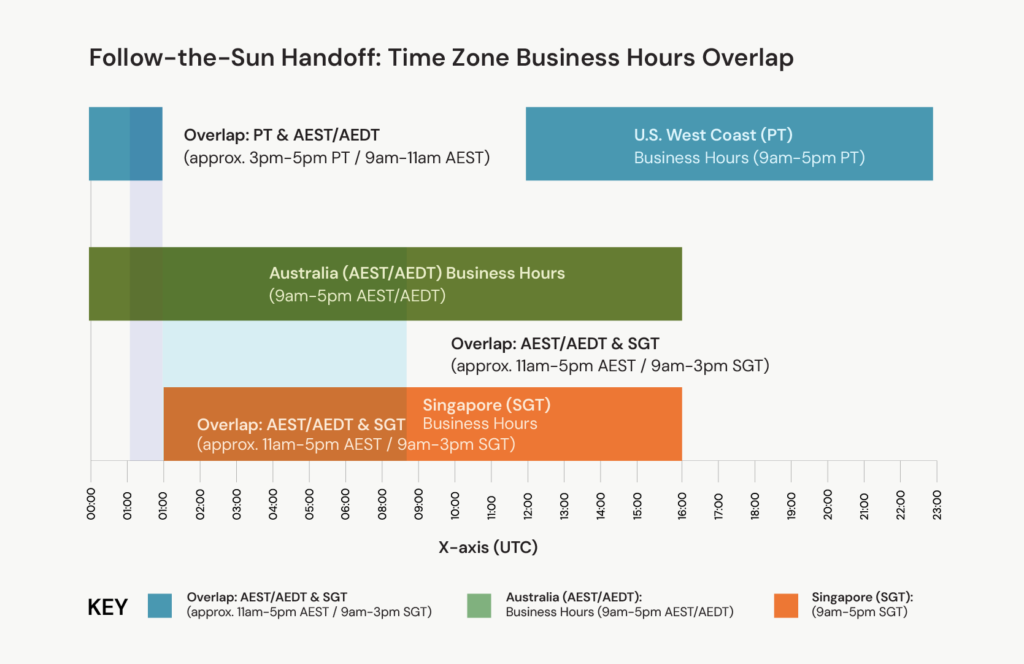
Australia's main tech hubs, including Sydney, Melbourne, and Brisbane, run on Australian Eastern Standard Time (AEST, UTC+10). Sydney and Melbourne move to daylight saving time (AEDT, UTC+11) from October to April, while Brisbane stays on AEST. Eastern Australian business hours overlap with most of the working day in East and Southeast Asia. Australian mornings also align with late afternoon on the U.S. West Coast, which is still on the previous day.
U.S. West Coast and Southeast Asian teams share almost no working hours. An Australian team overlaps with both, so it can bridge the divide between them.
Follow-the-sun delivery works well here because of that overlap. When a West Coast team signs off for the day, the Australian team is already online and can pick up the work through a live handoff. Teams in Southeast Asia start an hour or two later and carry it through their afternoon.
Which compliance frameworks matter for custom software projects in Australia?
Two frameworks come up often for companies building or hosting software in Australia. The Privacy Act 1988 sets out the Australian Privacy Principles. These govern how an "APP entity" (mid-size and larger businesses; most under $3 million AUD turnover are exempt) must handle personal information. Separately, the Australian Cyber Security Centre's Essential Eight is a baseline set of eight mitigation strategies, such as application control, patching, and restricting admin privileges.
APP 8, the cross-border disclosure principle, is the one that matters most for companies staffing projects with teams outside Australia. Before sending personal information to an overseas recipient, an APP entity must take reasonable steps, typically an enforceable contract, to ensure that recipient doesn't breach the Australian Privacy Principles. That obligation applies even when the recipient is simply a team member working from another country, with narrow exceptions such as the individual's informed consent.
It's mandatory for federal (non-corporate Commonwealth) agencies. Most state governments have adopted some version of it too, but requirements vary. NSW and Queensland mandate a minimum maturity level; Victoria treats it as guidance rather than a hard requirement. Many private-sector vendors adopt it as well, as a practical security checklist, even though it isn't legally mandatory for them.
Two frameworks that shape software projects in Australia
| Framework | What it covers | Who it applies to |
| Privacy Act 1988 (Australian Privacy Principles) | Collection, storage, use, and disclosure of personal information | APP entities (mid-size and larger businesses; most under $3 million AUD turnover are exempt, with exceptions) and Australian Government agencies. |
| Essential Eight (ACSC) | Eight baseline cybersecurity mitigation strategies (patching, application control, access restrictions, backups, etc.) | Mandatory for federal (non-corporate Commonwealth) agencies; state-government requirements vary, from mandated maturity levels in NSW and Queensland to voluntary guidance in Victoria. |
Neither framework replaces a vendor's own security posture. They're a floor, not a substitute for independent verification.
Because neither framework comes with a certificate a vendor can show, companies evaluating an Australian software development partner often ask for independent verification in addition to these. The most common request is ISO 27001 certification, which requires an external audit of a vendor's information security management system.
It's worth asking for directly, rather than taking a general compliance claim at face value. Svitla's Australian team holds ISO 27001 certification, carried over from Kiandra. It has also built software for other regulated industries. After the Royal Commission into Misconduct in the Banking, Superannuation and Financial Services Industry, it built a compliance portal for Centrepoint Alliance, a financial adviser network. The portal gives advisers one place to track new regulations, training, and compliance resources, instead of hunting across separate systems.

How does Svitla staff software teams in Australia?
Svitla expanded into the Australian market in 2026 by acquiring Kiandra IT, an Australian software development company founded in 1995 with about 45 engineers. Kiandra brought client relationships in healthcare, financial services, and government, including agencies that work under state Essential Eight requirements, along with a strong track record in Microsoft .NET and OutSystems. OutSystems named Kiandra its Growth Partner of the Year 2025 for the Asia-Pacific region.
Kiandra’s team is now part of Svitla’s global delivery network. Clients who work with Svitla in Australia get senior engineers who built regulated-industry software for Australian organizations before the acquisition and who now collaborate with Svitla teams across 15 other locations globally.
The MONSON shipping-industry project referenced above is a case in point: it ran on OutSystems, the same low-code platform Kiandra specializes in, for a client operating across more than 30 locations in Australia and Asia. The GS1 Australia member portal overhaul tells a similar story closer to home: an Australian client, the same OutSystems platform, delivered in six months for a system serving roughly 25,000 users. There, a local team's platform expertise and a global delivery network reinforced each other, achieving more together than either could alone.
It’s an example that shows what a local team adds to an offshore engagement model: context a purely remote arrangement doesn’t have.
What differs about software development in Australia?
Custom, web, and mobile app development projects in Australia follow the same engineering process as projects anywhere else. Most local differences come from two places: the compliance rules a client has to meet and the Australian systems a product needs to connect to.
Local integrations often mean payment providers or government identity systems, such as PayTo or BPAY for payments and myID for government identity (formerly myGovID). For example, a mobile application built for an Australian retailer still goes through the same design, build, and QA stages it would anywhere else. Vendor selection and hosting decisions, though, get shaped by the Privacy Act and Essential Eight considerations covered above.

How to choose a custom software development company in Australia?
Australia checks out on paper: lower salaries than the U.S., hours that overlap Asia and the U.S. West Coast, and compliance rules that have stayed stable for years. None of that pays off automatically, though. It depends entirely on the vendor you hire. Before signing a contract, check for these four things:
- A verifiable track record. Ask for named case studies with measurable outcomes and, ideally, a client reference you can call.
- Independent security certification. Look for ISO/IEC 27001 or SOC 2, and check that the certificate covers the team and software development services you're buying.
- A named local team. Meet the project lead and engineers who will work on your software development project before you sign, so you know who is doing the work and where they're based.
- A clear post-launch warranty period, so a defect found in week two doesn't become a new billable engagement.
None of this replaces direct due diligence, but a vendor that can show all four tends to deliver on the cost, speed, and compliance advantages this article has covered, rather than just advertising them. The questions below cover what comes up most often once a project is already underway.
Cost, time zone, and compliance are all part of the same software development Australia decision
It's tempting to treat cost, time zone, and compliance as three separate boxes to check when scoping a custom development project in Australia: cheaper if the salary math works, faster if the hours overlap, safer if the frameworks are covered. They're the same decision.
An in house team that's cheaper on paper but doesn't understand the Privacy Act ends up costing more once a client's legal team gets involved. A high-quality custom software team with overlapping hours and ongoing support but no local track record still requires project management as closely as a purely remote one.
Svitla's acquisition of Kiandra brings these factors together. Clients get engineers with Australian customer experience and a working knowledge of local privacy and security requirements, working hours that overlap with Asia and the U.S. West Coast, and access to Svitla's global delivery network.
Talk to Svitla's team in Australia.