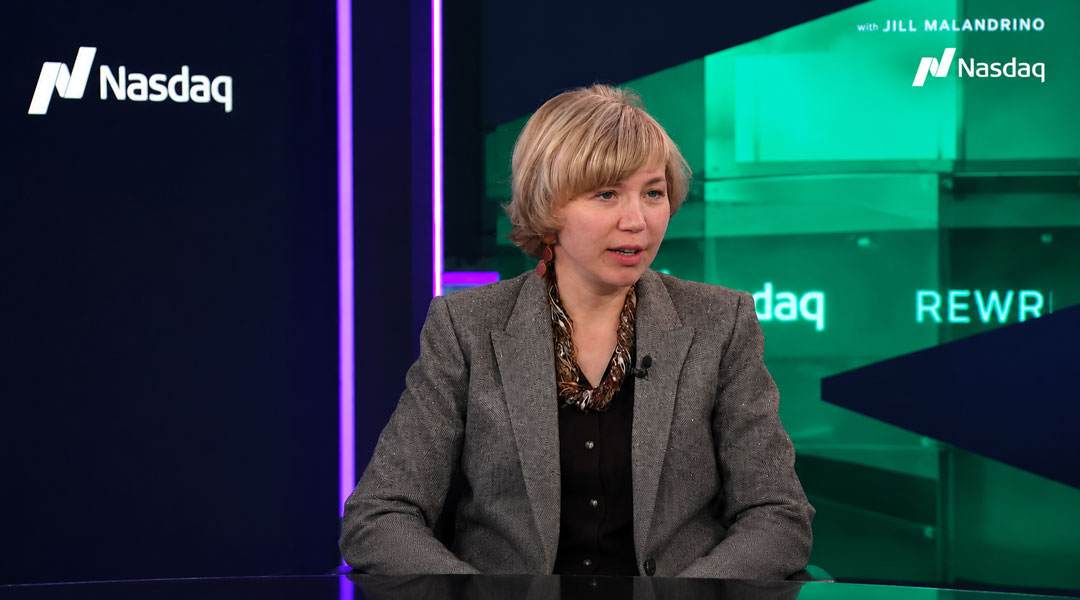
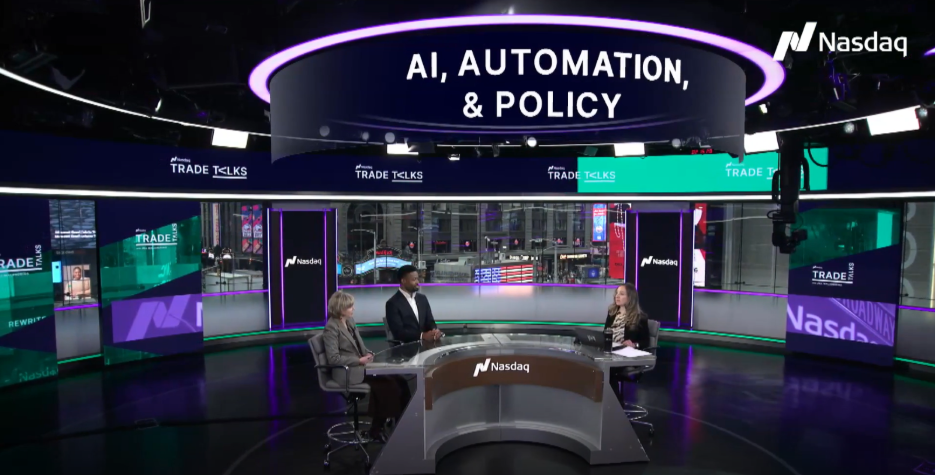
Nataliya Anon, Founder and CEO of Svitla Systems, took a seat at the Nasdaq MarketSite in Times Square to approach a problem most companies are still working out: how to scale AI responsibly. She joined host Jill Malandrino and Andrew Christian Davis of Edin Capital on Nasdaq TradeTalks, the show that brings in leaders working at the edge of emerging technology, regulation, and capital markets.
Natalia Anon brings 20+ years of building Svitla Systems, so while a lot of the AI conversation right now trades on hype, she stays grounded in what it takes to deliver.
Over the course of the interview, Natalia laid out how companies get real returns from AI, how they handle compliance and governance, and where the growth realistically sits.
The value has to be measurable before you scale
AI is the new operating system of modern business. It raises productivity, grows revenue, and helps companies win market share. It is also expensive, and plenty of AI projects never earn back what they cost. That gap between promise and payback is where most efforts fail.
It's important to start small and prove the value first. Run a proof of concept. Confirm the project returns something you can measure before committing a real budget.
The reason sits in how AI differs from ordinary software. Build a website and you know the finished product from the start. Train a model and you are chasing a target, say 90% accuracy, that you cannot guarantee until you build and iterate toward it. That uncertainty is exactly why ROI has to lead the conversation. A model that cannot justify its cost is not a project worth scaling.
AI should raise people up, not push them out
The second principle Svitla Systems holds to on every engagement is human-centric design. AI works best when it makes people better at their jobs.
This is a design limitation rather than a talking point. It changes what a team builds and how they scope it. The model exists to lift the quality of work a person already does, which keeps the human at the center of the process rather than at the edge of it. Value and people are the two anchors Svitla Systems returns to on every AI project, and they hold each other in place.
Governance is where the advantage hides
Responsible AI is often treated as a cost. It is closer to a moat. An AI system reaches the company, its customers, and its employees all at once, so a single failure in fairness, privacy, or accuracy can do lasting reputational damage and pull in regulators.
Transparency is the way out. Document how a solution works so it can be reviewed, and something useful happens: customers start asking for that documentation, and the ability to hand it over becomes a reason they choose you. Companies that build governance into the product win trust that competitors cannot easily copy.
Good rules need the public and private sectors in the same room
Scaling AI across an organization means building governance in as you go, and that work depends on public and private partnerships. A Stanford conference last spring is a useful model, bringing government and enterprise together to share what each side is learning.
The gap those conversations close is huge. Regulations already exist, but how to implement them is rarely spelled out, so companies have to work it out on their own. Regulators, in turn, need research and case studies from industry to know when to act. Timing matters as much as the rules themselves. Move too early or too hard and you slow the very work you meant to encourage. Rules should also protect smaller players rather than becoming red tape that locks them out of the market.
Local rules decide how far a solution can travel
Every new market brings new rules, and that reality shapes how an AI system should be built. The EU moved first on AI regulation. In the US, financial services already operates under real requirements, and Svitla Systems is helping a client in that sector keep its AI solution in line with them.
Cross into Europe and GDPR reshapes the design entirely, with penalties reaching up to 4% of global annual revenue depending on the breach.
Two moves protect a company here. Bring in experts who know the local regulations, because they catch the mistakes you would not see coming. And build modular from the start, so one solution scales across markets instead of being rebuilt for each one.
Compliance is a habit
Compliance is not something you finish. In a market changing this quickly, it needs constant attention, especially as a company enters new regions where rules are still being written.
Most companies do not have internal resources to keep pace. That is why the smart ones bring in outside expertise to design for compliance and stay current as regulations roll out.
Ethical leadership means asking the hard questions first
Two decades of building a company have shaped how Natalia Anon leads, and she is direct about it as a female founder. Ethical leadership means asking uncomfortable questions before a system ships, not after it causes harm.
Who does this AI benefit? Does it leave anyone out? Who could it harm? Who was in the room when it was designed? Those answers have to be honest, and the design process has to include everyone the system touches, from frontline workers to managers to company leaders.
The final test is both a business and a human one. Does the system lower costs and improve productivity? Are privacy concerns handled? Is it fair to employees and clients alike? Ethical AI has to benefit the people who use it, the clients who depend on it, and the communities around it. Anything less is not worth shipping.
Buyers are already asking for this
Companies are becoming more receptive to governance and compliance, not less. In financial services, where staying up-to-date with regulation is a must, clients are the ones seeking advice rather than resisting it.
That demand is the signal. Responsible AI has moved from a good idea to something buyers request by name. Companies that build governance into the product from the start put themselves in a stronger position to scale.