The global market was valued at $28.6 billion in 2025 and continues to grow as more organizations seek training that ties to business performance. With features like skills mapping, personalized learning paths, and more, the comparison with a traditional LMS reveals a big divide. While traditional systems act as static record-keepers, AI-powered platforms drive performance, transforming training into a business asset.
Key definitions:
- AI-powered LMS: An LMS that applies machine learning and behavioral analytics to adapt learning paths in real time, using what each employee already knows and where the gaps are.
- Customer education platform: A system that delivers product knowledge, onboarding, and certification paths to paying customers. It needs public-facing portals and CRM integration, which internal LMS environments are not built to provide.
- Extended enterprise training: Training delivered to people outside the organization, including partners, resellers, dealers, and distributors. It requires a different architecture from internal employee training.
- Learning management system (LMS): A software platform that delivers, tracks, and manages employee training programs.
- Skills mapping: The process of connecting training content to specific competencies, identifying gaps, and updating that picture as employee performance data changes.
Knowing which features matter at enterprise scale is what makes or breaks the choice of an AI-powered LMS. At enterprise scale, the features you pick decide whether an AI-powered LMS earns its place. Get them wrong, and even a well-funded program leaves you with little more than completion data.
The global LMS market was valued at $28.6 billion in 2025 and is expected to grow to $123.7B by 2033, according to Grand View Research. The market is expanding fast. But a growing share of that spend goes to platforms that never connect training to business results. Platforms chosen for their content libraries and feature checklists rarely connect training outcomes to business performance once they go live.
The features covered in this article define what an enterprise-grade LMS looks like in practice. We also walk you through how to evaluate and choose the right platform for your organization.
Why are enterprises adopting AI-powered LMS platforms?
Enterprise learning teams manage course catalogs. They also support onboarding, compliance, role-based development, leadership programs, technical enablement, partner training, and customer education.
An AI-powered LMS can help connect these activities to workforce skills and business goals. It does this by analyzing structured and unstructured learning data, including course metadata, assessments, job roles, learner activity, and competency records.
AI allows learning teams to scale their strategy by automating repetitive tasks and highlighting patterns that are hard to spot manually.
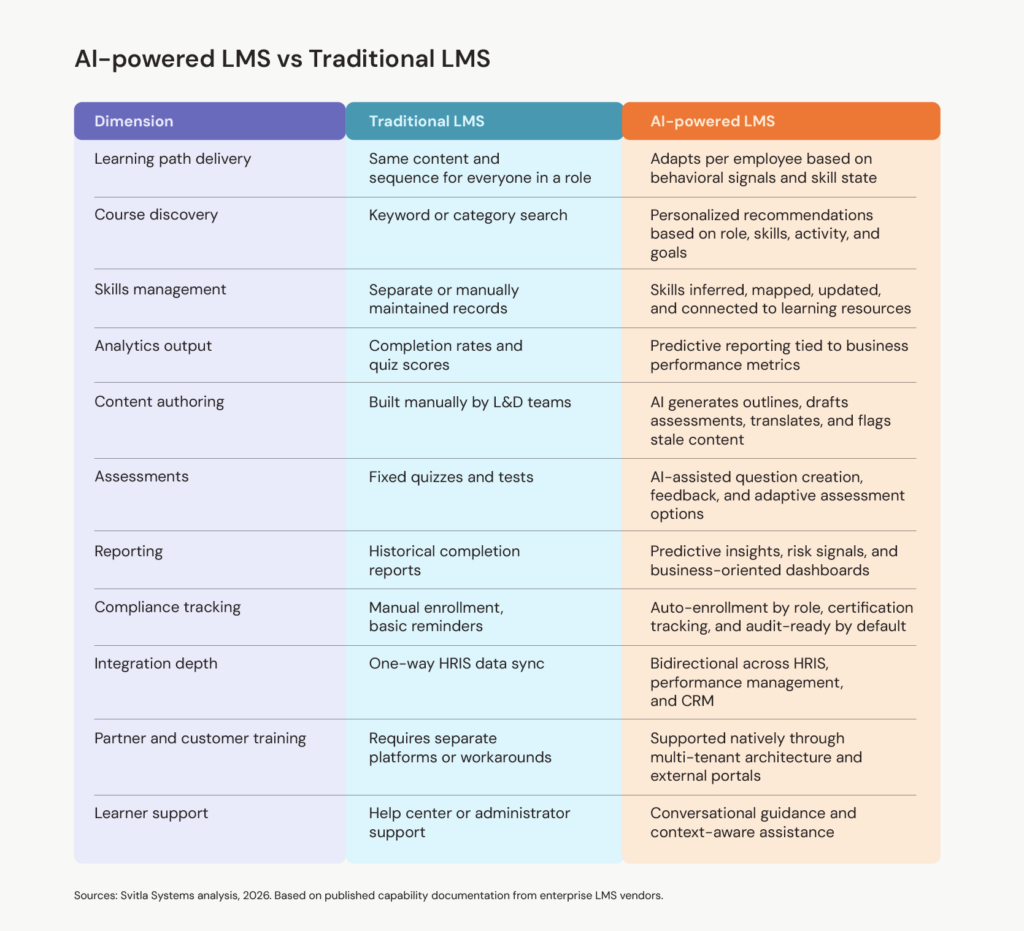
What is the difference between an AI LMS and a traditional LMS?
The difference between the AI LMS and a traditional LMS lies in how each system uses data to support decision-making and automate learning workflows.
A traditional LMS does three things well: it stores content, assigns it to employees, and records who finished. That was enough when training existed to satisfy a compliance requirement or deliver a fixed skillset. It stopped being enough when organizations realized they needed to know whether training was changing how people worked.
An AI-powered LMS platform uses behavioral records to adjust what each employee sees next, rather than what their job title assumes they know. An AI-powered LMS builds intelligence into its core product loop: collecting behavioral data, adjusting learning paths, measuring outcomes, and feeding results back into the next training cycle.
What are the must-have AI-powered features for your LMS?
AI-powered skills mapping and workforce development
McKinsey’s Next Era of Work Survey of European organizations found that 17% invest in AI tools without funding the capability of building required to use them effectively. Training programs should have the data infrastructure to measure and respond to skill development in real time.
The World Economic Forum's Future of Jobs Report 2025 found that 63% of employers identify the skills gap as their biggest barrier to business transformation. The same report found that 85% of employers plan to prioritize upskilling as their primary workforce strategy through 2030.
Skills mapping should connect employee roles, competencies, proficiency levels, learning activities, and business priorities. An AI-powered LMS can help identify these relationships from job descriptions, course content, assessments, project data, and learner behavior.
An AI-powered LMS approaches skills mapping as a continuous process, building individual skill profiles from behavioral data: assessment of performance, engagement patterns, time spent on specific topics, and signals from performance systems. When a mismatch appears, the platform responds without waiting for a manager to notice.
Look for the ability to:
● Define skills, subskills, and proficiency levels.
● Map skills to roles and learning programs.
● Detect possible skills gaps.
● Recommend learning for a target skill.
● Track evidence of skill development.
● Connect skills data with HR or talent systems.
Personalized learning paths
Personalization should go beyond assigning different courses to different departments. A useful learning path can combine formal courses, short videos, assessments, documents, simulations, mentoring, and on-the-job activities. The system should also allow learning leaders to set mandatory requirements and business rules.
Personalization is most effective when learners can understand why an item is recommended. Something like “This module supports the cybersecurity skills required for your role” is more useful than an unexplained list of suggested content.
AI-assisted content creation and curation
AI cuts the time it takes to prepare learning materials. Depending on the platform, it may generate draft summaries, learning objectives, quiz questions, metadata, translations, or content recommendations.
The LMS should require a human review step before any AI-generated content reaches learners. Subject-matter experts need to verify accuracy, terminology, accessibility, copyright status, and alignment with internal policies.
When curating content, the platform should classify resources by topic, audience, skill, level, format, and language. This makes large libraries easier to search and surfaces more relevant content.
Adaptive assessments and feedback
Assessments should measure whether learners can apply knowledge, not only whether they completed a module. AI can help create question options, identify weak areas, provide formative feedback, and adjust difficulty where the platform supports adaptive testing.
Enterprises should check how the LMS handles assessment validity. AI-generated questions require review for ambiguity, bias, incorrect answers, and inappropriate difficulty.
The platform should support multiple assessment formats, including knowledge checks, scenario questions, practical assignments, simulations, and manager or instructor evaluations.
Learning analytics and predictive insights
Gartner found that only 8% of employees are fully capturing GenAI’s productivity gains, meaning they use the tools often and get both speed and quality improvements. That figure points to a training and capability development mismatch that most organizations are not measuring because their platforms are not built to surface it. A platform that can show which training interventions affect AI tool adoption (and which do not) is worth more than one that can only confirm that the training happened.
An enterprise LMS should help learning leaders track engagement, assessment performance, skill development, and time to proficiency, then connect all of it to business outcomes.
Predictive analytics can identify patterns such as learners at risk of dropping out or programs with unusually low assessment performance. These signals should support human decisions rather than act as automatic judgments about an individual’s potential.
Useful dashboards should serve different audiences:
- Learners need progress and next-step views.
- Managers need team capability and completion views.
- Learning teams need program and content performance views.
- Executives need concise workforce and business-outcome indicators.
- Conversational AI for learner support
A conversational assistant can help learners find courses, understand requirements, summarize approved materials, and move through learning paths. It can also answer routine administrative questions and reduce the volume of support requests.
The assistant should ground responses in approved enterprise content. Administrators need controls for permissions, source selection, escalation, conversation logging, and data retention.
A conversational interface should complement the LMS experience. Learners should still be able to open the referenced course, policy, or resource directly.
Automated administration
Automation is one of the clearest enterprise benefits of an AI-enabled LMS. The platform should automate repetitive tasks, including enrollment, reminders, recertification notices, assignment rules, cohort creation, and completion tracking.
AI can also help classify users, content, and learning requests. But automated rules must be auditable. Administrators should be able to see why a learner was assigned a program and change the rule when business requirements evolve.
Partner training and customer education
Many enterprises need an LMS for audiences beyond employees: partners who resell the product, and customers who buy it. Partner training has different content requirements from internal training. A platform for partner training should support external identities, branded portals, audience-specific catalogs, delegated administration, certifications, and access controls. Partners need product certification paths that reflect the latest product releases and connect to sales enablement materials. They should be able to access content without involving IT. And the certifications they earn must be visible to the vendor's partner management team in real time.
You organize customer training by product line, use case, and segment. A first-time customer needs a different path from someone preparing for an advanced certification. An AI-powered customer education platform can suggest onboarding resources, guide customers to the right documentation, and flag where they commonly get stuck. That speeds up product adoption and takes load off your customer success and support teams.
For external learning, confirm that the platform can separate audiences and data. Partners and customers should see only the resources and reporting appropriate to their organization. Svitla's digital transformation expertise covers the integration architecture that connects learning platforms to the systems where that data needs to land.
Enterprise integrations
An LMS usually integrates with systems such as HR platforms, CRMs, content libraries, talent marketplaces, data warehouses, and more.
Prioritize standards-based integration where possible. Look for single sign-on, automated user provisioning, interoperability with learning content, APIs, webhooks, and export options.
An AI security LMS integrations review should cover both the LMS and the systems connected to it. Integration design determines what data enters the AI features, how it is processed, and who can access the resulting insights.
Security, privacy, and responsible AI controls
Enterprise learning data may include employee identities, performance information, assessment results, skills profiles, and customer or partner records. Treat security as a core capability, not an add-on you configure later. Important controls include:
- Role-based access control
- Tenant and audience isolation
- Encryption in transit and at rest
- Single sign-on and multifactor authentication
- Audit logs for admin and AI-assisted actions
- Data residency and privacy compliance
- Configurable retention and deletion policies
- Clear data-processing responsibilities
- Human review for high-impact recommendations
Ask vendors where AI processing happens, which models and subprocessors are used, how prompts and outputs are stored, and how administrators can remove or correct data.
How should enterprises choose an LMS?
The best AI-powered LMS for large enterprises depends on the organization’s audiences, operating model, technology environment, and governance requirements. In addition to a feature list, use an evaluation process and an implementation checklist that cover the following.
Evaluation process
- Define audiences and business outcomes
List the groups the LMS must serve: employees, managers, contractors, partners, customers, or other audiences. For each group, define the outcome the learning program should influence.
- Map current and future workflows
Document how users are created, enrolled, assigned content, assessed, certified, reported on, and removed. Mark which steps are manual and which should be automated.
- Establish the skills model
Identify the role families, critical skills, proficiency levels, and evidence requirements that the platform must support. Decide who owns the taxonomy and how often it gets reviewed.
- Validate integrations
Create a list of required systems and integration methods. Test identity, user provisioning, data synchronization, content exchange, reporting, and access revocation during the vendor evaluation.
- Review AI governance
Ask how the vendor handles data isolation, model training, prompt and output retention, explainability, bias testing, human review, and incident response.
- Test representative scenarios
Use real workflows in a proof of concept. Test employee onboarding, a skills-based recommendation, an external partner portal, an assessment, a report, and an administrator correction.
- Define success metrics
Set baselines before implementation so you can prove change later. Track time to assign training, time to proficiency, completion of mandatory learning, assessment performance, content engagement, support-ticket volume, certification renewal, and partner activation.
Implementation checklist
- Assign an executive sponsor and product owner.
- Define audiences, roles, and access policies.
- Clean and standardize user and course data.
- Approve the skills taxonomy and governance process.
- Configure integrations in a test environment.
- Review AI-generated content before publication.
- Establish data retention and incident procedures.
- Pilot with representative learners and administrators.
- Measure adoption and learning outcomes after launch.
- Improve recommendations, content, and workflows based on evidence.
Aligning learning with business velocity
Moving from a traditional LMS to an AI-powered platform changes what training does for the business. It stops recording who finished a course and starts shaping how fast your workforce can adapt.
The value of an AI-powered LMS is in the data loops it creates: mapping skills in real time, predicting where capability gaps will open, and automating the path to proficiency. Once you connect learning data to your core business systems, CRM, HRIS, and talent marketplaces, training stops being a cost center and starts informing workforce decisions. Skills change faster every year, which is why training has to be something you can measure.
Svitla's machine learning and digital transformation practices support enterprise teams building and connecting learning infrastructure, from platform selection and integration architecture through to the analytics layer that connects training outcomes to business performance.
FAQ
How do LMS platforms support skills mapping initiatives?
LMS platforms support skills mapping by connecting competencies to roles, learning content, assessments, and learner records. AI-enabled platforms can suggest skills from content and role data, identify possible shortfalls, and recommend learning activities. For enterprise teams, this means skills mapping becomes an operational function rather than an annual exercise, and the output is a live picture of workforce capability rather than a static report.
What is the best LMS for large enterprises?
The best LMS for a large enterprise is the platform that fits its audiences, integrations, governance model, learning workflows, and measurable outcomes. Platforms like Docebo, Cornerstone OnDemand, and SAP SuccessFactors Learning are widely deployed at enterprise scale. Still, the most widely deployed platform is rarely the best fit for a specific organization's requirements. A large organization should test scalability, external-learning support, identity management, analytics, security, and AI controls in realistic scenarios before selecting a vendor.
What does LMS stand for in education?
LMS stands for learning management system. It refers to the software platform an organization uses to build, deliver, and track training programs for employees, partners, or customers.
What is a learning management system?
A learning management system is a digital platform for managing learning programs and learner activity. Typical functions include content delivery, enrollment, assessments, certifications, communication, reporting, and integrations.
How do you choose an LMS?
Choose an LMS by defining your audiences and outcomes, mapping required workflows, validating integrations, reviewing security and AI governance, testing representative use cases, and setting measurable success criteria. The selection process should include administrators, learners, IT, security, HR, and learning leaders, as well as business stakeholders.
Svitla's guide to choosing the right AI-powered LMS for corporate training covers the evaluation framework in detail, including the questions to ask vendors before signing a contract.