TL;DR: The strongest use cases often include software development, marketing operations, document processing, supply-chain planning, and more. Generative AI for enterprise creates value when it’s connected to a defined workflow, a reliable data source, and a business metric. ROI should be measured with a baseline, a controlled pilot, adoption data, quality checks, operating costs, and financial impact.
Key terms
- AI ROI: The financial return an organization gets from an AI initiative relative to what it spent, typically measured at the use-case level.
- Enterprise AI strategy: A plan that connects AI investment to business outcomes, including which use cases to prioritize, how to measure them, and what governance controls apply.
- Generative AI: AI systems that create new content, such as text, code, images, audio, video, or structured outputs, in response to prompts and data.
- Large language model (LLM): The technology behind most generative AI tools, trained on vast amounts of large datasets to generate and process human language and code.
- Off-the-shelf AI tool: A generative AI product used as sold, with little or no customization.
Generative AI adoption is broad, but production-scale deployment remains rare. Even as most large organizations have moved past initial pilots, financial impact stays inconsistent: some use cases show fast, well-documented gains, while others have no measurable return at all.
This piece examines where the evidence for ROI is strongest, and what separates the initiatives that pay off from those that stall.
What is the ROI of generative AI?
IDC's AI opportunity study, sponsored by Microsoft and based on interviews with more than 4,000 business leaders, found that for every $1 a company invests in generative AI, the ROI is $3.70x. The study also found that top-performing organizations report returns nearly 3x higher than that average, concentrated in financial services, media and telco, mobility, retail, energy, manufacturing, healthcare, and education.
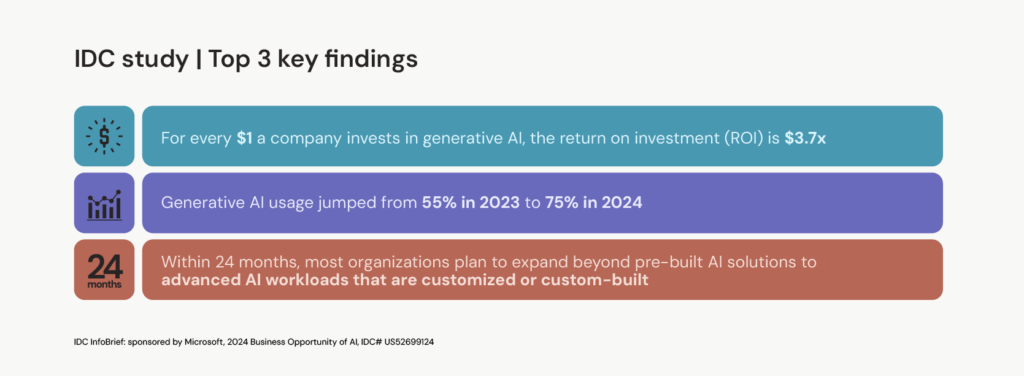
IBM's Institute for Business Value (IBV) found that most AI initiatives fail to deliver the returns their leaders expected, and only a small share have scaled past a single business function, as shown in the table below. The two findings aren't necessarily in conflict. IDC's number is an average, which a handful of top performers can lift even if most initiatives underperform. IBM's number counts something different: what share of initiatives hit the specific ROI target their own leaders set going in. An initiative can lift IDC’s average while still counting as a “miss” in IBM’s data, if it made money but fell short of what leadership expected.
Deloitte's State of Generative AI in the Enterprise survey found that most organizations say their most advanced generative AI initiative is meeting or exceeding ROI expectations, with cybersecurity initiatives most likely to outperform. Taken together, these studies point in the same direction. ROI concentrates in an organization's most mature, most focused deployment, not across every project it starts.
IBM's 2025 CEO study is built around a specific frame: 61% of surveyed CEOs say they’re actively adopting agentic AI and preparing to implement it at scale. A copilot-style tool has an easy-to-baseline job, and its ROI is simple to isolate. An agent that completes a multi-step task across systems is harder to baseline and attribute savings to. This is likely why IBM IBV found that only 29% of leaders measure agent ROI with confidence, even though 79% report seeing productivity gains. The gap between seeing and measuring benefits is bigger for agents than it is for copilot tools.
How do you calculate the ROI of generative AI?
The ROI of generative AI should be calculated at the workflow level. A basic formula is:
Generative AI ROI = (Financial benefits - Total costs) / (Total costs) X 100
Total costs may include:
- Software and model usage
- Integration and data preparation
- Security and evaluation
- Change management and training
- Monitoring and human review
Financial benefits may include:
- Cost savings for work that is removed or redeployed
- Additional revenue from an improved workflow
- Reduced error, rework, fraud, or compliance cost
- Lower support or processing cost
- Faster time to market
- Reduced spending on outsourced or external services
The structured approach to measuring generative AI includes the following steps:
- Define the unit of work: Choose a measurable unit, such as a resolved case, a reviewed document, a completed code change, a campaign asset, a planner exception, or an answered employee question.
- Establish a baseline: Measure current volume, time, cost, quality, error rate, and service level before introducing AI. A baseline prevents the program from confusing existing gains with AI impact.
- Set an eligible-use boundary: Define which tasks the AI system should support. Exclude cases that require expert judgment, sensitive decisions, or data that the system cannot access safely.
- Run a controlled pilot: Compare an AI-supported group, workflow, or period with a suitable baseline. Where possible, use a control group or phased rollout to reduce attribution errors.
- Measure quality and risk: Track accuracy, citation quality, policy compliance, defects, overrides, escalations, privacy incidents, and security findings. Productivity gains do not count as positive ROI if they create unacceptable downstream costs.
- Calculate the total cost of ownership: Include licenses, inference or usage fees, integration, data preparation, evaluation, security, monitoring, training, support, and human review.
- Validate adoption: A tool cannot deliver projected value if employees do not use it or if they spend more time correcting its output. Track active users, eligible-task coverage, acceptance rate, override rate, and repeat usage.
- Review benefits after deployment: Recalculate the business case at 30, 60, and 90 days, then at regular intervals. Models, workloads, policies, and user behavior change over time.
What are the most notable AI use cases for enterprises?
Enterprise adoption of generative AI tools is challenging to scale because production systems must protect sensitive data, produce reliable outputs, integrate with existing workflows, and deliver measurable results.
A successful program starts with a business problem. The question should be “Which workflow contains enough repetitive knowledge work, measurable friction, and usable data to justify an AI intervention?” This question is what sets an enterprise AI strategy into motion. A strategy defines priorities, ownership, architecture, controls, funding, and measurement across multiple use cases.
Customer service
Generative AI can summarize customer histories, retrieve approved answers, draft replies, classify requests, and recommend the next steps. A human agent reviews the output before sending it.
Potential value drivers include lower average handling time, faster onboarding of new agents, higher first-contact resolution, and more consistent responses. The most important quality controls are source grounding, permission-aware retrieval, escalation rules, and review of sensitive cases. Recommended metrics include:
● Average handling time
● First-contact resolution
● Cost per resolved interaction
● Customer satisfaction
● Agent adoption and override rates
● Escalation frequency
Marketing content and campaign operations
Generative AI can help marketing teams create first drafts, adapt messaging for channels, summarize research, classify content, and personalize approved campaign components.
A European telecommunications company used generative AI to replace broad, one-size-fits-all outreach with content tailored for 150 distinct customer segments. The system generated copy and imagery for each segment's language, dialect, and product interest, with full human review before anything reached a customer.
The result was a 40% lift in response rates and a 25% reduction in deployment costs compared with the manual process it replaced. The gains came from message relevance, not message volume. The company sent fewer, better-targeted communications rather than simply producing more content.
The business case should distinguish output volume from business performance. Useful metrics include campaign cycle time, cost per asset, content reuse, conversion rate, revenue per campaign, and time spent on revisions.
Software development
Generative AI for software development can support code explanation, test generation, documentation, code completion, migration planning, and issue triage.
A McKinsey developer productivity study, based on a controlled lab with more than 40 engineers, found that generative AI tools cut code documentation time by 45% to 50%. New code generation time was reduced by 35% to 45%, and code refactoring time dropped by 20% to 30%. On complex tasks involving an unfamiliar codebase or framework, time savings fell below 10%. Less experienced developers also saw smaller gains, and in some cases, the tools slowed them down as they learned to work with the output.
Faster code generation is not enough if review time, defects, security findings, or rework increase. Track metrics such as:
● Lead time for changes
● Developer time spent on eligible tasks
● Test coverage
● Defect escape rate
● Pull-request review time
● Security findings
● Deployment frequency
● Developer satisfaction
Document processing and back-office operations
Generative AI can extract information from contracts, invoices, claims, reports, forms, and correspondence. It can classify documents, summarize exceptions, draft responses, and route work to the appropriate team.
Back-office automation often delivers stronger returns than the front-office tools that get most of the budget. MIT Project NANDA’s State of AI in Business 2025 report drew on a systematic review of more than 300 public AI initiatives, structured interviews with 52 organizations, and survey responses from 153 senior leaders. Companies further along in AI adoption saved $2 million to $10 million a year in customer service and document processing by eliminating BPO contracts, plus a 30% cut in external agency spend.
That gain came from a report whose central finding was far less encouraging: despite $30 billion to $40 billion in enterprise AI spending, 95% of organizations are seeing no measurable business return, and just 5% of integrated pilots are extracting real value. The organizations that beat those odds kept a person in the loop instead of letting the system run unsupervised. Human review should remain mandatory when errors could create financial, legal, safety, or customer harm.
Measure processing time, automation rate, exception rate, accuracy, rework, cost per document, and review effort.
Supply-chain planning and operations
Generative AI use cases in supply chain include natural-language access to planning data, exception summaries, supplier communication drafts, scenario explanations, and operational knowledge support.
McKinsey described an industrial and electronics distributor that used generative AI to prescreen supplier bid documentation, a process that traditionally took procurement staff days to complete manually. The tool cut review time by 90% and shortened the timeline from tender to project start by two months. The consulting firm also found that embedding AI into planning, warehousing, and procurement can reduce inventory levels by 20% to 30% and logistics costs by 5% to 20%.
Generative AI should complement forecasting, network planning, and inventory systems for decision-making. An assistant can explain a recommendation or help users investigate an exception while existing systems continue to calculate the underlying plan.
Relevant metrics include planner time per exception, response time, stockout rate, inventory carrying cost, expedite cost, supplier response time, and forecast-review effort.
Human resources and employee support
An internal AI assistant can answer questions about approved policies, benefits, onboarding, learning, and workplace processes. It can also draft job descriptions or summarize employee feedback for authorized teams.
HR applications require careful access control and review because the data may be personal or sensitive. Generative AI should not make unreviewed decisions about hiring, promotion, compensation, discipline, or termination.
Measure employee self-service rate, time to answer, support-ticket volume, answer accuracy, escalation rate, and employee satisfaction.
What should an enterprise AI strategy include?
An enterprise AI strategy should name the business outcomes generative AI is meant to support, not just the technology being deployed. That means identifying which functions, whether software development, supply chain, marketing, or another area, have the clearest path from use case to measurable outcome, and sequencing investment there first.
Choosing among the leading generative AI solutions for enterprise usually comes down to a build-versus-buy decision made early in the rollout. Most enterprises start with off-the-shelf tools, then move toward customized or purpose-built solutions once a use case proves out.
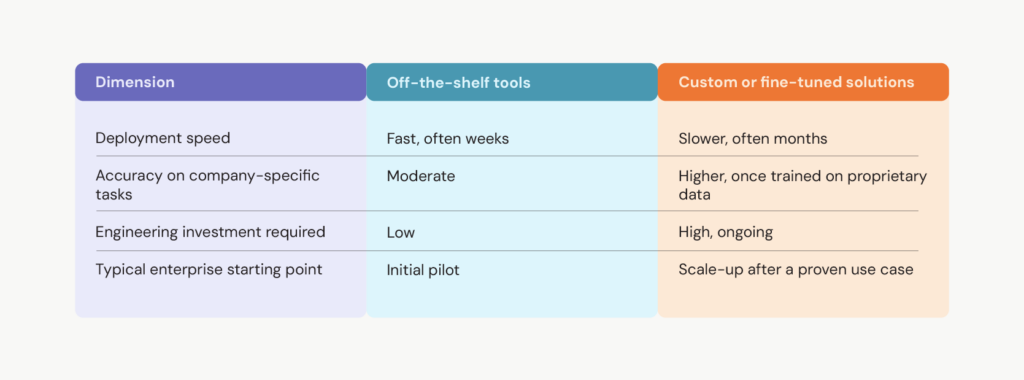
Whatever the deployment model, an AI strategy needs a governance layer: data controls, human review for high-stakes outputs, and a way to track the use cases producing returns.
Building an enterprise AI strategy
- Establish governance before scale: Define who approves use cases, who owns data, who evaluates model performance, and who responds to incidents. Create rules for sensitive information, approved tools, human review, and procurement.
- Prioritize use cases by value and feasibility: Score candidates using business impact, implementation effort, data readiness, risk, adoption likelihood, and time to value. Start with use cases that can produce evidence within one business quarter.
- Create shared services: Build shared services for identity, retrieval, evaluation, logging, model access, prompt management, and monitoring. Shared components reduce duplication across pilots.
- Manage change as part of the product: Train users on appropriate use, limitations, review responsibilities, and escalation. Update job procedures and incentives so that AI-supported work becomes part of the real operating model.
- Scale only after evidence: A successful demo is not proof of production value. Scale a use case after the pilot demonstrates acceptable quality, adoption, risk controls, unit economics, and measurable business impact.
Readiness determines where AI pays off and where it doesn’t
Generative AI can deliver enterprise value, but ROI does not come from model access alone. It comes from choosing the right workflow, integrating trusted data, designing effective human oversight, measuring the complete cost, and improving the system after launch.
The strongest results come from a narrow, well-defined task, measured early and expanded only after the numbers hold up. Begin with a small number of measurable use cases. Prove value in production, document the lessons, and then build reusable capabilities for the next wave of enterprise adoption.
Svitla's AI and machine learning practice works with enterprise teams on that sequencing, from identifying the first use case to building the governance and scaled deployment needed to support it.
FAQ
How do enterprises use generative AI?
Enterprises use generative AI in software development, supply chain and procurement, marketing, and customer support, applying it to tasks that involve producing structured text, code, or content from existing data. Each use case should have approved data, a defined human role, quality controls, and measurable business outcomes.
What is generative AI for enterprise marketing?
Generative AI for enterprise marketing is the use of large language models and image-generation tools to produce and personalize marketing content, from email copy to product concepts, at a scale that manual production cannot match. Enterprise deployments route generated content through human review before publication to protect brand voice and factual accuracy. The clearest returns come from personalization at scale, tailoring messages to smaller audience segments than a manual process could support.
What is the main ROI of integrating generative AI?
The main ROI of integrating generative AI usually comes from automating repetitive tasks in knowledge work, increasing capacity, improving service speed, reducing errors, or accelerating revenue-generating processes. The actual return depends on adoption, quality, integration cost, review effort, and whether saved time creates measurable economic value.
How do you measure the ROI of generative AI?
Measure ROI by establishing a baseline, defining the eligible unit of work, tracking AI-supported performance, measuring quality and risk, calculating total cost of ownership, and comparing benefits with costs. Use controlled pilots where possible and report strategic benefits separately from directly attributable financial returns.
When does generative AI deliver real ROI?
Generative AI delivers real ROI when it supports a high-volume workflow with clear success criteria, reliable data, efficient human review, strong adoption, and a measurable connection to cost, revenue, quality, speed, or risk. A polished demonstration without production adoption does not prove ROI.