Cloud engineering now sits behind almost every digital product people use. In a short time, it has become one of the busiest corners of modern technology. Platforms ship updates every few months, so for us, as a technology partner, keeping our skills, knowledge, and practices up to date is a standing commitment.
At Svitla Systems, we pay special attention to growing, cultivating, and supporting in-house expertise. 90% of the Svitla team consists of senior-level developers who are highly proficient, self-driven, and able to set mindful goals and consistently pursue them. To support continuous learning, we help engineers grow across AWS, Azure, DevOps, and other technologies through funded learning programs, covered certification costs, and bonuses.
We believe an expert who knows a client’s platforms in depth makes sharper decisions about how their systems are designed, built, and secured. That judgment, built through each certification, is what we put to work on the challenges our clients are trying to solve.
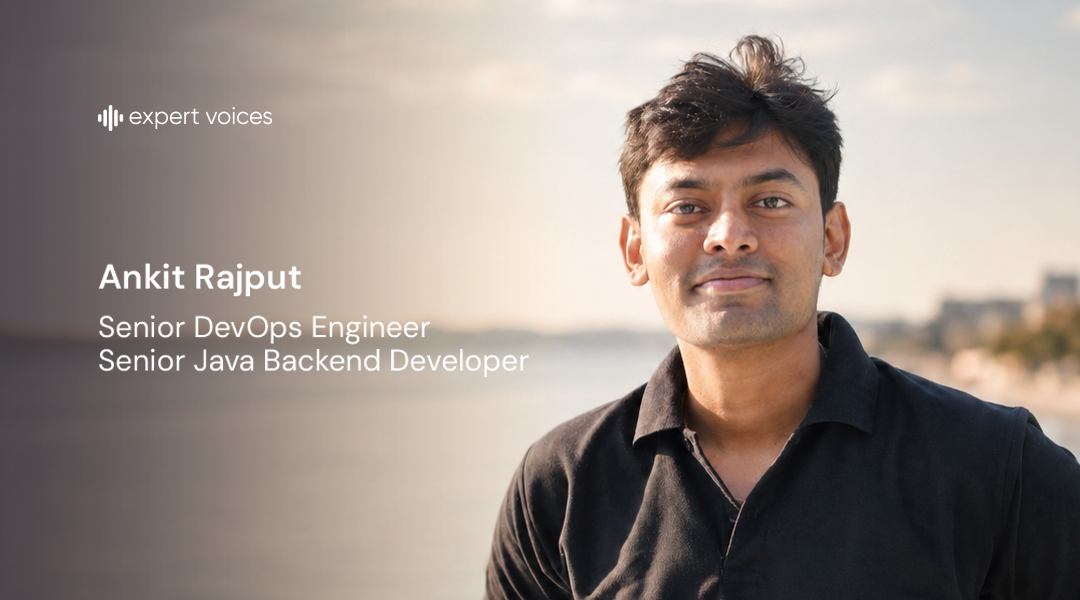
Meet our expert: Ankit Rajput
Ankit Rajput, Senior DevOps Engineer at Svitla Systems, has just earned his cloud certification, built across Amazon Web Services and Microsoft Azure reaching the professional and expert tiers of both. The AWS certifications came together over about six months this year, alongside a full-time project.
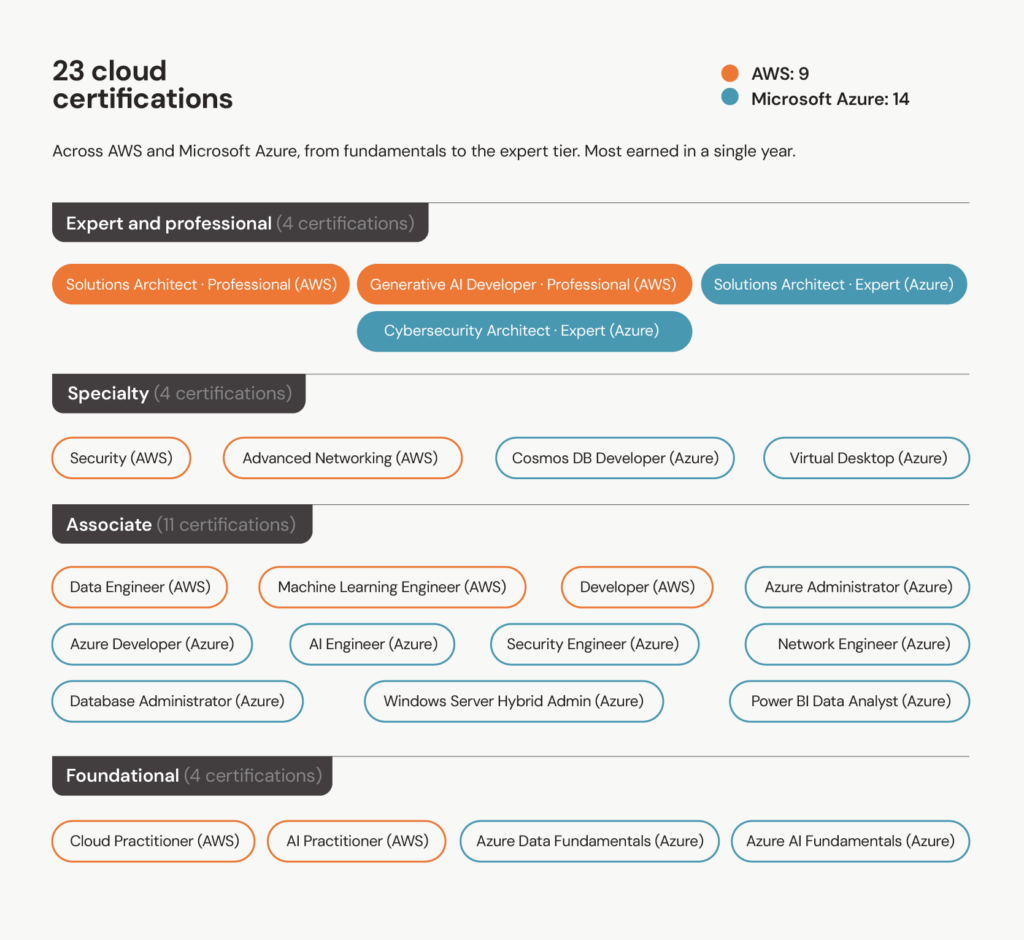
On the AWS side, Ankit holds 9 certifications, from Cloud Practitioner and AI Practitioner through the associate exams for development, data, and machine learning, up to the Solutions Architect Professional, with two specialties in security and advanced networking.
On the Microsoft side, Ankit holds 14 certifications, reaching the expert tier twice through the Azure Solutions Architect Expert and Microsoft Cybersecurity Architect certifications, along with associate-level certifications across administration, networking, security, development, and AI engineering.
These are legitimately difficult exams, aimed at engineers with years of hands-on experience. They come down to building real systems and weighing trade-offs, which is a big step up from just knowing what each service does.
Preparing for a certification can take weeks or months, depending on the exam's scope and the candidate's existing experience.
To see how he got here, we sat down with Ankit to talk about what the certification path really takes: the exams, the failures, the study routine, and how he keeps that much knowledge from going stale.
You did not start out in tech. How did you get here?
Honestly, I did not come from a tech background at all. I studied commerce and trained as an accountant, and for a while I thought I would end up somewhere in e-commerce. After I graduated, I took a basic computer fundamentals course and kept going from there. Fifteen years later, I am happy I ended up here. Learning never stops in this field, and that is the part I enjoy the most.
23 certifications, and a lot of them obtained in the last few months. Tell us about your cloud certification path.
I have been at Svitla for about two years, working on a large AWS environment for a client with a complex infrastructure. I was Azure-certified about three years ago, but those certifications had all expired by the time I came back to this, so this year turned into my certification year.
On the AWS side, the most dynamic part ran from April to July. Having already learned a lot of the material once, I got through the recent exams with maybe 60 to 70% of the effort a first-timer would need.
You've gone deep on both AWS and Azure. Very few people commit to two clouds at that depth. Why both?
I don't see AWS and Azure as competing knowledge areas. I went after both AWS and Azure on purpose. When you learn how two different clouds solve the same problem, you understand the architecture underneath much better, and you are not stuck if a project happens to run on the platform you know less well.
It also makes me more flexible as an engineer. Instead of being limited to one ecosystem, I can understand the underlying architecture and then apply that knowledge to whichever cloud a project requires.
Which certification was genuinely the hardest, and what made it hard?
The AWS Advanced Networking – Specialty was one of the hardest for me because networking requires understanding how many different components interact, not just memorizing services.
The Professional-level certifications were also challenging, as they require architectural thinking and an understanding of trade-offs rather than simply knowing individual services.
I've learned that even when the technology looks familiar, the exam can test why you would choose one approach over another.
Was there a specific moment that pushed you toward a certification?
The networking one came straight out of a project. I did a root cause analysis on a networking issue, but that part of the client's AWS setup sat with a separate team, and I didn't have the rights to work on it myself. So, it was an opportunity for me to get certified.
I had held a networking certification on Azure a few years back, so the concepts were not new to me. Once I passed the AWS Advanced Networking Specialty, I was able to communicate the identified networking issue and its solution. After that, they could hand me that kind of work directly, and the process became so much simpler.
Did you ever fail an exam?
Yes, I failed one. It was the AWS Certified Machine Learning Engineer – Associate, in May. Cloud and DevOps come easier to me, but machine learning sits outside my daily project work, so I had less to draw on.
When I failed, the result basically showed me exactly where I was weak. I went back to those specific areas, worked on them, and re-attempted in June. That time I passed.
"Failing is not something to get demotivated about. You find the points where you fell short, sharpen those, and clear it on the next attempt."
How do you decide if a topic is learned, and not just memorized for the test?
For me, the test is simple. If I can explain why something works, when I would use it, its limitations, and how it compares with alternatives, I consider it to be learned. If I can only recite the definition, that is just memorization.
That is why I don't believe in preparing from exam dumps. My machine learning failure is the clearest example. The environment I work in has no real machine learning footprint, so I had nothing to practice against, and it showed up in a failed exam.
I believe that you need some base project experience before you sit an exam. Without it, you are taking a huge risk of failing, and even if you pass, the knowledge does not stay with you the same way.
There's a lot of noise around AI right now. Do you use AI in your work?
Yes. I use AI as a productivity and learning tool, for example, to help investigate problems, understand unfamiliar concepts, generate ideas, and accelerate documentation or scripting.
But I treat AI as an assistant rather than a replacement for engineering judgment. I still validate the output and make the final technical decision myself.
My DevOps and cloud background keeps me grounded in how it works. I'm interested not only in building AI solutions, but also in how they are deployed, secured, automated, monitored, and operated reliably at scale.
That's why AI felt like a natural next step in my learning journey rather than a completely separate direction.
"If I can explain why something works, when to use it, and how it compares with the alternatives, I consider it learned. If I can only recite the definition, that is just memorization."
What did such dynamic learning and preparation cost you?
Exam preparation takes time, of course, so I’ve spent most evenings and weekends studying. I canceled a few vacations to stay on schedule. Also, fitness helped me survive. I have worked out every morning for 13 years now: a five-kilometer run and some bodyweight training, with Pilates a few times a week. I keep my health first, and sport lets me carry the workload without burning out.
Did Svitla play a part in it?
A big part. Certifications take time and consistency, and it makes a real difference when your company supports you. Svitla's certification program gave me the structure and a clear path to follow, and the recognition I got after each one kept me motivated to take on the next.
Support from my managers and colleagues mattered just as much. When the people around you are encouraging it, it is far easier to keep pushing yourself.
Where would you start if, for example, you were building a learning path for a junior engineer today?
I would start with the fundamentals. Networking, Linux, security basics, scripting, Git, and a real understanding of how applications and infrastructure work together.
Then one cloud platform and DevOps on top of that. I would also recommend stopping chasing certifications too early. Build the fundamentals and get real hands-on experience first, then use certifications to structure and validate what you already know. A certificate on its own, with no project experience underneath it, does not hold up.
What is next on your list? Are you aiming for a specific number?
There is one more on the AWS side: the certification for generative AI development As AWS retired its older Machine Learning - Specialty exam, I pursued the AWS Certified Generative AI Developer - Professional certification as the next step in my learning journey. I am going to sit for it in the next few weeks. Beyond that, I do not have a final number in mind. I had specific goals when I started, but now I see certifications as milestones in a much longer learning path.
Cloud keeps changing, so there will always be something new worth understanding. I try to keep what I have learned current by using it, following new developments and working with the technologies on live projects, rather than treating a passed exam as the end of the road.
"I do not have a final number in mind. I see certifications as milestones in a much longer learning path."
There was never a grand plan to reach a specific number. Each certification came from a gap on a project or a bit of curiosity, and once one was done, the next started the same way. Now, I try to translate certification knowledge into practical improvements: better architecture, automation, security, reliability, or troubleshooting to guarantee the best results possible.
The final word
Since this interview, Ankit passed his final AWS exam, the generative AI development certification, and completed his AWS certification path. "I've fully accomplished the AWS certification journey," he told us, already looking to what comes next.
That restlessness is the whole point. When self-driven engineers get room for professional development and real support along the way, their expertise compounds year after year. That is what we invest in at Svitla, and what clients rely on when they hand us their challenges to solve.